

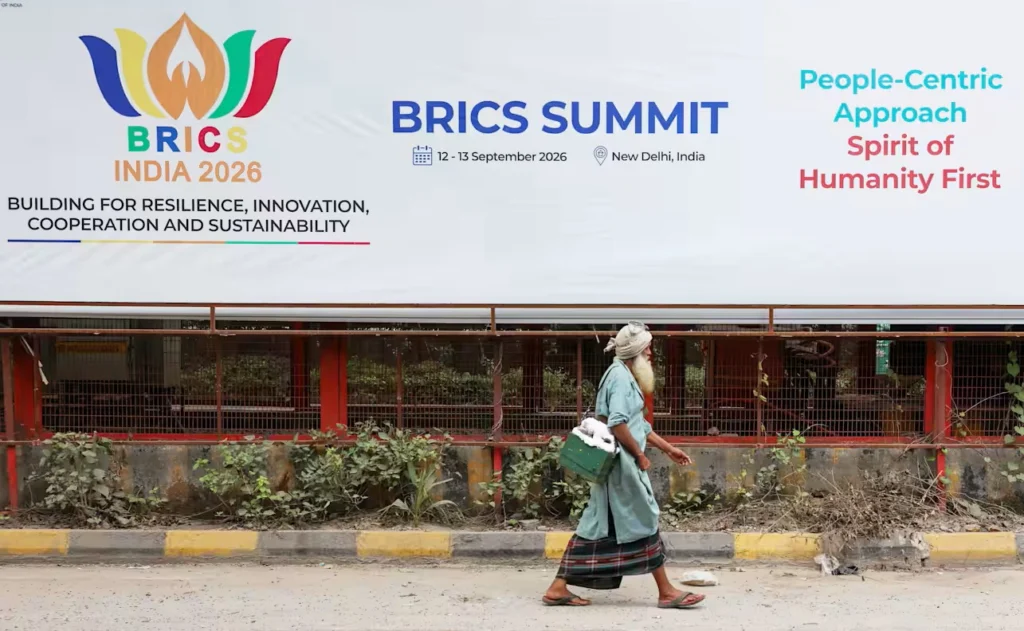
India is intensifying preparations for the upcoming BRICS Summit, scheduled for September 12 and 13, 2026, in New Delhi.
New Delhi is in the final stages of preparation for the BRICS Summit, set to take place on September 12 and 13, at the Bharat Mandapam Convention Centre. The city is adorned with banners celebrating the international gathering, and authorities have warned of potential traffic disruptions due to the movement of diplomatic delegations.
India is implementing robust security measures and mobility plans to ensure the smooth operation of the global event, which will focus on resilience, innovation, cooperation, and sustainability.
RELATED: BRICS Pay Expansions on New Delhi Summit Agenda
The summit itself will unfold at the Bharat Mandapam Convention Centre under a theme centered on resilience, innovation, cooperation and sustainability, four pillars that officials say reflect the bloc’s current priorities.
India assumes the rotating pro tempore presidency for the fourth time, following previous turns in 2012, 2016 and 2021, a track record that gives New Delhi considerable experience in shaping the summit’s agenda even as the bloc’s membership has grown substantially since those earlier editions.
India’s BRICS Chairship has brought together a year of dialogue, engagement and cooperation across the four pillars defining our Chairship- Resilience, Innovation, Cooperation and Sustainability.
In the run-up to the BRICS Summit, watch a glimpse of the work and initiatives… pic.twitter.com/HQ9Z9O6NgQ
— India in Chile (@Indiainchile) September 2, 2026
BRICS: A Unified Front
The summit will focus on assessing the state of internal cooperation to achieve shared goals. Leaders will exchange views on political, economic, and mutual interests at both regional and international levels. This gathering is expected to provide a platform for additional investment and economic growth, aligning with the broader objectives of the BRICS nations.
In addition, discussions on economic cooperation are expected to include strategies for trade facilitation, investment opportunities, and the establishment of financial mechanisms that support member countries in overcoming economic challenges. This focus on economic integration is vital for enhancing the bloc’s competitiveness on the global stage.
As trade relations between BRICS nations evolve, the summit will provide an avenue for exploring new markets and opportunities for collaboration. This could lead to joint ventures that leverage the strengths of each member state, enhancing economic resilience across the bloc.
Member countries are likely to exchange best practices in renewable energy and sustainable agriculture, which could pave the way for future collaborations in these critical areas. Furthermore, the summit’s emphasis on resilience and sustainability reflects a growing recognition of climate change as a pressing global issue.
Once gathered, the participating global authorities are expected to review the state of internal cooperation among member states in order to consolidate shared goals, while also exchanging views on political, economic and other matters of mutual interest at both the regional and international level. Because BRICS has expanded considerably in recent years, these discussions are likely to cover a wider and more complex set of interests than in previous summits, reflecting the bloc’s growing geopolitical weight.
The summit also serves as an opportunity for bilateral meetings among member states, enabling leaders to forge stronger relationships and explore collaborative ventures beyond the formal agenda.
The economic bloc currently comprises eleven members drawn from emerging economies and developing nations: Brazil, China, Egypt, Ethiopia, India, Indonesia, Iran, Russia, Saudi Arabia, South Africa and the United Arab Emirates. Beyond that core membership, the group added ten additional nations as partner countries during 2025, namely Belarus, Bolivia, Kazakhstan, Cuba, Malaysia, Nigeria, Thailand, Uganda, Uzbekistan and Vietnam, a wave of expansion that has significantly broadened the bloc’s geographic reach and, by extension, the range of perspectives expected to shape discussions at this year’s summit in New Delhi.
Mobility Plans
To manage traffic congestion and ensure safe passage for diplomatic convoys between hotels, airports, and the official venue, the Delhi Police have conducted mobility drills and mapped out alternative routes. Citizens are encouraged to use public transportation, particularly the metro system, to mitigate traffic issues.In addition to traffic management, schools will be closed on September 11. Public and private sector offices will also evaluate closing or adjusting work schedules for that day, following government directives and internal organizational decisions.
.@WION is joined by China, Russia and Iran for the biggest and most comprehensive global coverage. Continuing coverage of BRICS 2026 from Bharat Mandapam, bringing you global and Indian voices.
10-14 September 2026
New Delhi pic.twitter.com/8SctOURHfs
— Shreya Upadhyaya (@ShreyaOpines) September 6, 2026
The 2026 BRICS Summit represents a pivotal moment for member countries to reaffirm their commitment to collaboration and collective progress. As global challenges continue to evolve, the need for cooperative frameworks that address these issues becomes increasingly crucial. The outcomes of this summit could set the tone for future engagements and strategic initiatives that benefit not only the member states but also the global community at large.
From teleSUR English via This RSS Feed.