

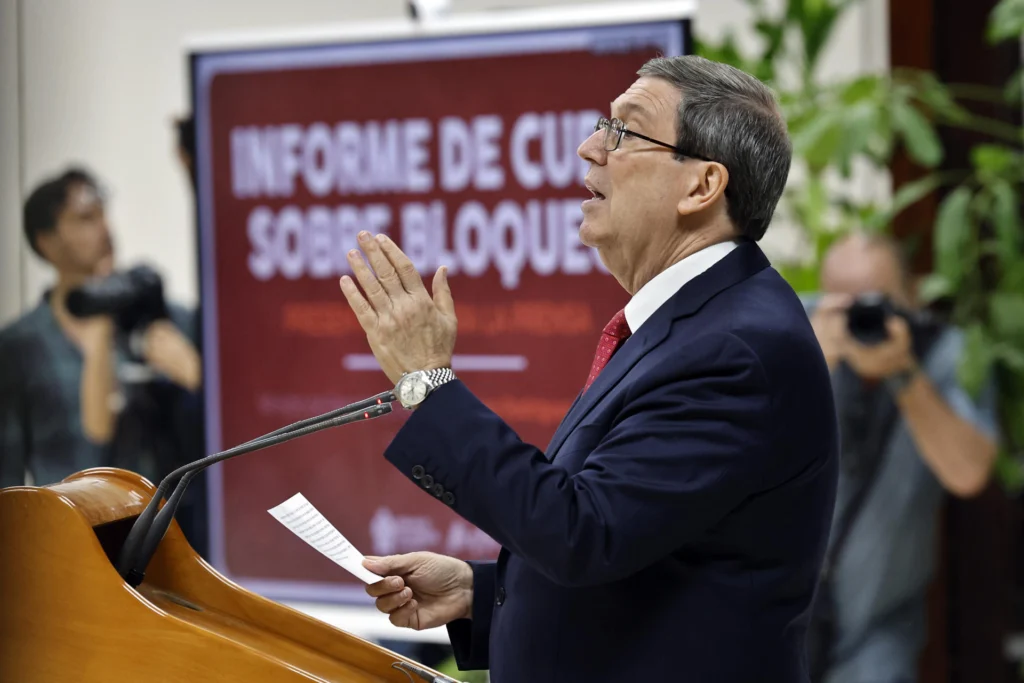
Cuba’s Foreign Minister, Bruno Rodríguez, has denounced this Monday the severe impact of the U.S. economic blockade on the country’s healthcare system, particularly on infant mortality rates.
Cuba’s government announced on Monday that the economic toll of the decades-long U.S. blockade reached a record $8.083 billion between March 2025 and February 2026, marking a 7% increase over the previous reporting period and pushing the accumulated damage since the policy began to roughly $178.7 billion at current prices, according to Foreign Minister Bruno Rodríguez.
Speaking to both national and international press accredited in Cuba, Rodríguez announced that the UN General Assembly will once again consider the issue of the U.S. blockade against Cuba on October 27 and 28.
RELATED: United States Blockade Causes Drastic Decline of Tourism in Cuba
FM Rodríguez presented the figures as part of an official report and framed Washington’s approach not merely as an economic dispute but as a policy that reaches into nearly every corner of daily Cuban life, affecting food supplies, water access, electricity, healthcare, education and transportation.
He characterized the sanctions regime as a form of “collective punishment” aimed squarely at citizens rather than the state itself.
Ante la prensa nacional y extranjera acreditada en nuestro país, anuncié que los días 27 y 28 de octubre próximo, la Asamblea General de @ONU_es considerará nuevamente el tema de su agenda titulado “Necesidad de poner fin al bloqueo económico, comercial y financiero impuesto por… pic.twitter.com/gDaGLvioTF
— Bruno Rodríguez P (@BrunoRguezP) September 7, 2026
Text reads: “Before the national and foreign press accredited in our country, I announced that on October 27 and 28, the General Assembly of @ONU_es will consider again the item on its agenda entitled “Necessity of ending the economic, commercial and financial embargo imposed by the United States of America against Cuba”. Despite extraordinary U.S. pressure and intimidation on member states, Cuba is confident of overwhelming support for the call for an end to the blockade in the vote on Wednesday, October 28.”
The healthcare sector has arguably borne some of the heaviest costs. Rodríguez said power outages and diesel shortages have disrupted operating rooms and life-support equipment, including mechanical ventilators and neonatal incubators, at times forcing medical staff to rely on manual procedures or phone flashlights during complex procedures. He also pointed to the detention of more than 7,000 containers of medical supplies and medicine, attributing the delays to pressure placed on shipping lines, and connected that bottleneck to a sharp rise in infant mortality, which he said climbed from 4 per 1,000 live births in 2018 to 9.9 in 2025.
Beyond the physical toll, Rodríguez described broader disruptions to family life, including difficulty sleeping through hot nights without functioning fans or air conditioning, interrupted schooling for children, and limited access to communication and entertainment networks for young people and the elderly.
Cuba’s denouncement of the U.S. blockade’s impact on healthcare and infant mortality rates serves as a stark reminder of the human cost of such economic measures. As the UN General Assembly prepares to address this issue, the world will be watching to see if the international community will stand with Cuba in its fight against the blockade.
Denuncié la verdadera existencia del cerco energético contra #Cuba, aunque el Secretario de Estado de EEUU intente negarlo cínicamente.
La Orden Ejecutiva del Presidente de EEUU del 29 de enero de 2026 decretó el bloqueo de combustible que impide la llegada de los suministros a… pic.twitter.com/IFJgGt3hhn
— Bruno Rodríguez P (@BrunoRguezP) September 7, 2026
Text reads: “I denounced the true existence of the energy blockade against Cuba, even though the U.S. Secretary of State cynically tries to deny it. The Executive Order of the President of the United States of January 29, 2026 decreed the fuel blockade that prevents the arrival of supplies to Cuba by the threat of sanctions, intimidation of companies owning tanker ships and harassment of these.
They threaten shipping companies and forbid them to transport parts and components for the thermoelectrics.If fuel oil and diesel could be imported for distributed generation generators, the outage could be minimized. But the fuel blockage prevents them from being imported. We have rapidly changed the energy matrix with the solar source. Shipping companies are now being threatened not to bring in solar panels and batteries for the new photovoltaic parks we have learned to install in 45 days.”
Blackouts Deepen Crisis
Among the most visible consequences cited was the country’s chronic energy shortage. Rodríguez said many Cubans now go without electricity for all but two or three hours a day, a situation that has led to widespread spoilage of food due to the lack of refrigeration. He linked the deepening blackouts to a presidential order signed by Donald Trump in late January, which threatens tariffs tied to Cuba’s fuel imports, arguing it has intensified an already fragile energy matrix even as the island has pushed to expand solar capacity.
According to Rodríguez, shipping companies bringing solar panels and batteries for new photovoltaic parks -some completed in as little as 45 days- have faced pressure not to deliver the equipment, while fuel needed for backup generators remains largely unreachable because of blockade-related restrictions.
The ripple effects extend well beyond lighting homes. Water pumping stations, the Minister noted, rely on electric motors and generators that are themselves weakened by fuel and spare-parts shortages, meaning that when power cuts hit, water pressure drops and hydraulic systems can take hours to recover once service resumes.
The Cuban Minister announced that the United Nations General Assembly will once again take up Cuba’s annual resolution calling for an end to the blocakde on October 27 and 28, with a vote expected October 28. Despite what he described as intense pressure from Washington on other member states, Rodríguez said Cuba expects the resolution to again receive overwhelming international support, as it has in previous years.
The upcoming UN General Assembly session is crucial for Cuba, as it seeks international support to end the blockade. The international community’s response will be closely watched, given the historical support Cuba has received in previous votes against the blockade.
From teleSUR English via This RSS Feed.