

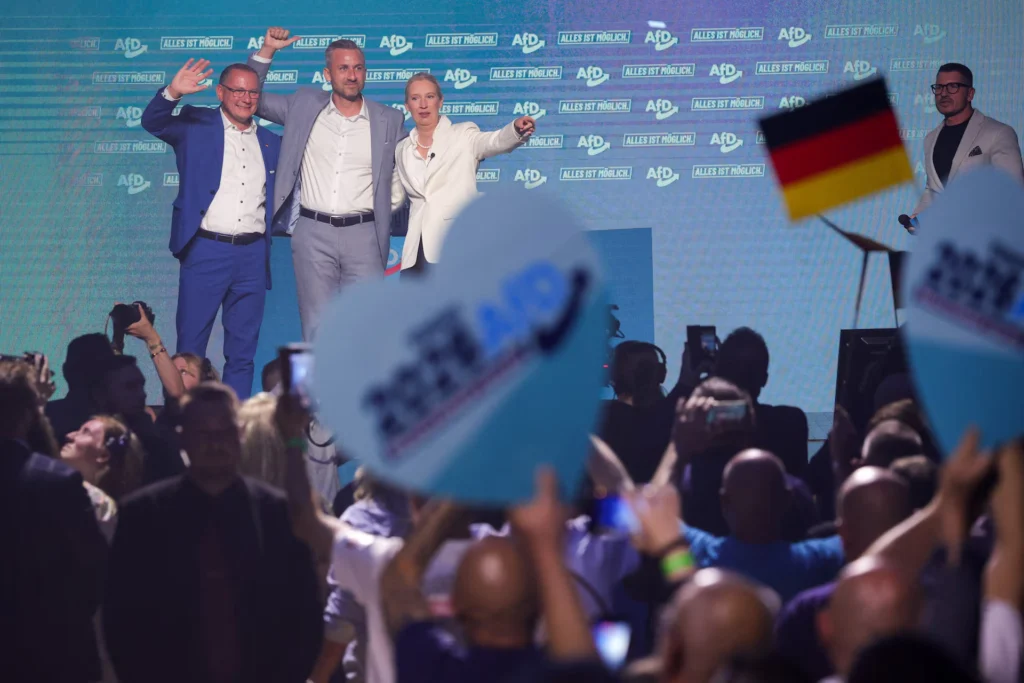
Decades of regional economic and stagnant wages drive former industrial regions toward far-right politics.
The political landscape of the Federal Republic of Germany is undergoing a radical transformation. The Alternative for Germany (AfD) has evolved from a small economic lobby into a major political organization capable of reshaping federal and regional governance.
RELATED:
AfD’s Victory in Saxony-Anhalt Reflects Social Tensions in Germany
The AfD’s growth is tied to broader socioeconomic changes rather than isolated cultural disputes. Decades of fiscal austerity, reduced public infrastructure investment, real wage stagnation, and regional disparities have increased economic insecurity across several demographics.
By linking public sector declines, housing shortages, and wage pressure to immigration, the AfD directed public dissatisfaction toward minority groups. This strategy allowed the AfD to build support among working-class voters affected by industrial transitions and public spending reductions.
From German Ordoliberal Skeptics to Ethno-Nationalists
The AfD was founded in February 2013 by a group of conservative economists, journalists, and business academics led by Bernd Lucke. The party initially focused on economic policy during the Eurozone sovereign debt crisis.
Its primary goal was to oppose financial bailouts for southern European nations, advocating for an orderly dissolution of the Eurozone, and demanding a return to strict fiscal austerity and ordoliberal economic principles.
During this phase, the AfD drew support mainly from bourgeois, middle-class voters dissatisfied with Chancellor Angela Merkel’s economic policies.
AfD’s ideological trajectory shifted significantly during the 2015 European migrant crisis. As hundreds of thousands of asylum seekers arrived in Germany, nationalist and anti-immigration factions within the party gained influence.
At the Essen party congress in July 2015, Bernd Lucke was ousted from leadership, marking the decline of the party’s moderate economic wing and the rise of a right-wing nationalist agenda focused on borders, demography, and cultural identity.
Following this leadership change, more radical internal factions expanded their influence. Key among them was The Wing, an ethno-nationalist faction associated with Thuringia party leader Björn Höcke.
Although The Wing was formally dissolved in 2020 under pressure from domestic intelligence agencies, its core network and ideology remain influential within the party hierarchy.
This ideological evolution led to increased monitoring by state authorities. Germany’s Federal Office for the Protection of the Constitution (BfV), the domestic intelligence agency, placed the AfD under official surveillance as a suspected extremist entity.
By 2023 and 2024, the BfV classified the party’s regional branches in Saxony-Anhalt, Thuringia, and Saxony as confirmed far-right extremist organizations.
Intelligence reports cited the party’s promotion of an ethnic definition of national identity, which conflicts with the human dignity protections guaranteed under Article 1 of the German Basic Law.
‘In 1st 100 days, we will carry out LARGE scale deportations’ — Alice Weidel as AfD wins eastern state
‘Germany’s borders are CLOSED, dear friends’ pic.twitter.com/rQhwxQbDcN
— RT (@RT_com) September 7, 2026
The Saxony-Anhalt Landtag Election and Future Prospects
The AfD’s electoral trajectory reached a major milestone in the September 2026 Saxony-Anhalt state election. Led by 35-year-old candidate Ulrich Siegmund, the party secured 43.8% of the vote and 39 of 83 seats in the Magdeburg parliament.
This is more than its 20.8% vote share in 2021 and marked the highest vote share by the AfD in any German state election.
Meanwhile, the incumbent Christian Democratic Union (CDU), led by Chancellor Friedrich Merz, fell to 17.2%. Voter turnout reached 77.8%, reflecting heightened voter mobilization across the state.
The structural base of the AfD’s support remains concentrated in the eastern federal states. After decades 90′ of German reunification, structural economic disparities persist between the eastern and western regions.
The privatization process managed by the German Privatization Agency in the 1990s led to widespread deindustrialization, job losses, and significant out-migration of young workers.
Today, eastern states continue to record lower average wages, fewer corporate headquarters, and reduced public infrastructure compared to western states. These historical and economic factors created long-term grievances that the AfD has exploited politically.
The outcome in Saxony-Anhalt highlights growing pressure on the political firewall, the agreement among mainstream political parties to refuse formal coalition agreements or parliamentary cooperation with the AfD.
Although the AfD fell three seats short of an absolute parliamentary majority, its strong presence makes stable governing majorities by traditional parties mathematically difficult. A coalition combining the CDU, Social Democrats (SPD), and Greens would control only 31 seats, requiring complex arrangements with other groups to reach a 42-seat majority.
What a Far-Right Return to Power Means for Europe
The expansion of AfD influence introduces structural changes to democratic institutions, policy frameworks, and regional governance. In states where the AfD holds significant parliamentary seats, it can block constitutional judge appointments, influence public broadcasting oversight boards, and alter parliamentary procedures.
The AfD’s campaign platform in Saxony-Anhalt explicitly included plans to initiate withdrawals from regional public broadcasting agreements, restructure local education curricula toward nationalist themes, and impose restrictions on state funding for non-governmental organizations working on civil rights and integration.
At the social level, the party advocates policies that reduce protections for minority groups and organized labor. Key proposals include the “remigration” concept, which outlines large-scale deportation measures for foreign nationals and naturalized citizens deemed insufficiently integrated.
The AfD also opposes gender-mainstreaming initiatives, public diversity programs, and federal anti-discrimination legislation. On labor issues, the AfD opposes mandatory union collective bargaining coverage and seeks to limit the scope of workplace co-determination rights.
In international and European affairs, the AfD seeks a major reorientation of German foreign policy. The party’s platform advocates for “Dexit”, Germany’s exit from the European Union, or a radical restructuring of the bloc into a loose confederation of sovereign nations.
It opposes the European Green Deal, euro currency mechanisms, and common EU migration management policies. Furthermore, the party calls for the immediate termination of military assistance and financial aid to Ukraine, the lifting of economic sanctions against the Russian Federation, and the resumption of direct energy imports from Russian state suppliers.
Ulrich Siegmund has been dubbed Germany’s ‘most dangerous man’. The AfD politician just won an election in Saxony-Anhalt and could form the first far-right state government since World War Two. pic.twitter.com/xfRZwg4ABc
— Al Jazeera English (@AJEnglish) September 7, 2026
Class Realities vs. Populist Rhetoric
The AfD’s official policy platform presents an economic framework that contrasts sharply with its working-class voter base. While the party frames itself as a defender of ordinary workers against political elites, its voting record and platform documents advocate market deregulation, higher incomes from tax-reduction brackets, and reductions in social welfare spending.
Economic studies from research institutions, including the Halle Institute for Economic Research (IWH), indicate that the party’s tax and spending proposals would disproportionately benefit high-income households.
The AfD advocates the abolition of the inheritance tax, the elimination of the wealth tax, and the implementation of a flattened income tax structure.
To balance state budgets under these revenue cuts, the platform proposes reductions in social spending, including stricter eligibility criteria for unemployment benefits (Bürgergeld) and cuts to public subsidies for renewable energy transitions.
By focusing public attention on migration, cultural change, and national sovereignty, the party redirects debate away from structural economic issues such as landlord speculation, stagnant real wages, and corporate price increases.
This ideological alignment allows the AfD to build electoral coalitions among working-class voters without altering core market arrangements or corporate tax structures.
The Contradictions of Alice Weidel and the Path Forward for the Left
The leadership of Alice Weidel, co-chair of the AfD alongside Tino Chrupalla, illustrates the gap between the party’s populist discourse and its internal leadership profile.
Weidel’s personal and professional background differs markedly from the nationalist, anti-globalization rhetoric used in party campaigning.
A former financial analyst at Goldman Sachs and Allianz Global Investors who holds a doctorate in economics, Weidel represents an elite economic background.
Weidel lives in a same-sex civil partnership with a Sri Lankan-born filmmaker, and the couple raises two children while maintaining their primary residence in Switzerland.
Despite this personal background, Weidel leads a party whose official platform opposes full adoption rights for same-sex couples, rejects civil equality initiatives for LGBTQ+ individuals, promotes traditional family models, and calls for strict border controls and mass deportation programs.
This dynamic reflects a strategic division within modern far-right movements. Figures with professional credentials and cosmopolitan backgrounds can present radical nationalist platforms to mainstream audiences, giving the party an appearance of administrative competence.
Culture-war rhetoric around national identity and social values serves to mobilize voters, while the party’s underlying economic program aligns with corporate deregulation and wealth protection.
Addressing the rise of the AfD presents a significant structural challenge for democratic institutions and progressive movements.
Moral condemnation and mainstream political isolation have proven insufficient to halt the AfD’s electoral growth, as shown by recent state election results.
Reversing this trend requires addressing the underlying economic conditions, such as regional inequality, wage stagnation, public service declines, and housing shortages, that provide fertile ground for far-right political appeals.
The far-right Alternative for Germany (AfD) has secured a major victory in the Saxony-Anhalt regional elections, with projections showing more than 44% of the vote.
The result marks a significant blow to Chancellor Friedrich Merz. However, despite the landslide win, the… pic.twitter.com/3QZpN1EMWg
— teleSUR English (@telesurenglish) September 7, 2026
Sources: teleSUR – Al Jazeera – La Base – Spanish Revolution – TRT World – DW – BBC – France 24 – EFE – Reuters – El País – AP News – EU Perspectives – German Marshall Fund – Anadolu Agency
From teleSUR English via This RSS Feed.