

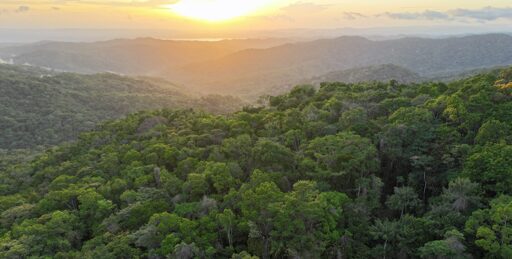
When Elsa Quiroz saw the spotted body of a jaguar appear on her son’s computer screen, she couldn’t believe her eyes. “I’d only seen them in books,” she said. In late 2025, a camera captured the animal crossing a semi-abandoned path in Puerto Lara, a an Indigenous Wounaan village north of Panama’s Darien forest, close to the Pan-American Highway, an area known for its rich biodiversity. The community was aware of how many birds lived around them, but not of the jaguars. Samuel Cheucarama, Quiroz’s son, reviews each photo taken by the two cameras installed in Puerto Lara every two weeks. He was as astonished as his mom when he first saw the extent of the biodiversity concealed within Puerto Lara’s forest, which covers an area less than twice the size of New York City’s Central Park. He reels off the list: agoutis, spotted rabbits, turkeys, margays, white-headed monkeys, among others, all found within this wilderness of just 600 hectares, or less than 1,500 acres. Cheucarama’s work is a small part of a wider project promoting nature-based economic alternatives in four communities managing a combined 18,000 hectares (about 44,500 acres) of tropical forest in eastern Panama. Although the Panamanian government has made efforts to reduce deforestation in Darién National Park, deforestation from illegal logging and agricultural expansion has increasingly been putting communities under pressure, with little to no support from local and national authorities. As a result, communities have been exploring alternatives to make their conservation efforts economically viable. In…This article was originally published on Mongabay
From Conservation news via This RSS Feed.