

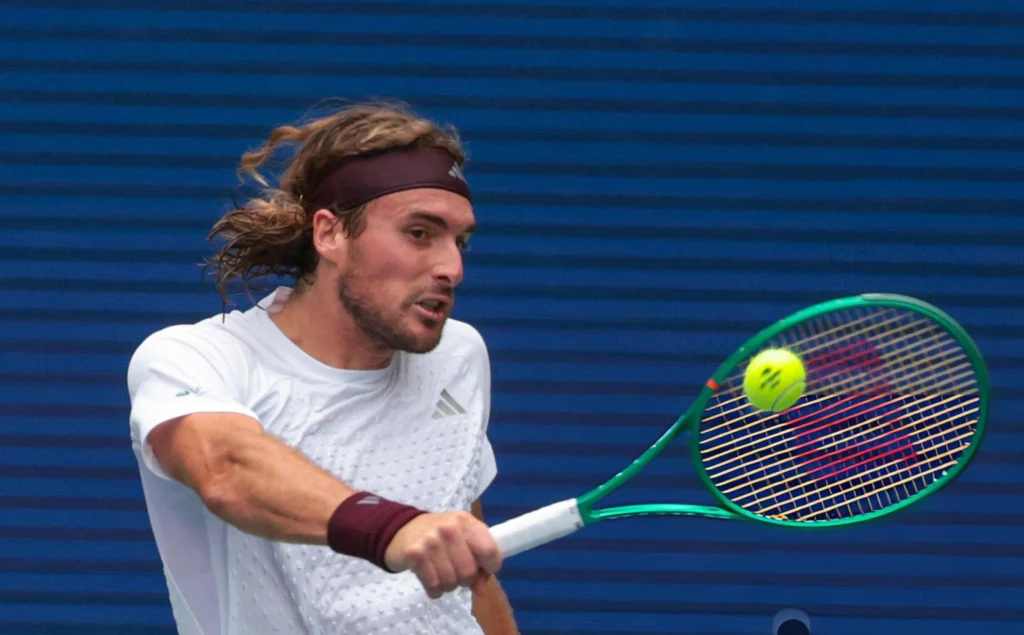
He joins other one-handed backhand specialists already eliminated, such as Italian Lorenzo Musetti.
Stefanos Tsitsipas’ elimination in the U.S. Open round of 16 against Ben Shelton confirmed that, for the first time in 150 years, no player with a one-handed backhand will reach a Grand Slam semifinal.
RELATED:
U.S. Open Roundup: Jessica Pegula Starts Strong
Tsitsipas had warned on social media about the “endangered status” of this shot, but he fell 6-2, 6-3, 6-4 to Shelton, who will face Spaniard Carlos Alcaraz in the quarterfinals.
The Greek joins other one-handed backhand specialists already eliminated in New York, such as Italian Lorenzo Musetti, Canadian Denis Shapovalov, and Bulgarian Grigor Dimitrov, further diminishing the presence of this style on the tour.
Even the legendary Roger Federer, a master of the one-handed backhand, analyzed the crisis of this shot, recalling that in his day most coaches practiced it, while today coaches who teach the two-handed backhand predominate.
Love you Stefanos Tsitsipas
Reaching your first ever Week 2 of the US Open in 2026 with everything that you’ve been through, was a huge achievement indeed
You gave us so much joy with your 3 fantastics performances & wins over Arthur Fils, Jiri Lehecka & Lloyd Harris
Keep… pic.twitter.com/cb37OKGO3r
— TennisHypeNews (@TennisMediaHype) September 7, 2026

Federer explained that the technology of rackets and strings, the slower speed of the balls and courts, and the reduced emphasis on transitions and volleys have favored the dominance of baseline play.
The Swiss player pointed out that tennis used to be played with a greater presence at the net, while now almost 90% of the game is played from the baseline, which benefits those who use the two-handed backhand for more effective defense.
Federer highlighted that the two-handed backhand allows for open positions and defensive slides, like those used by Rafael Nadal and Novak Djokovic, which have reduced the advantage previously offered by the one-handed backhand.
Venezuela and the United States may be entering a new chapter in their energy relations.
From oil and sanctions to investment and global energy markets, a potential policy shift could have far-reaching consequences for both countries—and beyond.
What could a new energy… pic.twitter.com/A3cRvoBUbx
— teleSUR English (@telesurenglish) September 1, 2026


teleSUR: JP
Source: EFE
From teleSUR English via This RSS Feed.