

Speaking optimistically, it’s been a mixed bag for the far right this weekend. Speaking realistically, they’re perhaps this Monday morning more emboldened than ever. Yes, Reform UK is looking battered by toe-curling undercover footage of key officers allegedly displaying a healthy appetite for illegal overseas donations. But over in Germany, its counterpart Alternativ für Deutschland (AfD) – also no stranger to dodgy foreign funds – has won big time in a state election in the country’s east.
Meanwhile, a masked, black-clad vigilante group took to the streets of Dover on Saturday, blocking traffic, chanting “stop the boats” and pledging England til death. This morning, they turned up in Portsmouth too.
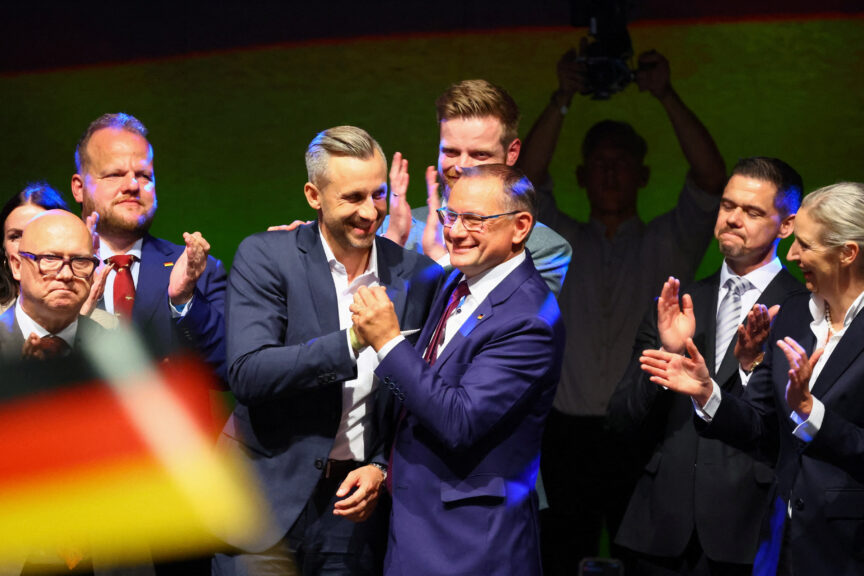
In the relatively small eastern-German state of Saxony-Anhalt, the country’s AfD has won its biggest victory yet. For the first time since the reign of the Nazis, a far-right party looks set to take control of one of the German Federation’s states. ‘Federation’ is important here: Germany’s national political structure gives great power to state governments, including control over policing, culture and education.
The AfD is already the second largest party in Germany’s federal government, where it won 125 of 650 parliamentary seats last year, doubling its power on its previous general election result. The same has now happened in Saxony-Anhalt, except the doubling this time means 44% of the vote and power very close to hand.
Although it has nothing to do with the state’s name, in German the word ‘Anhalt’ means, in some contexts, a clue. Like I say, Saxony-Anhalt is small, representing only around 2.2 million of the country’s 84 million inhabitants. But of those who could vote in this election – and the turnout was an extraordinary 77.8% – the hint is in the electoral breakdown. Women, young people, folk of all educational levels, whether rich or poor, voted in extraordinary numbers for the far-right.
Ulrich Siegmund, the AfD’s photogenic leader in the state, can take much of the credit. With almost 900k followers on TikTok, he’s mastered the Mamdani: big eyes, great smile, keep it local and talk directly to the people. It’s long been a maxim of some parts of the left that social media cool, as well as women and young people as a broad demographic, are inherently theirs. This election shows the emptiness of that approach, as well as the AfD’s success in concealing its connections to right-wing extremism in Germany.
The AfD’s victory comes at great expense to the country’s governing party, the Christian Democrats (CDU), which leads the country in coalition with the Social Democrats (SPD). In this state election, the CDU saw its vote halved, while its coalition with the Greens and SPD lost power. Germany’s unpopular chancellor, the CDU’s Friedrich Merz, is said to be holding a crisis meeting this morning as voices internal to his party calling for him to be replaced grow louder.
But the AfD’s victory can’t simply be explained by online vibes nor hostility to the CDU, either. Many voters in the state will have seen the party’s policy slate, and said yes please. The AfD’s promises include a pledge to limit women’s reproductive rights, mass deport immigrants and establish so-called “citizen patrols”, seen by some as street militias, as a part of the state’s security apparatus.
And while the party has tried to cleanse itself of its more extremist elements, prominent members have used Nazi slogans, diminished the significance of the Nazi dictatorship, and allegedly joined with neo-Nazis to plan the remigration on non-German citizens.
While the AfD has won this election, it’s still three seats short of the majority of state-parliamentary seats needed to govern single-handedly. Until now, the AfD has been kept out of power in states like Thuringia, where it won the state election (though much less decisively) in 2024. There, the informal ‘firewall’ agreement between all the country’s other parties to prevent a far-right party holding power kicked in, causing the CDU and the SPD to enter government with the much smaller Sahra Wagenknecht Alliance (BSW).
In Saxony-Anhalt, the left-conservative BSW – formed by former Die Linke (the Left) party MP Sahra Wagenknecht – has won five seats. It’s also the only national party that hasn’t ruled out governing with the AfD. Following this weekend’s election, it said it was open to governing with the AfD but only if a neutral premiere is chosen, while ruling out entering a coalition with the CDU.
The AfD, though, will likely go it alone. The math isn’t mathing for a ruling firewall coalition of other parties without the BSW, and Siegmund has said he’s prepared to call fresh elections to take majority power in the state.
It’s too soon to say whether the AfD’s victory portends a wider transformation of Germany’s political culture. Governing, after all, is hard, and keeping populist promises even harder. Some, though, are celebrating, with US president Donald Trump posting the election results of a relatively obscure German state on Truth Social last night.
From Novara Media via This RSS Feed.