

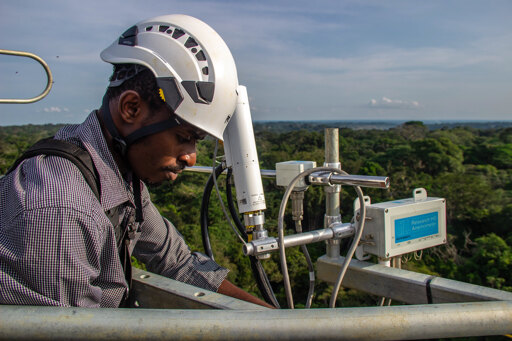
In 2020, a strange rumor began circulating in villages around the Yangambi Biosphere Reserve in the Democratic Republic of Congo’s Tshopo province. A newly constructed scientific tower, people said, was extracting oxygen from the surrounding rainforest and sending it to Europe, where it was being sold for profit. Not long after, an initiative to plant acacia trees around the reserve was incorporated into the rumor: the trees, some people claimed, were being planted to produce more oxygen for the tower to extract. Then, during an unusually hot spell in May 2024, another version spread rapidly through social media in Kisangani, the provincial capital. This time, the tower was accused of causing the extreme heat by removing oxygen from the atmosphere. When that rumor spread in 2024, the DRC’s then environment minister, Ève Bazaiba, publicly attributed such claims to “ignorance” and “superstitions.” She posted a video on social media to demonstrate that the tower, CongoFlux, does not extract oxygen: it measures exchanges of greenhouse gases between the rainforest and the atmosphere, helping scientists understand the Congo Basin’s role in global climate regulation. But correcting the science only gets us so far. Rumors can also tell us something about the people who spread them — and their relationship with conservation. While conducting research in Yangambi, recently published in Environmental Sociology, we learned that the rumors are ways for people to contest conservation, but also to make claims about who should benefit from it. At the same time, they are shaped by a…This article was originally published on Mongabay
From Conservation news via This RSS Feed.