

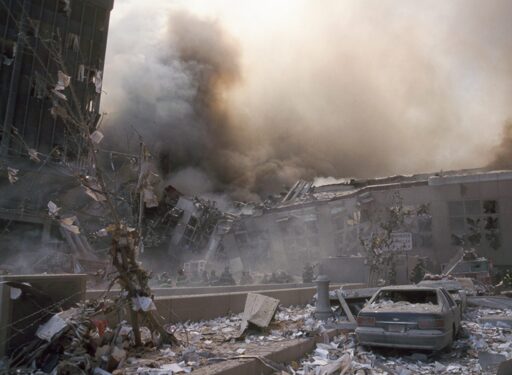
Disappearance became as clear as the blue sky, which, for a moment, appeared complicit in the violence below. Planes exploded and steel melted as the world observed a spectacle characterized by erasure. Towers vanished in plain sight, representing an inversion of Hiroshima, where destruction resulted not only in death but also in an immense field of dust that swept through the streets and extended toward the waters that once welcomed generations of migrants. Photographs continued to circulate, their outlines remaining vivid in the memories of those who were forced witness to their occurrence. Absence became a new landmark. For a city accustomed to orienting itself by visible structures, New York was now compelled to navigate by what was missing and could no longer be seen. Even the gestures made toward repair carried the shape of the void rather than its correction: two beams of light rising each anniversary from the same footprint, conjuring towers made of nothing as if somehow unaware of the rapture their appeal to divinity inevitably suggested. The memorial built on the site made no attempt to replace what had stood there now in abstention. Out of the excavation, waterfalls descending into an abyss, so that the missing buildings were marked by the negative space they left in the wounded ground.
The depth of trauma was immeasurable as images were recalled of individuals falling from the burning buildings, some seemingly asserting agency over the circumstances of their death before being lost beneath the weight of the collapse. One photograph in particular, of a man falling upside down against the vertical lines of the towers, became so difficult to look at that newspapers ran it once. An image withdrawn almost as soon as it appeared. Many victims could not be identified and became part of a collective of the missing, their photographs displayed throughout the city. Such imagery evoked the walls of cities in Latin America, where families posted images of those disappeared by military regimes. Rendering absence visible, each photocopied face served as evidence of existence and belonging – to a family, workplace, neighbourhood, or city. Even now, decades on, the city’s medical examiner continues to test bone fragments recovered from the site, a slow forensic disappearance still being reversed one identification at a time.
In the days that followed, St Pauls chapel in lower Manhattan functioned not only as a refuge but also as a destination for those searching. Families arrived with descriptions and fragments of information, waiting for updates that gradually transformed into mourning. New York was covered with signs inquiring about the whereabouts of missing individuals, whose location was barely in doubt. The city became a landscape of ghosts, faces appeared everywhere, dusted by the arrival of a new insecure dawn, each representing the possibility of a person who had disappeared and may never be recovered.
A few years later, Gerhard Richter’s September (2005) returned us to this moment with a devastating purpose, offering the kind of transgressive witnessing only art can provide. The painting is small, abstracted, smeared almost to the point of dissolution, and yet it holds within its surface a testimony to the violence of movement that is the hallmark of disappearance. Here the vanishing is held in suspension, so that we can look at the moment when appearance is about to suffer its inevitable oblivion. Intended or not, the painting also offers more as the physical rotations of the canvas might be read as the four acts of disappearance. Held as intended, we peer through glass as forced voyeurs, caught between the television screen that carried the terror into living rooms and the windows of adjacent towers through which survivors watched the second plane strike; here, presence and absence, appearance and disappearance, are not opposites but a single violated movement, a sacrificial present already receding into memory. Rotated ninety degrees in a clockwise direction, the canvas becomes aftermath: the faintest trace of the towers dissolving into earth and dust, an open horizon under a blue sky, a white band like a road with some vehicle entering or leaving the frame, an ambiguous gesture toward life resuming in a haunted city, even as vertical smears on the dirtied glass still insist something terrible has fallen into the streets below. Rotated again, we return to the original scene yet inverted back into the first uncertainty of that morning, when nobody yet had answers, memory reasserting itself as something abstract, ferociously swept, and always subject to the co-opting winds of the historical process that follows. The final rotation is the most surreal and cataclysmic: the waters of Manhattan lifted into a liminal calm, the sky as delicately blue as it was that hospitable September morning, until closer inspection reveals that the sky itself has fallen, a blackened column hanging at the top of the composition like the accumulated weight of history, threatening at any moment to descend and take the horizon, and the coming days, with it.
Tuesday, September 11th, circles around absence. On the same day and date back in 1973, military aircraft targeted the centre of democracy in Santiago, Chile, initiating a coup where disappearance soon became a favoured tool in establishing a regime of terror, backed on this occasion by the United States. The word desaparecido entered the political vocabulary of an entire continent that year, and it would connect to Argentina’s Dirty War, where the Madres de Plaza de Mayo circled the presidential palace, every week holding photographs of children who never returned.
In Chile & Argentina, individuals vanished into clandestine sites, compelling families to search for bodies the state refused to acknowledge. Without a body, there was no crime; without a record, history was being denied. In contrast, the violence of 9/11 was defined by its spectacle: it was public rather than hidden, witnessed rather than concealed. Millions observed the collapse of those iconic structures, once defining the Manhattan skyline. The events at Ground Zero, which reset the world to zero, signalled the beginning of a new era: the age of hyper-visible disappearance.
Initially, the event was perceived as an exceptional moment: mass death broadcast live in a way that uncannily felt unique, yet all too familiar given how frequently it had already occurred on the big screen. Exceptionalism justified in the minds of some an extraordinary response and, subsequently, underwrote exceptional abuses of power. As Walter Benjamin observed in his analysis of the state of exception, over time such conditions don’t wish themselves away, but become the rule. What belongs to the extreme often becomes the norm and part of the damaged fabric of the everyday. In the decades that followed 9/11, disappearance slowly became normalized. It is now the defining feature around which modern politics revolves, overexposed in full subtractive glory.
The disappearance of belief was amongst the first casualties of 9/11. Millions witnessed the attacks, which were replayed until the images became unbearable, not in the horror being observed, but in their familiarity and repetitions. In response, “truthers” emerged, refusing to accept that images could still serve as evidence, setting off a litany of conspiracy theories pointing to controlled demolition, missing planes and other absurdities. Although the event was widely observed, faith in its reality had diminished. Paul Virilio anticipated this phenomenon, suggesting that speed and technology would transform not only what can be seen but also the possibility of believing what is looked upon. The towers may fall, repeatedly, yet repetition does not resolve the questions of what occurred, why it happened, or by whom? Hypervisibility thus inaugurated a distinctive form of disappearance: the event was universally observable, yet its meaning melted away.
Televised images once possessed authority; to see an event was, at least provisionally, to believe it had occurred. There was such a thing as “observable truth”, which was inseparable from the most central ideas shaping democracy. This relationship dissolved in the fallout of 9/11. The illusion that once held it together – much like the illusion of security – vanished into the toxified air. News images ceased to function as conclusive evidence and instead became an object of interpretation, manipulation, and suspicion. This shift represented one of the major transformations of the post-9/11 world. Some of it was welcomed; however the more definitive path was as equally troubling as what passed as the subjective purposefully merged with post-truth. The central issue was not just that governments or actors could conceal information within clandestine structures, but consensus on the meaning of observation itself had eroded. Two decades later, the effacement of the image has become defining of our times; nobody today believes their eyes.
Footage from that morning shows people frantically running into a nearby store, before the atmosphere suddenly shifts and the dust descends; the street engulfed in darkness. Such darkness – the visible realm of nothingness – became a defining characteristic of Alejandro González Iñárritu’s cinematic contribution to 11’09”01: September 11. Rather than reproducing the spectacular images of the collapsing World Trade Centre that had already become fixed in the popular imagination, Iñárritu begins by removing the moment of impact. The screen becomes predominantly black, leaving viewers with voices that build into an unsettling anticipatory clamour of indecipherable noise before the identifiable screams, news reports, and sounds of the disaster. Brief flashes then reveal those bodies falling from the towers. This deliberate removal of the image makes disappearance the central experience of the film: the physical world disappears into darkness, the victims disappear from view, and the certainty of what we are seeing continually interrupted. Glimpses of the falling thus disturb because they emerge momentarily from an otherwise empty screen, appearing almost like shards of memory that cannot be fully grasped. This is followed by the silent witnessing of the falling towers: no narrative, no sound, just movement that demands no words to make the reality of the disaster apparent. The film ends with a thoughtful musical score, which out of a dusty greyness emerges Arabic script that when translated questions: “Does God’s light guide or blind us?” Iñárritu turns absence into an aesthetic encounter, forcing the viewer to imagine what the screen conceals rather than allowing the destruction to be consumed as another spectacular media image. In this sense, disappearance is not simply what the film depicts but what its form makes the viewer experience: the loss of visibility, the loss of bodies, and the impossibility of fully representing a traumatic event.
Out of this impossibly and the challenge it poses to representation, which is something that needs to be appreciated and continually defended, followed a clear politicisation of the uncertain, not one committed to openness, but a kind of uncertain certainty that consciously produced a disappearance of truth. Despite the visibility, the Global War on Terror, to evoke Psalm 23:4 which George Bush read during its declaration, operated within a “valley of the shadow of death”. Black sites for abducting bodies in the name of freedom were routinely used in a shadowy planetary network of disappearance. The secretive became more than a method of withholding information in the name of national security. It became a definitive political technology. As with the unfounded weapons in Iraq, the absence of evidence linking the abducted to any crime did not weaken the argument for the need to counter terror with terror. Pre-emptively speaking, absence simply became evidence of a hidden potential. Something could be hidden because it was dangerous and dangerous because it was hidden. You cannot disprove a potentiality!
Uncertainty has since become a powerful watchword, ensuring governments do not need to prove threats exist in order to shape the environment. Suspicion is sufficient. The unknown is actionable. This was captured almost perfectly in Donald Rumsfelds now-famous distinction between the known unknowns and the unknown unknowns, a formulation ridiculed at the time, yet which quietly became the operating grammar of security. In this sense, the post-9/11 state did not simply inaugurate a state of surveillance. The state has become organised around making uncertain. A conditioning of the normalisation of insecurity. What becomes of the secret thus assumes a double meaning. Citizens have been thrown into an insecure new world where governments have the right to know more about them, while explaining less about its reasons, knowing that uncertainty is enough justification. Disappearing values is an inevitable consequence of this.
Immediately after the attacks, discourses of freedom and justice were seemingly as ubiquitous as the apparent nature of the threat. Yet, as the logics of inside and outside firmly collapsed, resulting in what Zygmunt Bauman termed the “symbolic ending to the era of space”, the boundaries of both shifted beyond the thresholds that once gave meaning and a semblance of principled truth. Torture took on a bureaucratic language, rebranded as “enhanced interrogation” enabling officials to rationalise its civil qualities. Surveillance entered the homes of everyday citizens, later confirmed at a scale few had imagined possible even in popular culture. Indefinite detention was detached from ordinary legal protections as the disappearance of the person became inseparable from the denial of the very legal categories meant to constitutionally protect them.
Speaking of the disappeared as such no longer referred only to those whose bodies had been hidden. It now included those the state could place outside recognition, protection, and responsibility. Ambiguity in law thus became key as abducted bodies were thrown into a condition Giorgio Agamben called a “zone of indistinction”. Was the detainee a prisoner, an enemy combatant, a suspect, a citizen, or a foreigner? Ambiguity was not merely a legal problem. It was the mechanism through which power operated as the new rules were written by ink soaked in the detritus of a disaster.
Guantánamo Bay would become a defining space marked by these conditions, where many of its dynamics were concentrated. It was not a prison but an experiment in separating the body from the legal protections and basic human rights attached to it. Detainees were hyper-visible to surveillance while invisible to international law. Bodies were seen and controlled, yet the person was denied any political status through which those observations gained legal consequence. Guantánamo, however, wasn’t a single site or anomaly that was presented as a strategic necessity given the climate of terror and fear the attacks created. It belonged to a wider geography of disappearance that conditioned what was more widely possible. It was not “secret” in the ordinary sense. The world knew its whereabouts. Journalists wrote endless copy about its conditions. And the highly visible orange jumpsuit became equally symbolic, only later to be mimicked when ISIS recorded the murder of journalists in the desert, whose bodies have never been recovered. Meanwhile, photographs from Abu Ghraib performed a similar inversion: images meant to remain hidden inside a military prison escaped into public view, even as the men who ordered the practices they depicted mostly disappeared from any account of responsibility, leaving a few to act as scapegoats for what Erroll Morris called Standard Operating Procedure .
Disappearance is about thresholds and borders, bringing into focus the violently enforced and policed lines between presence and absence, life and death, truth and deniability, inclusion and exclusion. Within the architectures of the post-9/11 landscapes, it was no coincidence to see how the border became one of the principal sites through which the exceptional logic of the War on Terror entered American life. Securitisation ceased to be an emergency measure against existential threats and gradually became a way of organising domestic space, movement, and belonging. Homeland Security gave this new geography a name. Immigration enforcement gave it an everyday presence.
The border was no longer merely a line that marked the edges of the American Nation. It became a logic that could travel inward. Airports, train stations, databases and cities became secured. A collapse inward was defining. People could be taken from workplaces, homes, streets and courthouses, sometimes in full view of the public. Soon this extended beyond the so-called “Islamic threat” to become routine national policy applied to other undesirables who were presented as dangerous, potentially so, to the Nation. Parents were separated from children at the southern border under a policy meant to deter future crossings, many of which were put into detention facilities made by the same security contractors. Absence produced not by concealment but by bureaucratic efficiencies. The disappearance no longer required secrecy. It required a system capable of making absence appear ordinary, just as disappearance ceased to be understood exclusively as something done by authoritarian regimes in backyard places. It became embedded within ordinary administrative systems and normalised camps. Bodies could now be held in state of permanent suspension, held indefinitely in liminal spaces where the absent reside.
The architecture of extraordinary rendition did not therefore disappear when the black sites officially closed. It moved inward, shedding its foreign address and resurfacing within the domestic immigration enforcement apparatus. Where individuals were once seized from streets in Milan or Islamabad and flown, hooded, to unnamed compounds, now Immigration and Customs Enforcement use unmarked vehicles to arrive unannounced and take persons to unknown destinations. This practice continues today as plain clothed agents lift people appeal to the same operational logic that formerly defined rendition: speed, concealment, and moving a body faster than any lawyer or family member can locate it. The detainee, once flown across borders to escape the reach of law, is now often moved between detention facilities inside the country, transferred state to state. The secrecy is administrative rather than covert, disappearance achieved not via a hidden site off the grid but through transfers, and the officious language of obfuscation and procedure. What connects Bagram to a county detention centre in rural Louisiana is not the visibility of the institution, which in the ICE era is often unapologetically public, but the same underlying grammar: the state’s capacity to remove a person from the world of the accountable and hold them in a condition that also makes a spectacle of their absence.
In this light we can see that Guantanamo was just the start of an experiment in normalising abduction and indefinite detention in the name of freedom, democracy and justice. The geography of disappearance has since expanded back down the Americas, and outward across the globe. What once appeared exceptional has begun to resemble an archipelago, a dispersed network of prisons, detention centres, and security institutions where unwanted bodies are forcibly contained. In El Salvador, CECOT is one of the starkest contemporary expressions of this logic. The prison is deliberately monumental. Its scale communicates the power of the state, into which abducted bodies from across the continent can be thrown. Here the paradox of hypervisibility returns within the confines of a desert, which also evokes memories of those who disappeared in the Atacama plains of Chile. The prison is visible. The state does not try to conceal its existence. It is displayed as proof of its unmediated power to disappear those it accuses of disappearing others such as notorious gang members. Here the individual disappears within the institution’s image.
We are now 25 years on from the violence of September 11th 2001 – a period of time most tend to equate with being generational. One of the marks of a generation is precisely how lived memory slips into history, which is then subject to either memorialisation or a fading into a distant unrelatable past. Writing of the disappearance of 9/11 should not simply return a generation to the disappearance of the towers. It is the disappearance that followed, which should command attention. The event of 9/11 has disappeared into the image, the image into memory, memory into war, and war into the ordinary machinery of the state, which has made disappearance both its object and rule. Disappearance rarely happens all at once. One thing vanishes, then another, then another. A building. A body. A photograph. A fact. A legal protection. A boundary. A political value. By the time disappearance becomes ordinary and assumes the kind of normalised status it does today, it can be difficult to identify when it all began to unravel.
On one fateful September morning, New York was forced to look at what was no longer there. A generation later, the question is not only what disappeared that day, but what kind of world was built in the space left behind. And in that space, one key question remains: what happens to a society when it learns to live by what is missing?
The post The Disappearance of 9/11 appeared first on The Philosophical Salon.
From The Philosophical Salon via This RSS Feed.