

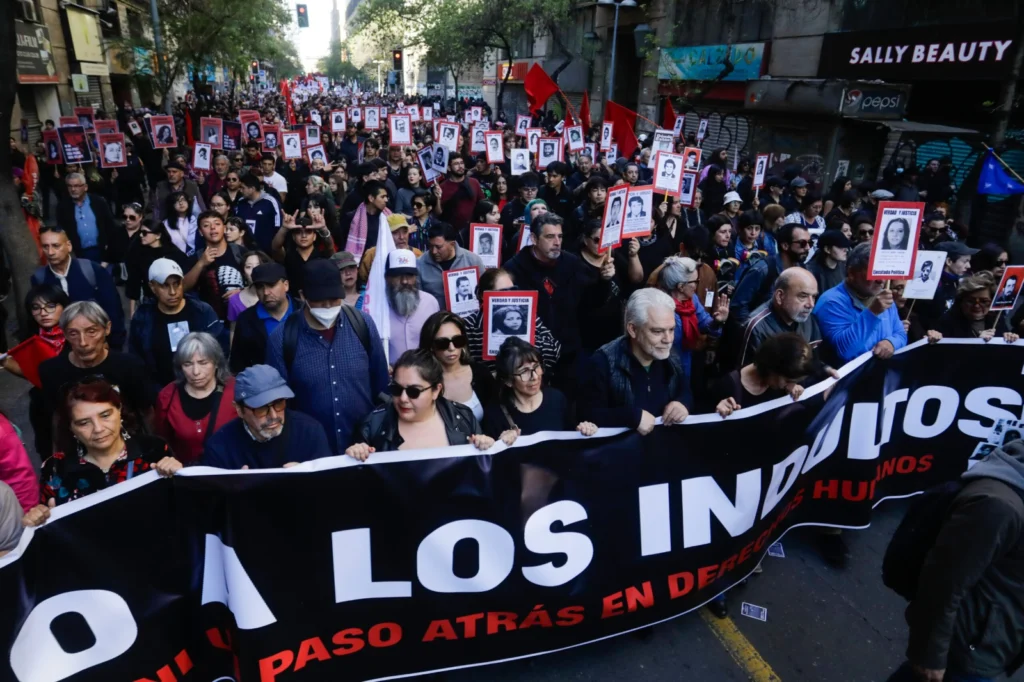
Chile coup memorial march draws thousands in Santiago to honor victims and denounce funding cuts to memory sites under President José Antonio Kast.
Related: Chilean Opposition Condemns Milei Over Praise For 1973 Coup
Chile coup memorial march draws thousands in Santiago to honor victims and denounce government cuts
A Chile coup memorial march brought thousands of people to the streets of Santiago on Sunday, September 6, as organizations commemorated the 53rd anniversary of the September 11, 1973 coup that overthrew President Salvador Allende. The demonstration, which advanced toward the General Cemetery, was marked by strong denunciations of policies under President José Antonio Kast, particularly regarding cuts to public funding for memory and human rights institutions.
The Chile coup memorial march is part of a long-standing tradition of remembering the victims of the civil-military dictatorship. This year, however, the event took on added urgency as activists warned that recent budget reductions threaten the operation of sites dedicated to historical preservation and reparation.
Human rights groups, unions, student organizations and the National Human Rights Table participated in the mobilization, emphasizing the need to protect memory spaces and ensure accountability for past and present violations.
Chile coup memorial march confronts funding cuts and police response
During the Chile coup memorial march, representatives from human rights organizations and memory sites highlighted the operational impacts of announced public funding cuts. These reductions affect institutions responsible for preserving historical records, maintaining memorials and supporting victims’ families.
Protesters also reported police interventions involving water cannons and tear gas on side streets and near the General Cemetery. Carabineros de Chile deployed crowd-control measures that forced march organizers to coordinate movement in blocks to ensure safe access to memorial areas.
The demonstration built on earlier student-led protests criticizing the government’s socioeconomic direction and the police response to social mobilization. Despite tensions, participants remained focused on entering the cemetery to pay tribute to executed political prisoners and the disappeared.
External references for human rights monitoring:
- Amnesty International: https://www.amnesty.org/
- Human Rights Watch: https://www.hrw.org/
Honoring victims and defending memory in Chile coup memorial march
At the General Cemetery, attendees gathered at memorials to honor victims of the military dictatorship, underscoring the ongoing search for more than 1,500 Chileans whose whereabouts remain unknown. The Chile coup memorial march served not only as an act of remembrance but also as a call to strengthen mechanisms for truth, justice and reparation.
Participants also expressed rejection of recent remarks by Argentine President Javier Milei regarding Chilean political history and Salvador Allende. Activists criticized the lack of an official protest statement from Chile’s Foreign Ministry, viewing it as a missed opportunity to defend historical memory at a diplomatic level.
The march reinforced the role of memory sites as living spaces for education and reflection, ensuring that new generations understand the consequences of authoritarianism and state violence.
- United Nations transitional justice frameworks: https://www.un.org/
- Museo de la Memoria y Derechos Humanos (Chile): https://www.museodelamemoria.cl/
Historical context: Escotilla 8 and the National Stadium
A central symbol referenced during the Chile coup memorial march is Escotilla 8 of the National Stadium in Santiago, which functioned as a mass collective cell and transit point to torture during the dictatorship. The space held hundreds of political prisoners, many of whom left messages, initials and song verses engraved on the walls with keys and other objects.
Each cell held approximately 300 to 400 detainees, with men confined in locker rooms and hatch areas. Conditions were harsh: cold, damp cement walls, flooded sections after rain, limited blankets and inadequate food and hygiene. Diseases spread quickly, worsened by constant physical violence and sleep deprivation on floors or improvised bunks.
These testimonies, preserved as part of Chile’s historical memory, highlight the systematic nature of repression and the resilience of survivors who continue to demand justice.
Geopolitical context
The Chile coup memorial march unfolds in a regional environment where right-wing governments in Latin America have increasingly challenged progressive narratives on memory and human rights. The alignment between Chile’s administration under Kast and figures like Argentina’s Javier Milei reflects a broader ideological shift that often questions or minimizes the legacy of past dictatorships.
This dynamic has implications for regional cooperation on human rights, transitional justice and the protection of memory sites. It also intersects with global debates over historical revisionism and the role of the state in preserving truth.
For Chile, defending memory institutions is not only a domestic issue but also a matter of international credibility and commitment to human rights norms. The outcome of these struggles will influence how the country navigates its democratic consolidation amid polarized politics.
From teleSUR English via This RSS Feed.