

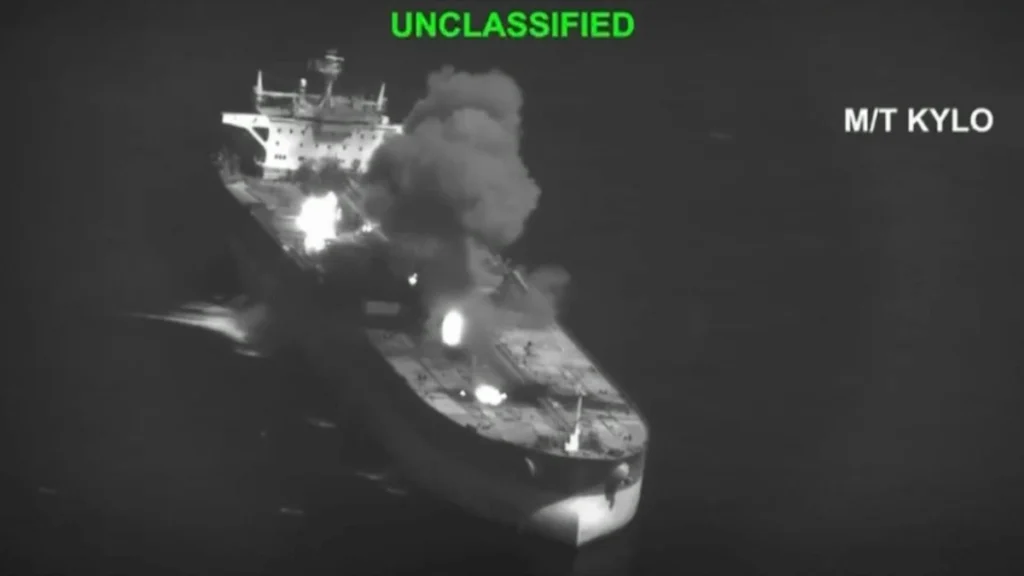
Iran’s Islamic Revolutionary Guard Corps (IRGC) Navy attacked three oil tankers transiting an unauthorized route in the Strait of Hormuz and three U.S.-linked vessels on Saturday, responding to U.S. forces’ morning strikes against three Iranian tankers off the coast of Kharg Island, near Jask, and in the Gulf of Oman.
Prior to Saturday’s maritime operations, U.S. forces bombed multiple targets on Tuesday in the provinces of Sistan-Baluchestan and Hormozgan, causing civilian casualties and prompting Iranian retaliation against U.S. military bases in the region.
RELATED: Trump’s War on Iran Enters Its 7th Month
The IRGC Navy, in a statement carried by IRIB, detailed the offensive against the six ships and issued a strict navigational warning for the strait. Military officials directly cautioned ship operators and shipping companies against being deceived by what they termed the “terrorist U.S. army,” urging them to avoid any suspicious movements through unauthorized waterways and warning that violators would become military targets.
Armed Forces spokesman Ebrahim Zolfaghari, as quoted by Fars, warned that Tehran will ramp up actions against U.S. military vessels in the region if the naval blockade and harassment continue. Zolfaghari stated that if the U.S. Army persists in its “atrocities and harassment” against Iranian ships, endangering them, and maintains the blockade, attacks by Iranian forces on U.S. warships will become “even more powerful.” He also did not rule out expanding the overall scale of operations.
The Fars report further indicated that Iran’s Aerospace Force launched ballistic missiles at a U.S. aircraft carrier and a destroyer as part of the broader response to U.S. aggression.
BREAKING: Footage shows black smoke rising from one of the 3 oil tankers struck by Iran moments ago in the Strait of Hormuz. Iran says all 3 tankers are burning and disabled. pic.twitter.com/qtw7EZ3rnc
— The Hormuz Letter (@HormuzLetter) September 5, 2026
This surge in hostilities follows a memorandum of understanding signed in Islamabad by the leaders of both nations last June aimed at ceasing confrontations. However, tensions reignited after the U.S.-initiated exchange of attacks on the night of July 7–8. The current escalation traces back to an unprovoked U.S. and Israeli aggression starting February 28, after which Tehran tightened its control over the Strait of Hormuz, prompting Washington to impose a maritime blockade against Iran.
Tehran has conditioned the future reopening of the strait on the full lifting of the U.S. naval and economic blockade, a sustained halt to aggression on fronts including Lebanon, and clarification of the situation in Yemen.
Separately, the IRGC Navy urged captains to disregard Washington’s announcements regarding a supposed opening of the route, reiterating that any transit attempt ignoring Tehran’s established permit system and designated passageway risks being engaged as a military target.
From teleSUR English via This RSS Feed.