

Indigenous representatives from various regions of Argentina, speaking via a virtual press conference, denounced the government of President Javier Milei over policies they say aim to strip their communities of ancestral lands to benefit large landowners and foreign companies.
Since taking office in December 2023, the administration has restructured the National Institute of Indigenous Affairs (INAI), stripping it of all autonomy; dissolved the Senate Committee on Aboriginal Peoples; and terminated the National Registry of Indigenous Communities. The presidential hall formerly named for indigenous peoples was also renamed the Hall of the Heroes of the Malvinas.
RELATED: Controversial Changes in Argentina Electoral Reform for 2027
In November 2024, Argentina was the only country to vote against a United Nations General Assembly resolution concerning the protection and promotion of indigenous rights. One month later, Milei declared an end to the territorial emergency status that had suspended evictions until studies of traditionally occupied lands could be completed; the government argued that the emergency status had created legal uncertainty and seriously infringed upon the property rights of legitimate owners and of provinces over natural resources.
The administration has pushed for the Law on the Inviolability of Private Property, which would process evictions through an accelerated mechanism allowing expropriation even before a land dispute is resolved.
On August 6, the Senate approved the bill after eliminating two chapters, including one that would have permitted unrestricted foreign land purchases. The Chamber of Deputies has yet to vote on the legislation, though eviction efforts are increasing on lands coveted for mining and other extractive activities, which the president promotes.
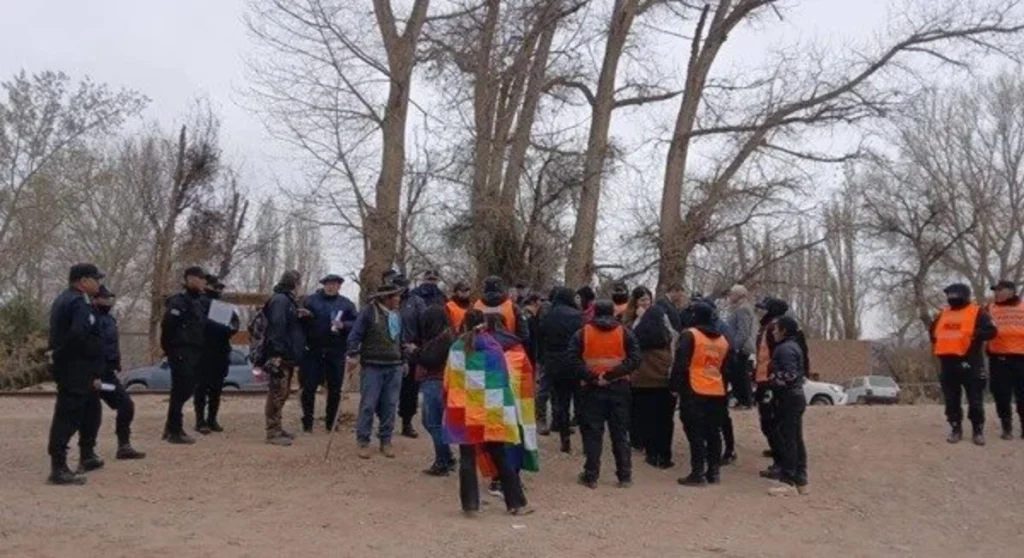
In February 2025, arson attacks occurred in native forests in the cordilleran zone of Chubut province. The provincial government attributed the fires to the Mapuche Ancestral Resistance and ordered federal and local forces to carry out raids that resulted in arrests. On August 19, the Lof Kinxikew community, located near Bariloche, along with the Lof Melo community, was targeted in what marked the eighth eviction attempt since 2011 over an area claimed by a family of Belgian origin. More than 130 people from both communities assert ancestral rights over lands on the shores of Lake Nahuel Huapi, within the national park of the same name.
The community resisted the security forces with the help of roughly a thousand external activists, and the eviction did not proceed; a court subsequently suspended the measure, citing a procedural flaw in its execution.
Lof Melo deputy chief Noelia Huenumil stressed that constitutional rights exist but are not respected, insisting that the world needs to know their reality. Mauro Millan, from the Pillán Mahuiza community in Chubut, stated that democracy, which they believed had been consolidated, was being destroyed.
Mapuche activist Moira Millan, one of the organizers of the press conference, explained the legal mechanism behind the proposed law, noting that even after 200 years of occupation and a legally initiated title-recognition process, they are expelled first and only afterward is the merits of the case examined.
Huenumil further charged that the government seeks to take away the water and natural resources of the area, calling for awareness of the wealth her people have preserved for so many years, and vowed: “We will resist until the end to preserve this territory and its natural resources.”
From teleSUR English via This RSS Feed.