

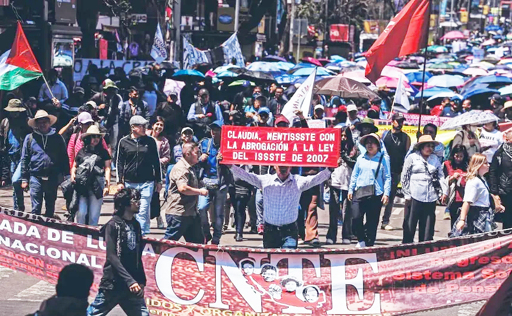
Interview with a CNTE teacher
A writer for Workers’ Voice in the United States interviewed Francisco Bravo, a veteran Mexican teacher and social activist, and a member of the National Coordination of Education Workers (CNTE), a militant teachers’ organization within the National Union of Education Workers (SNTE).
1. What are the historical reasons behind the creation and rise of the CNTE?
***FB:***The CNTE emerged in response to the rise of “charro” unionism led by the SNTE mafia. At that time, Carlos Jonguitud Barrios exercised true feudal-style control. In 1972, with the support of the federal government and through the use of weapons, he stormed the National Union’s headquarters and ousted the leadership that was then in control of the organization. From that moment on, he consolidated his power within the union.
By 1979, conditions for education workers were extremely difficult. A teacher’s salary was equivalent to barely 1.6 times the minimum wage during that period, and there were high levels of corruption, extortion, and abuse—including sexual abuse against female teachers. Tired of this situation, various groups called for a mobilization in Chiapas, where the CNTE was founded.
From its inception, the CNTE was not conceived solely as a teachers’ union. In that early stage, representatives of peasants and workers also participated, although they were not an organic part of the organization. Furthermore, many teachers’ union leaders were key figures in rural and community struggles against local political bosses.
The CNTE thus set itself three central objectives: the democratization of the union, the democratization of education, and the democratization of the country. For those who championed it, this last objective had a perspective rooted in the class struggle. From the outset, there was also a debate over whether to democratize the SNTE from within or to build a new union. The majority chose to work toward the democratization of the union, although that debate has never gone away and remains relevant more than four decades later.
One of the characteristics that, in my opinion, allowed the CNTE to survive while other organizations that emerged during that period lost momentum was its independence from electoral political parties. The CNTE established as a principle that it would not be subordinate to any party and that no one could use the organization’s name to participate in electoral processes. Anyone who does so must leave the organization or, if they do not do so voluntarily, may be expelled.
The other fundamental characteristic is that the CNTE is a mass organization. Decisions originate from grassroots assemblies—composed of classroom teachers—and move from the bottom up. In that sense, there are no charismatic leaders or lifelong rulers. This structure has been fundamental to the organization’s survival.
Throughout our history, we have confronted PRI and PAN governments that attempted to eliminate the organization through repression. Around 200 comrades have lost their lives in various episodes of this struggle. However, repression has not defeated the movement, and we continue to organize.
2. What inspired you to join the CNTE?
***FB:***My political involvement began in middle school. I was president of the student council, and ever since then, I’ve been outraged by the practice of busing students to attend political events for mayors and other officials. I grew up in Nezahualcóyotl, a municipality in the State of Mexico made up largely of migrants from different states across the country and marked by poverty.
From a very young age, I began to recognize the corrupt and corporate nature of that system. I lived in an environment of great inequality and gradually came to believe that this situation was unjust. That’s why I became interested in participating in various social struggles.
When I entered the National Teachers’ College, I continued that involvement. As a student, I participated in a strike over student demands. We were repressed; one class session was canceled, and I myself was detained for several hours by the Ministry of Public Education. Since then, my struggle has been closely linked to education.
When I graduated as a teacher, I witnessed firsthand the corruption within the union and the opulent lifestyles of some of its leaders. In many states, the practice still exists of forcing teachers to contribute to birthday celebrations for principals, supervisors, or district heads, or pressuring them to participate in parades and political rallies. If you don’t cooperate, you’re made to pay the price later.
All of that seemed—and still seems—despicable to me. That’s why I decided to join the CNTE, because it represented an opposition to “charrismo” and yellow unionism. I knew that decision could have consequences. I’ve suffered them physically: on one occasion, members of the Presidential Guard beat me, causing an eight-centimeter wound on my head and injuries to my nose.
During the struggle against the education reform—which we considered a process of privatizing education—numerous colleagues at my school were fired. It was the school with the highest number of firings in the country. All of this reaffirmed my decision to remain in the organization.
The CNTE aligned with my ideas, but it is not a homogeneous organization in ideological terms. There is a general framework linked to the class struggle and various Marxist currents, but within that framework, different positions coexist. Discussions can last 14 or 15 hours, but that is also the cost of democracy and of having freedom of thought. That is very different from what happens in the SNTE, where decisions are often already made before the assemblies even convene.
That is why I decided to join the CNTE. I cannot conceive of a union operating in such a way that a few enrich themselves at the expense of the rest of the workers. And it is important to clarify that the CNTE is not just another union: it is a form of organization and thought within the SNTE itself.
Currently, the CNTE is present in 28 states across the country, with varying levels of strength. In some states, it constitutes the majority of education workers; in others, it has a more limited presence or operates through Central Struggle Committees. However, when national assemblies are held, representatives from across the country participate.
3. Has the CNTE attempted to democratize other aspects of the SNTE and shift control away from the union bureaucracy?
FB: Since the CNTE’s inception, there has been an ongoing debate over whether we should continue fighting from within the SNTE or build an independent union. That debate remains open.
The CNTE’s mobilization capacity can exceed 500,000 workers. But what matters is not just the number: those who participate do so primarily out of conviction, not because they are forced to. In contrast, the control structures of the official union movement remain very strong. In many states, principals and supervisors serve simultaneously as education officials and union representatives. This makes it difficult to distinguish where government authority ends and union authority begins.
Furthermore, these structures can influence labor-related issues, such as work assignments or paid time off, which creates fear among workers who want to participate in democratic organizing.
The CNTE has succeeded in establishing negotiating tables with the federal government. We do not necessarily have the legal standing that official union enjoys, but we do have legitimacy because we have the support of thousands of workers. Some state-level groups are also seeking statutory and legal recognition.
The problem is that the government continues to formally recognize the yellow unions. Following the reform that established universal and secret balloting to elect union leaders, this mechanism was presented as a step toward democratization. However, in our view, the fundamental problem is that the power structures remain intact.
The union controls the resources derived from dues, has leaders with time off to campaign, controls the scheduling of elections, and sets the electoral rules. We do not have the same conditions. There is, therefore, no level playing field.
Universal and secret suffrage can thus become a mechanism to legally consolidate the very same power structures. Directors, middle and upper-level officials, and a large part of the union bureaucracy continue to depend on these structures. Workers may be subjected to pressure or threats related to their contracts and working conditions.
That is why we maintain that establishing universal suffrage alone is not enough. If the power structures are not dismantled and there is no level playing field among participants, the elections are not truly democratic.
In Section 9 of Mexico City, I headed the Democratic Government slate. That section is highly important, and the union bureaucracy has always tried to hold onto it. In my case, I maintain that fraud occurred on two occasions: in 2008 and in 2023. My assessment is that, despite changes in government, the power structures of union “charrismo” continue to be protected.
That explains our outrage when the government presents the current union leadership as the legitimate representatives of teachers. For us, the problem cannot be solved simply through elections if those same power structures remain intact.
4. What role did the CNTE play in Oaxaca in 2006?
FB: In Oaxaca, there was widespread frustration with the political patronage system of Ulises Ruiz Ortiz, then the PRI governor. The state was plagued by deep social inequalities, high levels of poverty, and a significant indigenous population. In that context, the political patronage networks wielded enormous control.
Ulises Ruiz accelerated that discontent. Teachers held a unique position because many of them also serve as representatives of their communities and participate in the social struggles of their towns. In the cities, moreover, many teachers were linked to urban organizations.
That is why the teachers’ struggle, the popular struggle, and the workers’ struggle converged. The conflict escalated into a full-blown social uprising, with barricades and clashes, including the use of weapons. The repression was brutal.
The resistance was also extraordinary. The Popular Assembly of the Peoples of Oaxaca (APPO) succeeded in bringing together different factions of the social movement. However, as often happens during periods of struggle, some sectors ended up using the organization as a platform to secure political office.
Despite this, the 2006 movement greatly strengthened the organization in Oaxaca. Since then, Oaxaca has become one of the CNTE’s strongest contingents, with a great capacity for mobilization and a significant cadre of leaders. It has also made mistakes and has contradictions that we have pointed out, but we cannot fail to recognize its work.
The movement failed to oust Ulises Ruiz. My interpretation is that the Mexican state closed ranks to prevent this because the overthrow of an institutionally established government by a social movement could set a dangerous precedent for other states in the country.
Oaxaca also reflected a much deeper contradiction: Mexico is a country where some of the world’s greatest fortunes coexist alongside sectors of the population that survive on extremely low incomes, especially in several southern regions.
5. How do you view the role of AMLO and Morena in relation to these movements?
FB: From my perspective, we must understand the political nature of Andrés Manuel López Obrador and Morena. This is a movement and a party that do not stray beyond the bounds of capitalism. Their policies may be welfare-oriented, but they do not break with that framework.
During various social conflicts, López Obrador maintained that he did not agree with violence or with certain confrontations. When episodes of repression occurred, he distanced himself from those actions and established a political separation from those movements.
To me, this reflects his vision for the country, which remains within the framework of capitalism and imperialism. I do not believe it can even be defined as a reformist government in the traditional sense.
In some respects, his vision draws on elements of the old PRI, particularly that tradition which spoke in the name of the Revolution and sought to revive certain revolutionary principles without breaking with the fundamental structures of the system.
6. How have teachers’ opinions of Morena, AMLO, and Sheinbaum changed?
FB: López Obrador’s arrival in office initially caused some ideological confusion and a decline in mobilization within certain organizations, including the CNTE. Many comrades had placed their hopes in his government, and this led to a period of reduced organization and mobilization.
Over time, the government’s own actions led many of those comrades to reconsider their positions. We gradually reorganized the struggle and reclaimed a fundamental principle: “Whoever governs, rights must be defended.” That phrase sums up a historical experience of the CNTE: our defense of rights cannot depend on who holds power.
I currently believe that most teachers clearly understand that the administrations of López Obrador and Claudia Sheinbaum do not represent a working-class government.
However, there are also sectors and leaders who end up acting in favor of the regime. At times, certain leaderships or factions do the government’s political work for it. A particularly serious problem is that national struggles become fragmented into state-level negotiations.
The CNTE should have a national policy and not allow the struggles to be divided through separate negotiating tables for each state. When each group negotiates on its own, a national strike can end up losing momentum because some states reach individual agreements while the rest are left isolated.
We have also seen cases of leaders who use the struggles as a political springboard. Some comrades who led movements ended up holding positions as legislators or government officials. In Michoacán, for example, a contingent that had been very strong ended up deeply divided. Despite all this, I still believe that the majority of CNTE comrades remain part of the struggle. With all our mistakes and contradictions, I believe that in recent years the CNTE has been one of the social organizations with the greatest capacity for struggle and the greatest impact.
We also need to engage in self-criticism regarding our own shortcomings, including the lack of leadership and the difficulties in building a national strategy. But personally, I continue to identify myself as part of the CNTE.
7. What role should revolutionaries play within a mass organization like the CNTE?
FB: The CNTE brings together many political and ideological currents. There is a Maoist tradition, a Leninist one, a Trotskyist one, and also Stalinist positions. It is a true melting pot of currents and debates. However, despite these differences, there is one fundamental line that has remained constant: our opposition to successive governments and our conception of the class struggle.
For those of us who identify as revolutionaries, the goal is to advance toward a socialist transformation of society and overcome the capitalist system. That is why I consider it essential to maintain the CNTE’s independence from the government and from the interests of the bourgeoisie.
Ideological differences can lead to heated debates and, at times, slow down certain processes. However, the CNTE has demonstrated the ability to accommodate these differences without destroying the organization.
We must also understand that governments of the same class nature can implement different policies. That is why strategies for confronting them must take these differences into account.
One example is welfare policies. The government may distribute resources to poor sectors and present this as a solution to inequality, but handing out money does not transform the structures that produce poverty.
The same is true of pensions. Retirement funds are linked to large banks and financial companies. Workers deposit their savings there and, on top of that, pay for the administration of those resources. When we talk about tens of millions of accounts, we’re talking about enormous amounts of money that end up being managed by the financial sector.
We defend the right to a decent retirement and pension. And our criticism is that the government has been unwilling to challenge the interests of the major financial groups. That’s where we see the limits of its policies.
8. What can you tell us about the context of the June 2026 strike and its main demonstrations?
FB: I think one of the problems was that the focus of our struggle wasn’t explained clearly enough. It wasn’t simply about changing the ISSSTE reforms—it was about defending the right to a decent pension and retirement. This must be explained in language that all workers can understand.
There is also an international context. Organizations such as the International Monetary Fund, the OECD, and the World Bank have promoted policies aimed at reducing pay-as-you-go pension systems and strengthening systems based on individual accounts. For us, it was essential that workers understand how these policies directly affect their retirement conditions.
There is also a contradiction between the promises made during election campaigns and the policies subsequently implemented. During her campaign, Claudia Sheinbaum spoke of restoring a pay-as-you-go pension system. Once in office, we demanded that she fulfill that commitment.
The central problem is the shift from a pay-as-you-go system [in which workers and the state contributed and it guaranteed a pension for life after retirement] to one based on individual accounts. In the latter model, the pension depends on how much each worker has managed to save individually. For a young teacher, even with hundreds of thousands of pesos accumulated, those funds may prove insufficient to guarantee a decent retirement for many years.
Those who entered the system before 2007 still retain, under certain conditions, the regime known as the Tenth Transitory Provision, which is linked to a solidarity-based system. Workers who entered after 2007 are mostly under individual accounts. According to my estimate, around 70% of the nation’s teaching workforce is already under this latter regime.
That is why one of the proposals I promoted was for all teachers to be able to transition to the Tenth Transitory Provision as a step toward breaking away from the logic of individual accounts and restoring a solidarity-based system. This alone would not solve all the problems, but it would allow us to move in that direction.
We must also acknowledge our own limitations. At that time, the CNTE was unable to develop a sufficiently strong national proposal that would have allowed us to move toward restoring the solidarity-based system. Instead, a dynamic prevailed in which each state negotiated separately.
The groups with the greatest capacity for mobilization—particularly Chiapas and Oaxaca—were able to negotiate more effectively, along with Guerrero and Zacatecas, while other states were left practically as spectators. This situation shows that we need to engage in deep self-criticism and correct our shortcomings so that the CNTE can maintain and strengthen its capacity for national struggle.
The post The teachers’ struggle and the social movement in Mexico first appeared on Workers’ Voice/La Voz de los Trabajadores.
From Workers’ Voice/La Voz de los Trabajadores via This RSS Feed.