

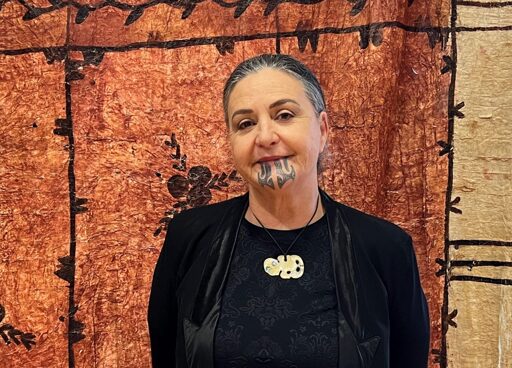

Professor Papaarangi Reid. (Photo supplied)
David Seymour says ACT will campaign in the coming election to scrap admission programmes like MAPAS — Auckland University’s Māori and Pacific Admission Scheme to its health programmes, especially medicine.
He claims a review of medical school admission programmes, so far still under wraps, shows they’re not justified.
But Professor Papaarangi Reid, a proud MAPAS graduate who now heads the programme, is confident the review will show the programmes exceed expectations.
She says the ACT leader is playing “a typical political trick” in labelling MAPAS racist while ignoring the longstanding racist outcomes of the education system.
By their own data, the Ministry of Education and the Tertiary Education Commission admit racist education outcomes privilege non-Māori and non-Pasifika students to more easily achieve higher NCEA scores. This means Pākehā students are more likely to gain entry into tertiary study.
It is a typical political trick to attack the intervention to fix this problem and ignore the bigger systemic issue — especially when the systemic issue privileges people who might vote for ACT.
The Māori and Pacific Admissions Scheme (MAPAS) is a social justice programme to address the inequity of who gets into the medical programmes at our universities.
It is offered because universities are legally obliged to enact human rights legislation which says that if there are inequities — which are obvious — then universities are ethically obliged to put in place interventions to change that. So MAPAS is an intervention to address the issue of who gets into the medical programme at Auckland University.
People like David Seymour like to frame what we’re doing as selecting medical students based on race. No, that’s actually the issue we’re trying to correct — the fact that historically our admissions processes have selected an overwhelmingly Pākehā student cohort and have produced an overwhelmingly Pākehā medical workforce.
Although that demography is changing, Māori and Pasifika are still hugely under-represented in the medical school classes and the workforce.
Typically, admissions have privileged students who have their own bedrooms, their own computers and access to WiFi and unlimited data. Perhaps they’ve had relatives who are doctors and so understand the likely topics for study and interviews. Students who’ve been to good schools, where they get taught all the sciences, have been privileged. As have students who have whānau members who’ve been to university and can access what they need to succeed in applying to university.
But just because these students had access to those things doesn’t mean they’re the only ones in our communities who are fit to be doctors. It simply means they’ve had what they need to be well-prepared, and so they’ve been given the opportunity to do well in entrance exams.
MAPAS and Vision 20:20 help get good people in the door, even if their poorer, less well-resourced schools weren’t able to offer them, for example, a full range of sciences or external NCEA exams. Then, once we’ve supported their access, we require everyone in the medical programme to achieve the same academic and professionalism standards.
All medical students must pass the same exams at the same pass rate. They all meet the same level. The doctors produced are all of the same standard. The bonus is that MAPAS graduates have greater cultural alignment with many of our communities who need medical care. They are well equipped culturally to work in areas where there are more Māori and Pacific patients.
The impact of Covid on education is still emerging, for example, on poorer schools that stopped doing NCEA external exams. NCEA exams themselves are now undergoing changes. During Covid, more Māori and Pacific students had to stop studying and either take care of family because illness and death rates were higher in their communities, or they had to start working because their family members lost jobs. This impact is still echoing in education statistics.
After Covid, more students were even less prepared to get into university, even if they’re exactly the type of person needed as health professionals in our communities. Smart, hardworking, disciplined, empathetic, and so on. Their social circumstances don’t make them incapable of being excellent doctors.
Most students seeking to enter the medical programme at Waipapa Taumata Rau—the University of Auckland are from the North Island. The demographic projections in our catchment area show that Māori and Pacific young people make up 40 percent of 18- to 24-year-olds. So equity would suggest having 40 percent of our intake as Māori and Pacific students.
That’s proving difficult to fill as only those ready to succeed are recommended for entry. But it’s an ambition that recognises our changing demographics, and the fact that Māori doctors still only make up 5.8 percent of our medical workforce, while Pasifika doctors are only 2.8 percent.
Still, people like David Seymour have asked the vice-chancellor why we’re selecting medical students in this way. He thinks it’s problematic. He wants to change it. But to change what we’re doing would require changing the human rights legislation, the Education Act, and our university charter. Our right to do this has been considered, approved, and enshrined in all those ways.
So it won’t be an easy thing if that’s what they want to do. We’ll fight for our students and our communities every step of the way.
The MAPAS programme and Otago University’s Te Kauae Parāoa have been reviewed as part of the National-ACT coalition agreement.
By all accounts, our programmes exceed the expectations in the terms of reference. The university has asked the associate health minister to release the report urgently so that this issue can be debated with evidence.
Unfortunately, even if ACT doesn’t succeed in getting rid of MAPAS, the rhetoric they’ve stirred up is already out there. Populism has given racism a voice again.
Our students are being exposed to more blatant racism from non-Māori, non-Pacific, and other students who are competing for places. All students are under a lot of pressure. There are limited places, and a number of really good people won’t get in.
I absolutely feel aroha for those students. That’s why we’ve also increased the number of places overall to make sure we’re producing enough graduates to meet New Zealand’s need. Because, right now, we import as many doctors as we train. Training is very, very expensive, and the pipeline from a graduate intake to placing doctors in our community is long. We need more training positions in hospitals and general practice and a whole lot of other things to get total numbers up.
Meanwhile, our students are still exposed to racism from patients who think they’re the orderly or the nurse, or who say things like, “Take away my meal tray,” to a sixth-year medical student.
There’s very clearly still a perception out there in the community that our people can’t be qualified. That’s what MAPAS is working so hard to change. And we’re succeeding. We now have a network of highly skilled professionals who can draw on each other’s expertise, and who have a powerful collective network to support one another and work together, so we can better serve our communities.
Māori and Pasifika graduates are more likely to be working in New Zealand 10 years after graduation, more likely to become specialists in general practice, more likely to work regionally or rurally, and more likely to serve communities that are traditionally underserved by the medical workforce.
We are just what New Zealand needs.
Ministry of Education data shows Māori and Pasifika doctors have comparable completion rates. And many of us complete our degrees with distinction, some are top of the class in various subjects, many get into very competitive specialty training programmes, and some become professors and world leaders in their fields.
MAPAS has existed for 54 years, and it has created a network of amazing, accomplished medical professionals who are making a real difference in our health system. You can read about some of them here.
Unfortunately, the quality of the conversation we’re seeing in government right now gives permission for people with low or no understanding of inequities to come in and have a voice.
Let’s remember Toni Morrison’s astute observation: “The very serious function of racism is distraction. It keeps you from doing your work. It keeps you explaining, over and over again, your reason for being.”
It’s for the sake of our students that I’m taking this moment to explain one more time.
Professor Papaarangi Reid is Tumuaki, Te Kupenga Hauora Māori, Faculty of Medical and Health Sciences at Waipapa Taumata Rau, University of Auckland.
As told to E-Tangata***.***
The post David Seymour is afraid of MAPAS because it’s working appeared first on E-Tangata.
From E-Tangata via This RSS Feed.