

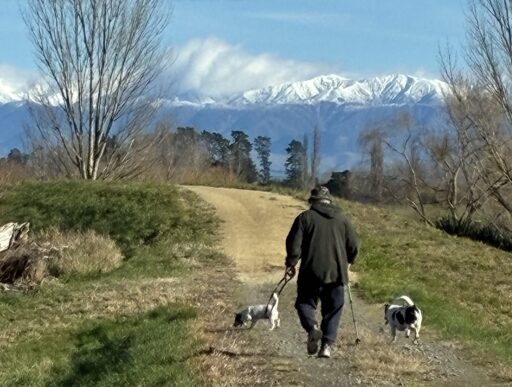

Bernie and the dogs out for a walk in Takapau, Central Hawke’s Bay. (Photo supplied)
Shelley Burne-Field and her husband Bernie live in Takapau township (population 450). It’s a small rural area in Tamatea rohe, also known as Central Hawke’s Bay, where there’s a shortage of GPs, and it takes 45 minutes for an ambulance to arrive in an emergency.
Good thing she knows CPR then.
My husband Bernie is my rock. My big old rock of a guy who’s always there for me. He likes working in his big māra kai, a vegetable garden where he plants broad beans, broccoli, cauliflower and kale — all while keeping life simple and practical.
His star sign is Taurus, and he is a pragmatic, non-drinking Pākehā ally, while I’m a weepy Cancerean wahine who is “finding myself” and trying to understand the rising racism in this country. We’ve been pretty good together for the past 30-plus years.
The morning Bernie’s heart stopped, I was sitting at the kitchen table writing a kids’ novel, Kimi the Kekeno’s Big Adventure, which would eventually be published by Allen & Unwin in 2025. It’s a story about appreciating the moment.
It was the first week of September 2024, early spring, and Bernie had been in his māra digging a trench to plant early spuds. He plants my favourite Rīwai, the dark-purple variety, and Agria. He was fizzing from a local gardening course at Mataweka Marae, taught by the amazing Hana Wilcox.
At the Mataweka pōwhiri and all through the course, Bernie learned local Māori history that had been hidden and suppressed over the years. There’s been a revival in the Tamatea rohe, where we live, led by mana whenua, which has brought to light the stories and meanings embedded in the special landscapes that hold the history in our rohe. It’s magical to experience.
Bernie was annoyed that he’d lived in Central Hawke’s Bay most of his life and never knew anything about the history in his own backyard. At school, he’d learned about English kings and queens. But thanks to Hana and the Mataweka whānau, he soon learned about old river courses, ancient pā sites, and the locations of kūmara pits and winter camps — and he gained a little understanding of the sadness of an oppressed people.
Bernie has had heart issues for a couple of decades, but he was being monitored by a specialist in Hastings. Because he was otherwise fit and didn’t smoke or drink, they decided not to give him bypass surgery. Okay, we thought.
But was it really okay? In the six months before his heart decided enough was enough, he’d developed breathlessness and two of the veins in his heart were 80 percent occluded. We couldn’t quite understand why they hadn’t done anything about it.
During those six months, we sat in the cardiologist’s office, and my husband actually said: “Do I have to have a heart attack before you’ll do anything?” To which the fellow replied: “Probably. Let’s hope you survive it.”
We kept pushing for his case to be discussed at the monthly surgical conference, and eventually a surgeon agreed to see him in Wellington to discuss options. That week, we’d planned to make the nearly four-hour drive down to Wellington on Friday.
On Monday, Bernie’s heart went into cardiac arrest.
My husband is a bit of a prankster. Over the years, he has on occasion given me “fun” frights by sneaking up on me, or, yes, by pretending to be hurt when he wasn’t. His laughter on those occasions was usually louder than my scream or my expletives. So it’s his own bloody fault I thought he was pranking me when he sat down in his chair and decided to die.
He came in from the potato patch and said: “Oh, my chest is a little tight. I’m gonna take a spray.” He was talking about the little red bottle of nitrolingual spray that eases angina. I was typing, typing, and looked around casually. “Yep, okay,” I said, and then I didn’t think any more of it. A few minutes (or was it seconds?) later, I heard him snoring. Well, what I thought was snoring. I think now it was more like a huffing noise. A last snort.
When I turned around from my keyboard, he was sitting up in his armchair, his head slightly bent. Eyes closed. I thought: Geez, he’s fallen asleep fast. But something wasn’t quite right. I called out to him. “Oi!” But no response. And that’s when I thought he was tricking. I actually giggled to myself. What a prankster.
“Hey!” I stood up and walked towards him. A smile on my face. I was ready to punch him the minute he jumped up and yelled: “Boo! Gotcha!” But there was no boo. There was a slight line of drool coming out of one side of his mouth.
There’s nothing like a life-and-death situation to bring you into the present moment. Everything else floats away like a kāhu flying higher and higher in the sky.
The moment becomes very clear. Well, it did for me.
Somewhere in my work history — it may have been working for Te Rangihaeata, a wonderful Gambling Recovery Service in Heretaunga Hastings — I had completed a Hato Hone Saint John first aid course. I still have the certificate. Admittedly, it was a few years before this incident. I’d completed other first aid courses over the years, too, and I remembered a few things.
First, check for response, ring for help, check breathing. If no breathing, start CPR, find the nipple line, begin chest compressions, press harder than you think for an adult, sing Happy Birthday. I didn’t remember how many compressions per breath. I thought it was 30 compressions per two breaths. I was right.
I shook him by the shoulders. “Hey!” I yelled. No response. I knew it must be a heart attack. I was breathing hard. I pulled him off the chair and put him onto the floor. He was turning purple. I knew I had to ring 111.
I forgot to tell you I wasn’t supposed to be home that morning. I was supposed to be up in Napier, writing at my favourite café, Hapi, but I’d decided to stay home. It was as if the planets were already aligning to send us a miracle. I still can’t remember to this day why I stayed home. I mention this because my husband’s phone was right there on the table. All I had to do was reach up and dial 111, then put it on speaker.
I began compressions. Nipple line. Press. Sing Happy Birthday. Give a breath.
Living rurally, I knew an ambulance would take 45 minutes. It wouldn’t get here in time. I knew the local Takapau Health Centre had staff and a defibrillator. I had to ring them. That meant leaving my husband to find my phone.
Another planet lined up. I don’t know how, but my phone was right on the other arm of the chair — right there. I had to stop. It was one of the hardest decisions I made. I stopped compressions and grabbed the phone, then tried to find the phone number with shaking hands. I remember holding the phone up to my face, trying to type in the right letters. My phone kept showing Takapau Food Market instead of Takapau Health Centre. Somehow, I finally found the number. I put it on speaker and prayed they would pick up.
I went back to CPR. The 111 emergency team had picked up by then and was guiding me. I couldn’t get a proper breath in, so they told me to concentrate on compressions. At this stage, I’d been doing CPR for probably two to three minutes.
The Takapau Health Centre answered the phone. “Kia ora, Takapau Health Centre.” It was a Monday morning. Anyone who knows a medical practice knows that Monday morning is busy, busy. They picked up. Another miracle.
I screamed: “It’s me, Shelley! Bernie’s had a heart attack! Please come!” I kept doing compressions. I felt his ribs crack a little. I almost spewed but kept going.
While Bernie lay on the floor, our terrier, Squirt, sat on one side of Bernie’s head with his muzzle resting on his little paws, quiet, knowing. Our other younger rescue dog, Afi, who’s a cross between a Jack Russell and a Heading Dog, was in fight-or-flight panic mode, barking as loudly as she could on the other side. Perhaps her barking was keeping him tethered to this realm.
I wondered if I would hear Bernie’s voice again.
His eyes were closed and weeping. He had that look. He wasn’t there. But I kept talking to him anyway. “It’s okay. You’ll be okay. It’s all right.” I knew it wasn’t all right.
The Takapau Health Centre nurses got to my house in three to four minutes with a defibrillator. The fire siren had gone up by then because all the other angels in the background — the 111 services, the fire brigade, the emergency responders — everyone and the cavalry were coming. Coming to lend a hand to this miracle.
I look back at this and wonder. At the time, I thought our world was ending.
Bernie’s heart had stopped. The Takapau Health Centre did more CPR, wired him up, and then defibrillated him. His heart started again. Fifteen minutes later, it stopped. By then, the Takapau Fire Brigade had arrived. They started on his chest and used their second defibrillator to shock him again.
Bernie came back. He pulled out the throat tube, and while he was lying on our messy carpet with all the wires and beeps and curses going off, he told me to go sit down and have a cup of tea.
The ambulance got there 30 minutes later, and their paramedics were amazing. The Lowe Walker emergency helicopter came and took Bernie to Wellington Hospital.

The Lowe Walker emergency helicopter that took Bernie to Wellington Hospital. (Photo supplied)
Our 16-year-old son became the rock for both of us as we navigated the next days, weeks, and months. He was right in the middle of a year-long course, and he smashed it. He had an interview for an apprenticeship two weeks after Bernie fell over, and he got it. My neighbours and friends drove our son to the interview and his course. I’ve never felt luckier.
Not everyone has this miracle ending. We realise this, and we’re eternally grateful.
The Wellington cardiac surgeon who performed the final miracle is Dr Radhakrishnan. He said to Bernie: “Mr Field, you’ve had blocked arteries since 2009. Why haven’t we seen you before now?” We wondered the same thing.
He also told Bernie he thought he deserved a surgical option: a quadruple bypass with a mitral valve replacement. Even though some of the team thought it was still too risky. Dr Radhakrishnan fought for us. My husband, son, and I shook this surgeon’s hand. We said thank you. We know what you did, Dr Radhakrishnan. We know what you gave us.
He said we should put the story on Seven Sharp. He said it would be a wonderful advocacy story about why everyone should learn first aid. I said we need a story on Seven Sharp about you, Dr Radhakrishnan, and all the people — nurses, doctors, paramedics, fire brigade, family, friends, and neighbours — who work together to support someone in need.
It took me two years to write this story. And to be honest, there are parts of it I can’t go back to. The minutes alone before help came. Waiting with our son during the 10-hour surgery. There’s more, of course. There’s always more.
When we look back, we realise that in the year before Bernie had the two cardiac arrests, his māra kai had suffered. He was slowly getting sicker, but he didn’t want to be a burden on the health system. Like many people, he just got on with it. Two kind gardeners came and gave us a hand with the weeding and maintenance. Thank you, kind gardeners.
But now, the māra has come back to life. The snow is still on the mountain range, but the spuds are sprouting as we speak, almost ready for early planting. The compost heap is fermenting well. Thank you, Hana and Mataweka.
Bernie tells me he likes to feel the soil run through his fingers, though sometimes he wonders why he was the centre of a miracle. I tell him that he is loved and an amazing survivor.
But we keep things simple. And when we take the dogs out for a walk, we pick out the old marae and pā sites we never knew were hidden under our feet. We wonder about what was grown here once. The air is freezing and fresh. To me, the breath of life and the feel of the earth feel so much more precious.
I talk to my tāne about emotions and the wairua of the present moment, and he nods at my inner life. We make an effort to see our marriage and each other as a gift and try not to miss the hours as the years go by. Bernie’s keyhole garden is producing silverbeet. Admittedly, a lot of it is feeding the yellow hammers over winter, but it’s looking good for spring.

Bernie is back growing vegetables in his māra kai. (Photo supplied)
Shelley Burne-Field (Sāmoa, Ngāti Mutunga, Ngāti Rārua, Pākehā) writes fiction, creative non-fiction, and poetry. She comes from Te Matau-a-Māui Hawke’s Bay and is a graduate of the University of Auckland’s Master of Creative Writing, and the mentoring programme Te Papa Tupu. Her second children’s novel, Kimi the Kekeno’s Big Adventure, published in 2025 by Allen & Unwin, was a finalist in the 2026 New Zealand Book Awards for Children and Young Adults.
The post ‘Not everyone gets a miracle ending’ appeared first on E-Tangata.
From E-Tangata via This RSS Feed.