

Venezuela oil production recovery: Delcy Rodríguez targets 1.5M bpd via US deal, 17 fields, Repsol-Eni alliances. Explore worker resistance, sabotage warnings, gas-petrochemical expansion.
Related: Venezuela Transforms its Petroleum Industry Through a Century of Struggle
Venezuela Oil Production Recovery: Delcy Rodríguez Targets 1.5 Million Barrels Daily
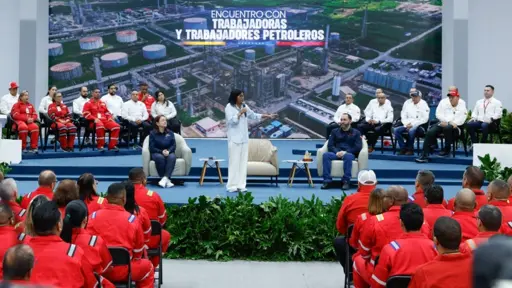
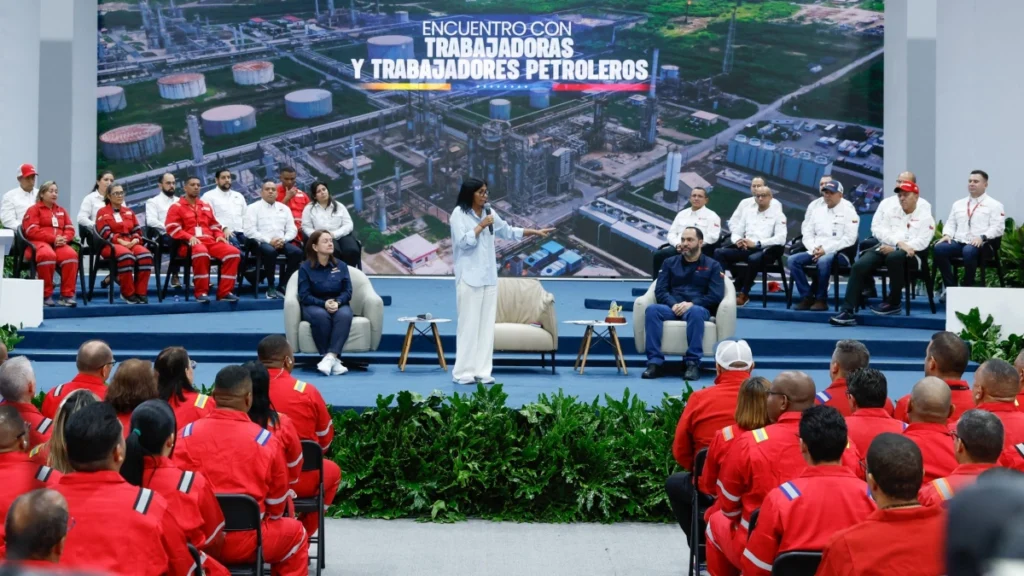
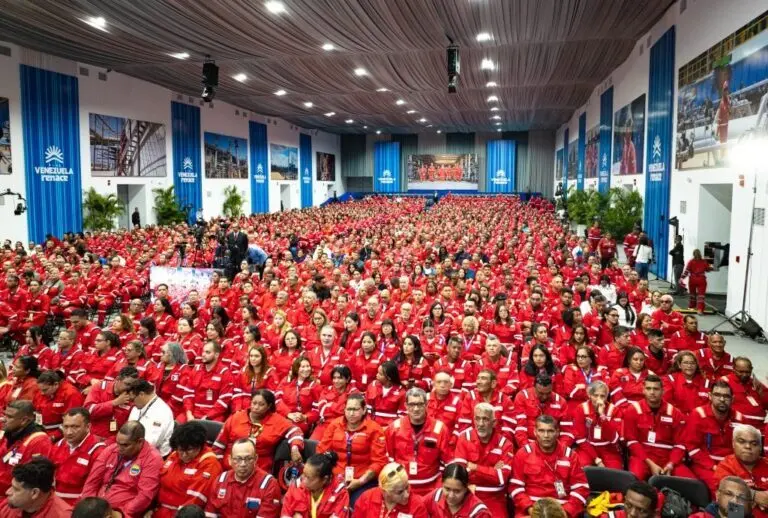
Venezuela oil production recovery took center stage on Friday, September 5, 2026, as Acting President Delcy Rodríguez addressed oil industry workers in Caracas, emphasizing the fundamental role of workers in preserving the national industry and asserting that recent contracts with foreign companies will boost the country’s energy development, including the gas and petrochemical sectors, positioning Venezuela strategically in the international energy formula. Rodríguez highlighted the importance of the binational agreement reached with the United States, as well as strategic alliances consolidated with European companies like Repsol and Eni, plus firms from the United Arab Emirates and Qatar, among other countries, while recognizing those who kept operations active and prevented system collapse amid the situation the energy sector has faced in recent years.[telesurenglish][aa.com][reuters][english.elpais]
Rodríguez recalled that following the signing of recent agreements with the U.S., covering the development of 17 strategic fields—eight in the Maracaibo Basin and nine in the Orinoco Oil Belt—the goal is to reach production exceeding 1.5 million barrels per day. She emphasized that 80% of oil and 90% of gas worldwide come from fields that have already peaked, while 90% of international investments are exclusively destined to sustain those fields. In that context, she highlighted that “we are signing to develop green fields” and stressed the magnitude of the 50 agreements signed to boost national oil and gas production. Rodríguez insisted on the central objective: national development based on its resources, stating: “Venezuela is the country with the largest oil reserves on the planet, but it is number 20 in exporter position. What good are those riches if we don’t develop them? We want to be the country with the largest reserves, yes, but we also want to be a producing power and have that production translate into the happiness of the Venezuelan people, of industry workers.”[telesurenglish][aa.com][reuters][hindustantimes]
Venezuela Oil Production Recovery: Worker Resistance, Gas Expansion, and Sabotage Warnings
Venezuela oil production recovery was framed by Rodríguez as a testament to worker resistance, comparing the oil working class to the Phoenix due to their victorious resistance against difficulties and sanctions. This identity has allowed the hydrocarbon industry not only to survive more than a decade of coercive measures, but to forge an unbreakable historical consciousness in each worker. “Each barrel currently produced bears the seal of this resistance, which has allowed the country to see new possibilities of development and growth for everyone,” she said. Rodríguez recalled the productive recovery achieved through self-effort: “We were able to recover production and reach 1.2 million barrels in December,” referring to December 2025 production levels that marked a turning point after years of decline.[telesurenglish][indexbox][reuters][english.elpais]
For Telesur English’s coverage of Rodríguez’s speech, see: Acting President Delcy Rodríguez Meets Venezuelan Oil, Gas Workers, Warns of Sabotage
Rodríguez recalled that since her appointment as Minister of Hydrocarbons by President Maduro, she promoted the objective of converting Venezuela into a gas and petrochemical export power. She noted that industrial reactivation will bring drilling rigs to the west, flexible pipes, chemical inputs, and an increase in quality jobs for Venezuelan youth. She urged leaving behind the pettiness of sectors that criticize her management aimed at guaranteeing better wages, health, education, and food for the people. “Let’s leave pettiness behind. They accuse me of wanting the country’s good, of wanting wage improvements for workers, of wanting public schools for our children, better food. We will overcome this together and leave it behind,” she affirmed before hydrocarbon sector representatives. The US Energy Secretary Chris Wright announced on September 2 that Venezuela’s oil production is expected to exceed 2 million barrels per day by 2030, with output presently just over 1.2 million barrels daily, forecasting production would rise above 1.5 million barrels per day during the first half of 2027 before exceeding 2 million barrels per day by 2030.[telesurenglish][indexbox][reuters][energynews]
For Reuters’ analysis of the US-Venezuela oil deal structure, see: How Are Caracas and Washington Structuring a Massive Oil Output Deal?
In the realm of national security, Rodríguez denounced political sabotage actions against the electrical system perpetrated by extremist mafias in response to the signing of oil agreements and the advancement they imply for Venezuela’s future. The acting president recounted that in recent incidents, gas pressures were manipulated to destabilize thermoelectric plants in Zulia state and the western region. “I want to take this opportunity to thank the PDVSA Gas team. You know that last Saturday they caused a blackout in the West; they manipulated gas pressures so the thermoelectric system in Zulia state fell and took down the West. Last night, thanks to the PDVSA Gas team, we detected that they close gas valves so gas systems fall, the thermoelectric plant falls, and the national electrical system falls, which is so hit by sanctions, by the demand for electrical growth, by the demand derived from high temperatures,” Rodríguez said. She made a direct call for alertness and collaboration to Corpoelec workers and all workers nationwide: “Extremist mafias are also joining to sabotage. I ask for the collaboration of all workers in the country and call on Corpoelec workers to be alert, because, given what the signing of these oil agreements means, their protest is to cause harm to the Venezuelan people.”[telesurenglish][aa.com][reuters][english.elpais]
Rodríguez concluded with a call to defend Venezuela: “All of us on our feet and alert to defend Venezuela, to defend our people, as we have done,” affirming that “oil workers are an insignia and example of what victorious resistance is.” “They won’t be able to. I tell you: come out into the open because we won’t allow it, they won’t be able to,” she added, referring to those seeking the failure of efforts to advance in the energy sector. The acting president reiterated that the national government’s horizon points toward the social and economic happiness of Venezuelans through agreements that guarantee the future energy infrastructure will be the nation’s indisputable patrimony. “We will continue on this path. Nothing will stop us, because our horizon is very clear, and our horizon is called the social and economic happiness of the Venezuelan people in sovereign negotiations,” Rodríguez underscored. She highlighted that “all these contracts, in the future, will also leave the country infrastructure, highways where there is now jungle; electrical service where today there is only land; energy infrastructure. It will be Venezuela’s, it will be ours.”[telesurenglish][aa.com][reuters][hindustantimes]
#EnVivo | Presidenta (E) de Venezuela sostiene encuentro con trabajadores petroleros https://t.co/vmv69jN41r
— teleSUR TV (@teleSURtv) September 4, 2026
Geopolitical Context: US Energy Dominance, OPEC Dynamics, and Regional Power Shifts
The Venezuela oil production recovery strategy unfolds against a backdrop of intensifying US-Venezuela energy cooperation following the August 28, 2026, announcement of a historic oil agreement granting the U.S. majority control over 65 billion barrels of Venezuelan proven oil reserves across 17 strategic fields in the Orinoco Belt and Lake Maracaibo. The White House fact sheet described the deal as “the biggest oil deal in world history,” with President Donald Trump securing U.S. majority control through a partnership with North American Blue Energy Partners (NABEP), which received 100-year concessions for the 17 fields. The agreement involves a three-layer structure: a joint venture between the U.S. government and an unnamed private Venezuelan operator, with the U.S. controlling 55% of effective output through ownership stakes and rights to purchase crude at cost, destined for the U.S. Strategic Petroleum Reserve and military use.[aljazeera][thenationaldesk][whitehouse][cnbc]
Regionally, the Venezuela oil production recovery plan carries significant implications for OPEC+ dynamics, as Venezuela’s return to higher production levels could alter quota allocations and pricing mechanisms within the cartel and its allies. The 1.5 million barrels per day target represents a substantial increase from current output of approximately 1.25 million bpd, though still far below Venezuela’s historical peak of over 3 million bpd in the 1990s. The involvement of European companies like Repsol and Eni, plus Middle Eastern partners from the UAE and Qatar, signals a diversification of Venezuela’s energy partnerships beyond traditional U.S. and Chinese investors, though the U.S. bilateral deal remains the cornerstone of the recovery strategy. The 25-year duration of the U.S. agreement, as confirmed by Rodríguez, aligns with Venezuela’s Hydrocarbons Law, though the 100-year concessions granted to NABEP have raised legal and sovereignty concerns among experts, lawyers, and opposition figures who question the long-term implications for Venezuelan control over its natural resources.[aa.com][reuters][reuters][bbc]
Globally, the Venezuela oil production recovery initiative reflects broader debates about energy security, resource nationalism, and the role of foreign investment in developing countries with vast reserves but deteriorated infrastructure. The U.S. Energy Secretary’s forecast of 2 million bpd by 2030 underscores the strategic importance of Venezuelan oil for U.S. energy dominance, particularly as the Trump administration seeks to replenish Strategic Petroleum Reserves and reduce dependency on Middle Eastern imports ahead of the November 2026 midterm elections. However, analysts warn that legal, political, and infrastructure risks cloud the deal’s future, with full development expected to take more than 25 years and requiring sustained investment, stability, and technical expertise that may be challenged by future political changes in either the U.S. or Venezuela. The BBC described the deal as a colonialist “fever dream”, while Yahoo Finance noted that the U.S. now controls 7.1% of proven global reserves through the agreement, reshaping the global energy map overnight.[indexbox][bbc][finance.yahoo][ogj]
The sabotage warnings issued by Rodríguez highlight the vulnerability of Venezuela’s energy infrastructure to political interference and criminal activity, with extremist mafias allegedly manipulating gas pressures to destabilize thermoelectric plants in Zulia and western Venezuela. The national electrical system, already strained by sanctions, high temperatures, and growing demand, faces additional risks from coordinated attacks aimed at undermining the oil recovery effort and discrediting the government’s economic management. The call for worker vigilance reflects a broader strategy of mobilizing labor support for the energy recovery plan, framing oil workers as defenders of national sovereignty against external and internal threats. The intersection of energy security and political stability underscores the high stakes of the recovery effort, with millions of jobs, social programs, and fiscal revenues dependent on sustained production increases and infrastructure rehabilitation.[telesurenglish][aa.com][reuters][english.elpais]
Furthermore, the Venezuela oil production recovery plan emphasizes gas and petrochemical expansion as complementary pillars to crude oil production, with Rodríguez highlighting the goal of converting Venezuela into a gas export power. The arrival of drilling rigs, flexible pipes, and chemical inputs to the western region signals a shift toward integrated hydrocarbon development, leveraging Venezuela’s vast gas reserves (estimated at over 200 trillion cubic feet) to diversify exports, generate higher-value products, and create quality jobs. The 50 agreements signed to boost oil and gas production include partnerships with international firms capable of providing technology, capital, and expertise for complex projects in the Orinoco Belt, Maracaibo Basin, and offshore fields. The long-term vision extends beyond immediate production targets to infrastructure development, including highways, electrical service, and energy facilities that will transform currently undeveloped areas into productive zones contributing to national development and social happiness.[telesurenglish][aa.com][reuters][hindustantimes]
From teleSUR English via This RSS Feed.