

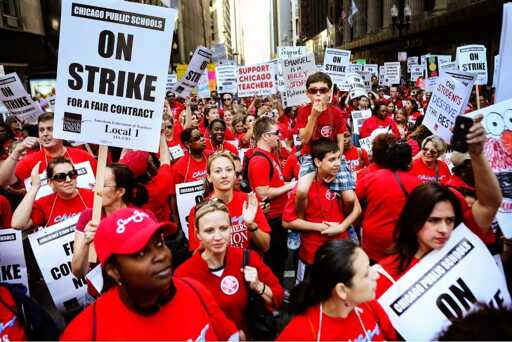
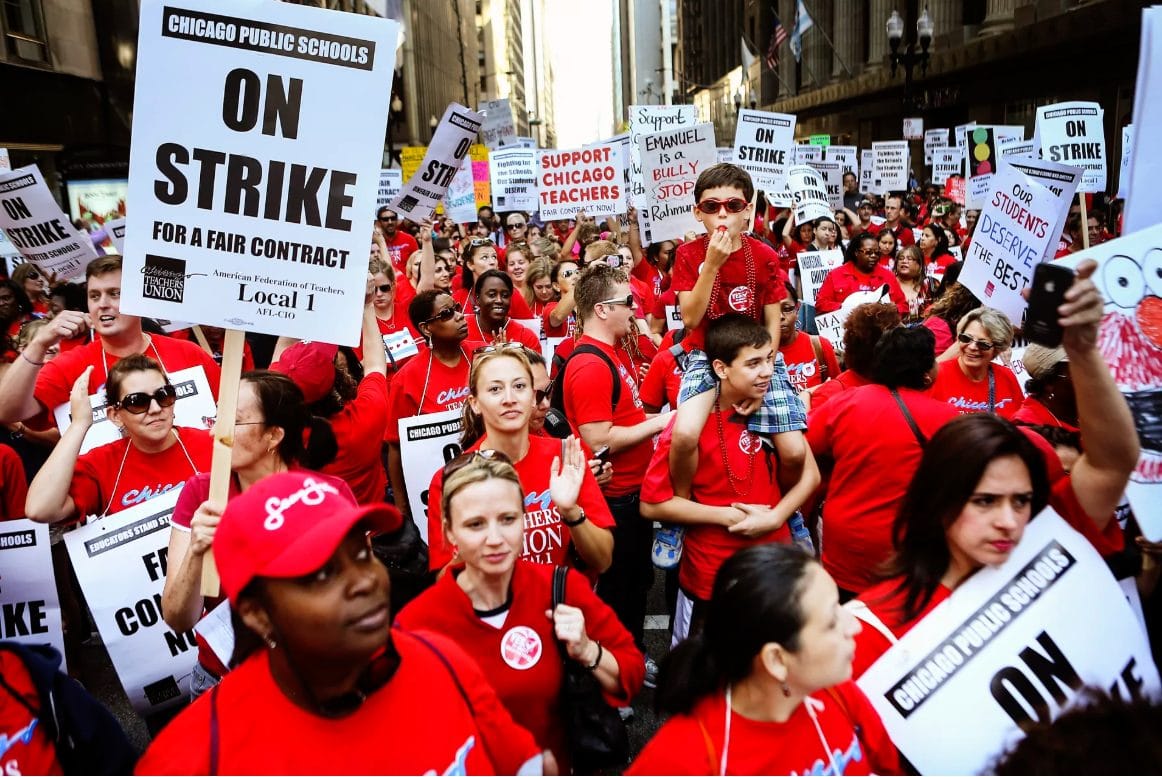
I began my career as a middle school educator over fifteen years ago in a neighborhood school in the South Bronx. Water leaked from the ceiling into a trash can in the computer lab, where we held our first all-staff meeting. I entered the classroom during the high years of “education reform,” as Michael Bloomberg laid siege to our union—the United Federation of Teachers (UFT)—and endangered the lives of our Black and brown students through Stop and Frisk. When a highly resourced charter school was co-located on the floor below us a few years later, my students glimpsed the completely refurbished hallways and bathrooms and asked why the other school could afford to have such luxuries. My students were outraged when Trayvon Martin’s murderer was set free after his acquittal.
All of these struggles were deeply felt by the educators on my floor, but our disorganization was paralyzing. The spark of solidarity, the call to build power to fight back, was absent. Instead, a deep sense of resignation reigned as we struggled to get through each day, trying to do right by our students as mandated curriculums, Common Core standards, and state testing were imposed on us and our students.
Years later, inspired by the presidential run of Bernie Sanders and frustrated by how both Democrats and Republicans contributed to the pain inflicted on my students, I joined DSA. It was there that I was encouraged to get involved in my union; to see it as a space to build solidarity and the power to wage fights against tyrant principles, negligent school districts, and an entire system structured to rob so many children of a future.
The myriad struggles educators and families face are indeed both economic and political—from the structures of educational apartheid enforced by school funding mechanisms, to the drains on enrollment and funds in public school districts caused by charter schools, and now, cyber charter schools. In his recent piece, “The Economic is the Political,” Communist Caucus comrade Zach W draws out these connections, arguing that the priority for socialist organizers in DSA should be to build economic power through independent working-class organizations, like teachers’ unions, as the weapon to deliver on our demands.
The dichotomy presented by the author, that pits building collective “coercive economic power” (or simply, strike power) against the partyist focus on the program, is a false one. The piece ignores the centrality of the merger formula to MUG’s politics, presents a strawman of MUG’s approach to labor organizing, and leaves open the question of who might fill the ranks of the well-rounded organizers the author calls for, and what might motivate them, in the struggle to abolish capitalism.
False Dichotomy
Early in the piece, comrade Zach states that:
The argument put forward by Communist Caucus is not quite, as comrades in Marxist Unity Group (MUG) have put it, that “the working class must be ‘formed as a class’ (read: organized) before the formation of a party and determination of its program” (emphasis added). This is not a question of sequence (first organization, then program/party), but a question of emphasis in our present historical moment.
Throughout the piece, the author uses the words “emphasis” and “priority” interchangeably. Without getting hung up on the semantics of whether having a priority implies a sequence, a driving argument is that the focus on a program is misguided given the disorganized conditions of the class. For example, two paragraphs later, the author argues that “…the most effective forms of political practice do not begin from a formal organization debating and arriving at the correct ideas. Instead, they begin from the day-to-day struggles of workers and tenants (emphasis added).”
We reject this chicken and egg conundrum. Our socialist ideas and program must be connected with day-to-day struggles. Engels first suggested this political project of merging the socialist and workers movements, which was then a key piece of the Manifesto he authored with Marx. It would later be described as the “merger formula,” popularized by 19th century Marxist theorist Karl Kautsky. The success of one movement was incumbent on the other. This was in contrast to the craft union pragmatism exemplified by Samuel Gompers and the then American Federation of Labor (AFL), and to the sectarian line of the Socialist Labor Party (SLP) under Daniel De Leon, which saw shop floor struggles for better wages as distractions from the goal of achieving socialism whole-cloth.
Material conditions have changed since this theory was first penned, but the truth remains the same; those committed to abolishing capitalism and its many oppressions must be on the front lines with workers, tenants, and oppressed people in all instances. Our task is to connect and bind these struggles together, to build and unite a fighting working class under a democratic mass political party.
The partyist approach to the shop floor is not about haranguing coworkers with “correct ideas” from the Manifesto, the Little Red Book, or the Workers Deserve More program. This caricature, raised on the floor at DSA’s National Convention in 2025 and littered throughout this piece, is plainly rejected by MUG and bears little resemblance to the organizing practice or politics of the many members of MUG organizing in our unions. From MUG’s 2026 Task and Perspectives:
We are small numbers of socialists intervening in a battered and often ineffective labor movement under conditions where large sections of the working class remain unorganized. In many cases, our immediate tasks are basic: fighting for a union to exist at all, or fighting for the right to access our contracts or holding regular union meetings. As we educate, organize, and struggle against the bosses, our numbers will grow.
As we can see, the reality is far from the caricature. Near the conclusion of his piece, the author writes, “DSA urgently needs to develop well-rounded organizers who can switch between these different levels of struggle and articulate the relationships between them, rather than activists trained to spread party gospel.” Ignoring the loaded terminology of activist versus organizer, I agree that we need to train well-rounded organizers. Training in DSA labor spaces ought to be the same as it ever was: establish yourself as a reliable and respectful coworker, bridge divisions among workers, direct ire towards the boss, empower and challenge others as workplace leaders, and build shop floor power.
But what happens when there is an important election or issue involving DSA? When your union leadership unilaterally endorses a candidate over the heads of the members? This was my situation when my local endorsed against DSA Congressional Candidate Chris Rabb in Philadelphia, which prompted negative reactions from a coworker. This led to a productive conversation about the disorganization of our leadership, and sparked interest in DSA. I believe this is the type of well-rounded organizer the author describes, but I also believe that in every serious opportunity possible, DSA members should be spreading the “gospel,” the good news, that there is a serious organization out there with the goal of uniting our separate struggles.
As DSA explodes into public discourse with nightly news segments covering our program, every member should be ready to champion the idea that there is hope for a political alternative to the corporate duopoly, that there is hope for a better world in our lifetimes, and that it is up to each of us to fight for it on every terrain. These convictions, these political ideas, have driven a new wave of labor organizing. In his 2025 book We Are the Union, Eric Blanc devotes a whole chapter to the role of youth radicalization as a driving force. He writes, “Many new young organizers have come into labor via radical politics, and, as such, they’ve also begun pushing labor in a new political direction.”
This mirrors my own journey. I wanted to fight for a better world for myself and others. It was in DSA that I was encouraged to get involved in labor organizing and to find a role in fixing our rudderless union. My years in DSA have introduced me to countless others who, seeking political hope, were motivated to get involved in their workplace struggles, or decided to support new organizing through salting. The call of William Z Foster, that the Left must take the lead in organizing the unorganized, rings true a century later.
When the author writes, “We need to develop and recruit a large layer of skilled organizers within DSA who carry out work in other proletarian organizations” he is correct, but fails to identify what motivates many of our comrades to engage in this arduous spade work in the first place. The immediate fight against the boss is a key piece to be sure, but so too is the understanding that each struggle is a part of something bigger. This all-encompassing struggle can only be carried out by a strong party of the working class, organized on a national scale and defined by its shared program.
One Struggle
Our shared political project does not only provide a clear “why” for the growing number of radical organizers building a new American labor movement, it also provides some guidance on the “how.” In addition to connecting new organizers to comrades with a wealth of experience who’ve been at it for decades, we are grounded in a legacy of organizing which is categorically opposed to the oppression and discrimination that rotted away the soul of the American labor movement. We reject the legacy of misleadership under Gompers, the AFL, and the near century of bureaucratic business unionism that has left American workers as disorganized as ever.
The author is correct when he writes, “The aim is to reconstitute a set of habits of rank-and-file-led class struggle that have been largely lost in the US.” But this begs this question, which set of habits? Anyone who has studied the high years of the Congress of Industrial Organizations (CIO) should be aware that rank-and-file organization varied considerably within it. The Partyist Labor Strategy seeks to reconstitute the best practices of communist-led unions from this era while avoiding some of their pitfalls.
As documented by Judith Stepan-Norris and Maurice Zeitlin in their study Left Out, “…the Communist-led internationals stood out, by all measures, in the struggle for women’s rights…The pattern of principled and practical commitments to women’s equality revealed here…is replicated as well in our analysis of radicalism, democracy, and racial egalitarianism.” Sexism, racism, and all forms of oppression are absolutely reflected on the shop floor, but it was organizers driven by an ideological understanding of how capitalism related to these other modes of oppression that fought for their ideals and won results. We believe that ideas about our material reality matter a great deal, especially when counterposed to the dominant ideas of pragmatism, nationalism, and Zionism that have guided the politics of union leadership for decades.
Not every oppression is experienced directly on the shop floor, however. Our imperialist state tries its best to commit its most explicit violence out of sight and out of mind for the American worker. DSA’s strong stance against the ongoing genocide in Palestine drew many into our ranks, and spurred a response from organized labor. The author raises the UAW UC 2024 strike over Palestine as an example of how “economic” demands can eventually give way to “political” ones. But if, as the author states earlier, “the most effective forms of political practice do not begin from…arriving at the correct ideas. Instead, they begin from the day-to-day struggles of workers and tenants” it is left unclear what mechanism will connect these day-to-day struggles to the struggle against the war machine. Organizers with a program that places us within a global struggle against the war-makers understand these connections, and can create the opportunities to make them clear to others as they build power on the shop floor.
Conclusion
There is little disagreement between MUG and Communist Caucus about the importance of the shop floor, the importance of class-independent organizations, their role in reviving a lost culture of organizing, and the importance of building strike power. In fact, every socialist I have met in DSA understands that economic issues have political implications. The weakness of the argument lies in the rote dismissal of collective political organization. The author most clearly expresses this in his rejection of a party program, which he caricatures as the idea that:
The right demands articulated correctly will bring the class-conscious layers of the proletariat into the ranks of “the Party” to follow our correct ideas and leadership. This is an ultimately idealistic approach, which argues that ideas and slogans are what primarily drive history toward socialism.
Almost two centuries since the Manifesto was written, and with many bold predictions of the imminence of socialism scattered in the graveyard of our movement since, it feels like hubris to suggest what might finally get us across the river to the promised land. Yet, we find ourselves at the threshold of history. We’ve built a precarious socialist movement that is growing, winning, and calling on us to push forward. The reality is, our ideas and politics, now crystalized as a program, have brought more people than ever towards socialism in the US. And we have shrewdly worked together to deliver wins that will bring in even more.
The dichotomy between ideas and action raised by the author can only fall away as we build a movement that can both properly think and act*.* I conclude with Marx arguing against such a division in 1844: “The weapon of criticism cannot, of course, replace criticism of the weapon, material force must be overthrown by material force; but theory also becomes a material force as soon as it has gripped the masses.”
Light & Air / Marxist Unity Group
Liked what you read? Subscribe to stay plugged in.
From Marxist Unity Group via This RSS Feed.