

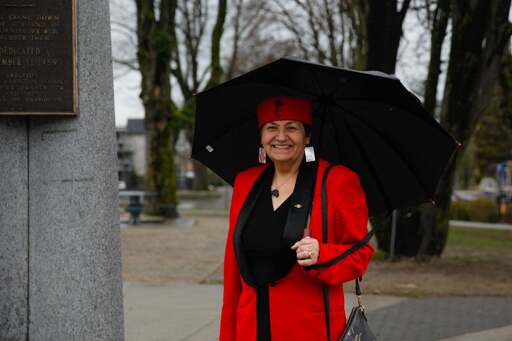

Joan Phillip, Amshen, stands next to the Grandview Park Cenotaph in 2024. She passed away on Aug. 28, 2026, at the age of 74. Photo by Kayla MacInnis
Fearless. Fierce. Wise. Courageous. Cherished.
Those were just a few of the words that colleagues and loved ones used to describe the late Joan Phillip, Amshen, at her funeral service in snpink’tn (Penticton, B.C.) on Wednesday.
Before Amshen was laid to rest in the community cemetery in syilx Okanagan homelands, leaders, dignitaries, and people from near and far packed the Outma Sqilx’W Cultural School’s gym — with hundreds more watching a livestream online — to remember the beloved leader.
“It was one of the dreams and hopes of our people for years to have our own school in our community to teach our children. Joan helped get this here,” said caxasket Joseph Pierre of the Penticton Indian Band (PIB), who moderated the funeral service.
Amshen, an Indigenous leader and lifelong activist from the Tsleil-Waututh Nation, died last Friday on Aug. 28, at the age of 74. Her grandfather was the late Chief Dan George.
At the time of her death, she was serving as a member of the Legislative Assembly (MLA) of British Columbia. She represented the Vancouver-Strathcona riding — previously Vancouver-Mount Pleasant — through the NDP, a position she held since 2023.
‘Do not be afraid to stand like Joan stood’
Amshen spent more than 20 years as the lands administrator for PIB, retiring from that role in 2019. She was a member of the Penticton Band Council and married to Grand Chief Stewart Phillip, the president of the Union of British Columbia Indian Chiefs, who was chief of PIB for 14 years. The couple split their time between “Vancouver” and snpink’tn.
“I thank the Creator, I thank kʷuləncutn, for putting Joan on my path — for herself and my path,” the Grand Chief said at Amshen’s funeral, whom he had grown to know as “Bunny” during their marriage.
“We were able to have such a wonderful life together. I feel no regrets. My heart is in a good place. I feel gratitude. I feel amazing, powerful gratitude, that I had the opportunity to be together with Joan. To share her life, to share her love, to share her principles and integrity.”
A staunch advocate for Indigenous title and rights; the wellbeing of the land and for future generations, Amshen’s relatives recalled a woman “who had no fear” and “stood up” against colonial injustices.
“Joan was all about children, young people, our Elders. People in the Downtown Eastside absolutely loved Joan, because they knew she was there for them,” said the Grand Chief.
People shared stories of her involvement with the Red Power Movement and the Native Alliance for Red Power when she was just 16 years old, as well as her moments of solidarity with the Oka Crisis, the Gustafsen Lake standoff, and Standing Rock.
In one of her final acts in the fight for the rights of Indigenous Peoples, Amshen stood up against B.C. Premier David Eby and her own political party earlier this year, when attempts were made to amend the province’s Declaration on the Rights of Indigenous Peoples Act (DRIPA).
“I was so proud of her,” Phillip said of his late wife and her opposition to amend DRIPA.
“We’re not oil people in this room. We’re not pipeline people. We’re not corporate people. We’re Indians. That was the beauty of Joan — she knew that. She knew which team she was on, and why she was on that team.”
While they mourned her loss, the Grand Chief and others in Amshen’s close circle encouraged people in the room to honour her legacy by continuing on with the work that she had committed her life to.
“When we move forward in the work that’s ahead of us, do not be afraid to stand like Joan stood,” said the Grand Chief.
“Don’t be afraid to stand up. Joan’s principle was: we have to stand up, no matter what. So I ask you to do that.”

Stewart and Joan Phillip stand with their fists in the air against Kinder Morgan on Burnaby Mountain. File photo
‘That legacy needs to carry on’
Eby was in attendance for Amshen’s funeral, and was the first guest invited to speak at her service. While acknowledging that it was a difficult day for everyone in the room, he described his colleague as “a remarkable person with such incredible history in our province.”
“Joan was absolutely fearless. She’s one of the strongest people I’ve ever met in my life. And she was an incredible friend and colleague,” said Eby.
He spoke of the “tough go” he had with Amshen earlier this year when attempts were made by his government to amend DRIPA.
“Joan disagreed with the direction I was setting for the government — rightly so,” he said.
He thanked her family in the room for “sharing Joan with the province of British Columbia, in all of her work.”
“I know with certainty that Joan made our province a better place to live. Just as I know that that involved sacrifices from you, in order that that could be the case,” he said.
In her act of standing up for DRIPA this earlier year, syilx and Secwépemc author teɬkənitkʷ Elaine Alec said that Amshen “chose the chiefs and the communities that she was accountable to.”
“She held the line. And the government backed away from the proposed legislation,” said teɬkənitkʷ.
“It was remarkable because after more than 50 years of activism, she was still the same Joan. The room had changed and the stakes had changed. The title beside her name changed. But when the moment came, she still knew what she had to do.”
Bravery, teɬkənitkʷ said, was the route that Amshen always took.
“Everything I have ever done in my own life that required real courage has some part of Joan in it. Some of the hardest decisions I’ve ever made and some of the scariest things I’ve ever done, I was able to do it because I could hear Joan saying, ‘You know what you need to do,’” she said.
“That is what I want the women, the girls and the young people listening to remember about Joan’s fearlessness. Fearlessness does not mean you never feel afraid. Courage is being afraid and doing something anyway, because you know it is the right thing to do.”
A way to honour Amshen, she said, is “not by trying to become her, but by carrying whatever piece of her she gave us.”
“This is what legacy looks like to me. It is not everybody becoming Joan. There can only be one Joan. It is each person carrying the part that she gave them,” she said.
“Some of us will hear her voice for the rest of our lives, whenever we are scared and already know that we need to do.”
Carrying responsibilities for the land and waters
Amshen’s relative and fellow Indigenous activist Rueben George from the Tsleil-Waututh Nation read aloud a passage written by their ancestor Chief Dan George, from his 1967 “A Lament for Confederation” speech.
“Like the thunderbird of old I shall rise again out of the sea; I shall grab the instruments of the white man’s success — his education, his skills, and with these new tools I shall build my race into the proudest segment of your society … in the houses of law and government, ruling and being ruled,” George read.
George said that when Amshen was elected as MLA, that her grandfather was smiling down on her.
“Because he prophesied that. Fifty-five years ago, he wrote that. He wanted that for our people,” he said.
Teachings around the relationships and responsibilities to care for the lands and waters was something Amshen carried and taught to both George and his kids, he said.
“She worked with my kids on how to be, on how to love, how to gain those teachings and how to incorporate that in your life,” he said.
With Amshen continuing her grandfather’s legacy, George said it’s up to the people now to keep that work going to protect the land; the waters; and the people.
“It takes all of us. We have to continue to teach our kids. We have to continue to teach something and save something for the future generations,” he said.
“It already looks bleak. But we have to stand up. When all the odds are against us, Joan would stand up. When you have industry, government and everything closing in on you, we do ceremony and we stand up. We stand up and do something for that.”
Assembly of First Nations National Chief Cindy Woodhouse Nepinak said that, for Indigenous Peoples, Amshen’s life is a testament to “how all of us should live and be.”
“I just want to thank God that he gave her to us. He loaned her to us for a little while, and now he wants her back,” said Nepinak.
“I can’t imagine what she’s doing up there — shaking things up already.”
‘I knew her to be so determined to build a better future for our children’
sil-teekin Greg Gabriel, y̓ilmixʷm (chief) of PIB, spoke of all the years he spent working with Amshen and her husband.
He said that “her love for the community, her love for the land — for everything — was always her focus.”
“In all the years I’ve known Joan, she was always there with you, fighting for our title and rights. Fighting for our land and environment,” said Gabriel.
“Her main focus was all of that. But I knew her to be so determined to build a better future for our children, and our future generation.”
All she wanted, he continued, was “a better place for all of us to work together, and make this world a better place.”
“That legacy needs to carry on. That work needs to carry on, by all of us,” he said.
Amshen’s son, Monty Joseph, shared with everyone his mom’s biggest message.
“Whatever work we don’t finish here and now, we pass on to our next generation,” Joseph quoted his mom.
“It ends up becoming inherited by us younger people, whatever work isn’t done.”
He remembered his mom as fearless, strong and tough, but also, “kind and gentle, when she needed to be,” he said.
“My mom loved to love. And she loved very hard. She loved each and every single one of you,” he said.
“Whatever you do in your future, remember to love those that are close to you. Love those that are around you. Love those that you don’t know.
“The more love you share with other people, the more they start to feel that connection, too.”
The post Community mourns Joan Phillip, Amshen, who fought for justice and ‘loved very hard’ appeared first on Indiginews.
From Indiginews via This RSS Feed.