

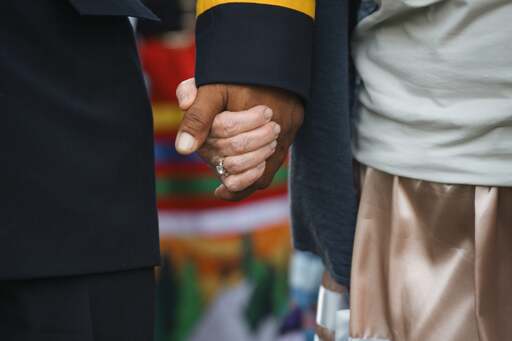

Chief Edwin Ananas (left), of nîpisîhkopâwiyinînâhk (Beardy’s and Okemasis’ Cree) Nation, holds hands with Governor General Louise Arbour at Treaty 6 commemorations in August. Photo by Curtis Cameron
For much of this country’s history, Indigenous peoples have been falsely treated by the “Canadian” state as though we need hand-holding.
A handshake, it seems, was never enough.
Treaty 6 was negotiated and marked 150 years ago, first at Fort Carlton, and later at Fort Pitt and at several adhesion sites in the years that followed. (An adhesion was when other communities were later incorporated into an existing treaty).
But it was more than a written legal document; it must be understood through its spirit and intent, grounded in Cree concepts such as pimâtisiwin (to live a good life), miyo-wîcêhtowin (to work together), wîtaskêwin (to share the land) — because of wâhkôhtowin (we are all kin).

READ MORE: ‘A living relationship’: Cree Youth honour 150 years of Treaty 6, vowing to carry it forward
Through the Indian Act, the reserve and pass systems, residential schools, and generations of paternalistic policies, “Canada” relentlessly positioned itself as the authority over our lives and nations.
When Indigenous peoples have asserted our own laws, governance systems, and responsibilities to land and community — under the guidance of Elders — we remind “Canada” that treaties don’t make nations. In fact, it’s nations who make treaties.
Understanding this threatens to unmoor “Canada’s” manufactured power.
There is an irony in this history: “Canada” assumed the role of guardian, while refusing to recognize Indigenous nations as the capable political partners with whom the Crown had entered treaty — even as “Canada” itself remained tied to the British Crown.

A commemorative medal a Crown representative gave to Cree Chiefs at the signing of Treaty 6 in 1876. Photo by Curtis Cameron
In 1876, as Treaty 6 was signed, government representatives presented the gathered chiefs with medals. On their face is an image intended to communicate the treaty relationship: a British representative and a First Nations chief stand face-to-face and shake hands.
Behind them the prairie landscape, with tipis and a rising sun; before them is a pipe (or, as some may see it, a buried hatchet).
But it’s the handshake that’s at the centre of the scene.
From a European perspective, the handshake was a readily understood symbol of agreement: two men meeting to negotiate, settling terms, concluding a transaction.
Symbolically, a handshake could reduce something as complex as treaty to a single moment — a deal done, hands gripped and then released.
But in fact, treaty asks that the hands return to one another.
Treaty must be understood as an enduring, tripartite (three-way) relationship between First Nations peoples, the Crown, and Creator.
Indigenous peoples bring their nations and their connection with Creator to that relationship; but to honour it, the Crown must also come in good faith to the table.
Earlier this year, a delegation of Treaty 6 chiefs travelled to Buckingham Palace for a private audience with King Charles III.
They requested the Crown return to their territory to honour the treaty’s 150th anniversary. Months later, their invitation was answered: Louise Arbour, the Governor General of Canada, represented the Crown at Fort Carlton. Her presence mattered — not only ceremonially, but as an affirmation of the relationship promised through Treaty 6.

Chief Edwin Ananas (left) and George Stanley (right) hold hands with Governor General Louise Arbour at Treaty 6 commemorations in August. Photo by Curtis Cameron
On Aug. 23, exactly 150 years after Treaty 6 was signed at Fort Carlton, Arbour stood in between Chief Edwin Ananas — of nîpisîhkopâwiyinînâhk (Beardy’s and Okemasis’ Cree) Nation — and George Stanley, the former chief of Frog Lake First Nation.
Yet rather than simply shaking the governor general’s hand — a gesture so familiar to the imagery of treaty — they held it.
This handhold asks us to consider whose presence, and what ways of understanding treaty relationships, have been obscured in its visual history.
Indigenous political life has never existed only within masculine spaces.
Grandmothers, mothers, matriarchs and women’s societies have always carried law, kinship, language, ceremony, family and responsibilities to future generations. Their roles cannot be understood simply by looking at who placed a mark on a written document, or whose portrait appeared on a medal.
Kohkoms have always been here.
That matters, because treaty is fundamentally about relationships across generations.
Treaty created obligations not only between governments, but between peoples: obligations to live together, to care for one another, to honour commitments made, and to consider those who will inherit the relationship long after us.

The signatures page of the original 1876 Treaty 6 parchment is displayed in ‘Fort Carlton, Sask.’ Photo by Brittany Boschman
A handshake can signify an agreement between parties; holding another person’s hand asks something different.
A handshake was perhaps cast in silver 150 years ago as a readily understood icon of our treaty relationships.
With the right intentions, a handshake can signify welcome, greeting, and the acknowledgement of equal partners.
But where a handshake suggests closure, a handhold must be sustained.
In contrast, within Anglo-European traditions, a handhold has often been feminized: understood as intimate, relegated to the private sphere, and — particularly between men — often viewed with discomfort or even as taboo.
Holding hands requires closeness, trust, vulnerability, and care.
And while it may be a softer act than the masculine political handshake preserved on the treaty medal, it is not weaker. In many ways, it asks considerably more of us.
Standing at Fort Carlton 150 years after Treaty 6 was signed at that very spot — where the original medals were presented, and where generations of treaty people have continued to return — the gesture between two Cree chiefs and the country’s highest representative of the Crown offered another way of considering the Spirit and Intent of the treaty.

Governor General Louise Arbour (left) holds hands with George Stanley, former chief of Frog Lake First Nation, at Treaty 6 commemorations in August in pêhonânihk (Fort Carlton), where the original treaty was signed in 1876. Photo by Curtis Cameron
One-hundred-fifty years later, at the same place, treaty chiefs and the Crown’s representative stood shoulder-to-shoulder, hand-in-hand.
The gesture was no longer simply, “We agree.” Instead, it seemed to optimistically say something closer to “we are still here together.”
There was something distinctly feminine in that gesture — not because gentleness belongs exclusively to women, but because colonial political traditions have so often undervalued care, intimacy, kinship and relational responsibility as forms of political strength.
Indigenous women have long demonstrated otherwise. Gentleness and strength are not opposites. Care is not the absence of authority. Holding someone accountable to a relationship can itself be an expression of power.
A hand held can also steady, comfort — and when necessary — even resist.
For a moment, the governor general’s hands were held and raised above her head by sovereign chiefs. And for that one moment, the choreography of Crown protocol gave way to the relational protocol of treaty.

At 150th-anniversary celebrations of the signing Treaty 6 at ‘Fort Carlton, Sask.’ last month, Governor General Louise Arbour raises her hands alongside numerous Indigenous leaders from across the treaty lands. Photo by Curtis Cameron
Colonial portrayals of Indigenous men have long oscillated between emasculation and hypermasculinity — between paternalistic notions of dependency, and unruliness.
The power of holding hands lies in its rejection of these colonial constructions, returning instead to intimacy, gentleness, and an understanding of kinship as central to the treaty relationship.
Perhaps, then, the intimate and powerful gesture created at Fort Carlton in 2026 offers a different treaty iconography for our own time.
The handshake on the 1876 medal tells us that an agreement was made, but it also reflects the conventions of its time: a formalized image of diplomacy and treaty-making represented through an encounter between men.
A century-and-a-half later, the handhold shared between leaders, reminds us that the relationship was never supposed to end there — and it did not begin there either.

READ MORE: IndigiNews First Person stories
Treaty is not a transaction completed in 1876. It is an ongoing and intimate relationship requiring work, responsibility, love, reciprocity and kinship.
Treaty requires us not merely to remember that hands once met, but to ask whether we have continued to hold one another’s hands through everything that followed.
And so, standing shoulder-to-shoulder at Fort Carlton , on the land where Treaty 6 was made, perhaps we can recognize something the original medal could not fully depict: the matriarchal and feminine spirit that has always sustained treaty relationships.
It was not newly created at that moment. Perhaps it was simply, and rightfully, being returned to place.
The post The power of a hand held: Treaty 6, 150 years later appeared first on Indiginews.
From Indiginews via This RSS Feed.