

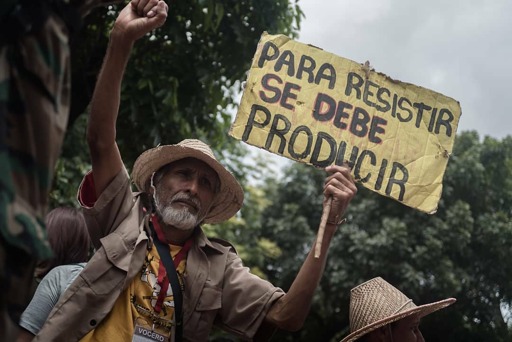
Caracas, September 4, 2026 (venezuelanalysis.com) – Dozens of campesino families in Bolívar State, southeastern Venezuela, are calling for support from the acting Delcy Rodríguez government after their land title was arbitrarily revoked.
“This should not happen. We have worked the land which we fought for and secured legally,” campesino spokeswoman Zurima Carvajal told Venezuelanalysis.
Carvajal belongs to the “Ojo de Agua Las 3 Raíces” campesino council, which brings together 41 families in a 470-hectare land estate with the same name located in the Padre Pedro Chien municipality of Bolívar state.
The rural organization denounced that their collective land title was arbitrarily revoked in 2024 but local authorities did not give any notice for more than two years. In recent weeks, the campesino families have denounced intimidation and attempts at eviction.
“A few days ago there were shots fired against my house,” Carvajal stated. “Local police came and wrote a report, but then nothing happened.”
The campesino leader denounced that a local family who claims to own the land has ties to military officials, National Assembly legislators, and Bolívar State Governor Yulisbeth García. Carvajal added that she has received recurring threats and that a group of men hired to intimidate the campesino council destroyed a fence, causing the families to lose five heads of cattle which ran into nearby fields.
“We urge national authorities, from Acting President Delcy Rodríguez to Agriculture Minister Vladimir Padrino, as well as the Land Institute (INTI), to investigate this case and restore our land deed,” Carvajal concluded. “There has to be a mechanism to protect those who work the land.”
The Ojo de Agua campesino council began its struggle in 2016, reporting to authorities that vast tracts of land were abandoned in the Padre Pedro Chien municipality. Shielded by Venezuela’s Land Law, which protects rural collectives who occupy and produce in idle estates, the campesino families began to settle in the area in 2018.
Carvajal recalled that the organization immediately faced intimidation and violence from would-be landowners who could not produce any property deeds after the INTI opened an investigation. However, they repeatedly destroyed the campesinos’ crops, while bringing legal charges that led to the jailing of several activists.
The Ojo de Agua organization had a decisive breakthrough after joining the 2018 Admirable Campesino March that saw hundreds of rural activists march for hundreds of kilometers to demand that the Nicolás Maduro government address agrarian issues, including landowner violence and the judicial persecution of local organizers.
With support from other campesino organizations, Ojo de Agua received its land title from the Maduro government in 2020. Carvajal affirmed that the land has been permanently productive, with a variety of crops including corn, sugar cane, beans, and vegetables, as well as a small herd of cattle.
Land struggles have recently intensified in rural Venezuela, with a growing number of rural collectives denouncing the arbitrary revocation of titles. Opposition party Vamos Vamos Venezuela, backed by agroindustrial and cattle rancher lobbies, has campaigned for the repeal of the landmark 2001 Land Law, approved by former President Hugo Chávez, in order to turn Venezuela into “a country of property owners.”
Campesino movements have vowed to fight to defend the popular gains in the countryside.
The Venezuelan acting government and parliament have yet to comment on a potential reform to the Land Law. However, the National Assembly preliminarily approved a law to “protect cattle rearing activities,” with legislature President Jorge Rodríguez publicly criticizing the nationalization of large land estates under Chávez.
In parallel with land issues, Venezuelan rural organizations have also denounced that national production is at risk due to unrestrained imports of foodstuffs such as corn, rice, and sugar. Small-scale producers have pointed the finger at agribusiness corporations for resorting to imports during harvest season in order to drive down crop prices.
The US is the second largest source of agricultural imports to Venezuela by volume, totaling $758 million in 2025. Researcher Felipe Pacheco reported that corn imports from the US more than quadrupled in the first five months of 2026, compared to the average of the prior five years.
Edited by Lucas Koerner in Philadelphia, USA.
The post Campesino Collective Demands Justice After Land Title Revoked appeared first on Venezuelanalysis.
From Venezuelanalysis via This RSS Feed.