

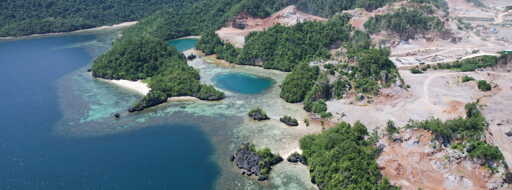
SOUTH KONAWE, Indonesia — A marine protected area in Indonesia’s Southeast Sulawesi province is home to a critically depleted population of humphead wrasse. The species presence helped the area gain its protected status, but mining permits overlap parts of the conservation zone and line its coast. A 2024 government survey, published the following year, found just 22 humphead wrasse (Cheilinus undulatus) across 10 sampling stations — an average density of 1.17 fish per hectare — in the Moramo Bay local marine protected area (LMPA) in Southeast Sulawesi’s South Konawe district. It recorded no fish at three sites where the species was still observed in 2018. Officials and researchers say the bay’s coral reefs face mounting pressure from sedimentation, pollution, vessel activity and other threats, but no study has established a direct link between mining and the wrasse’s decline. “In a polluted area … this fish will definitely disappear,” Sasanti Retno Suharti, a coral reef fish ecology researcher who has been researching humphead wrasse since 2006, told Mongabay Indonesia in August. “It will move far away into deeper waters.” “If it is no longer there, eventually the crown-of-thorns starfish will take over and feed on the corals,” she added. “The ecosystem will be damaged.” The presence of humphead wrasse was one reason Southeast Sulawesi first proposed Moramo Bay as a LMPA in 2011. The proposed area expanded to 21,786 hectares (53,834 acres) in 2016 from 10,371 hectares (25,627 acres) in 2014. In 2021, the Ministry of Marine Affairs and Fisheries designated…This article was originally published on Mongabay
From Conservation news via This RSS Feed.