

This article by Fernanda Monroy originally appeared in the September 3, 2026 edition of Contralínea, one of Mexico’s leading investigative magazines.
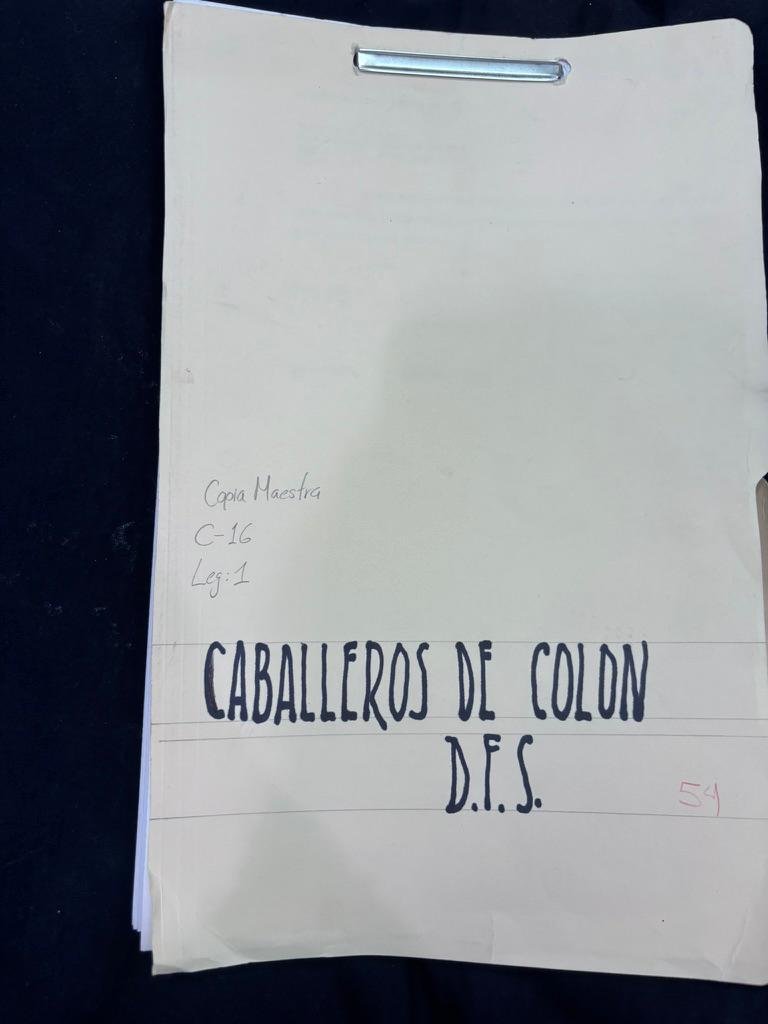
The DFS master file on the Knights of Columbus: box 16, file one. Photo: Contralínea
Part Four. A historic opponent of progressive agendas and of the sexual and reproductive rights of women and the LGBT+ community, the far-right organization Knights of Columbus (Caballeros de Colón) has associated not only with right-wing parties but also with conservative pressure groups, such as the National Catholic Association of Parents and Mexican Catholic Action. Sheltered under the country’s most reactionary Catholic banner, their ideas are linked to anti-communism.
For more than three decades, the Knights of Columbus—an organization founded in the United States in the late 19th century and with an international presence—built in Mexico a network that linked members of the National Action Party (PAN) with businessmen, Catholic hierarchs, and foreign leaders.
The file that the Federal Security Directorate (DFS) compiled on this group—kept among its master copies, in box 16, file one—shows that its members’ activities went beyond charity and religious formation: they took part in electoral campaigns, educational disputes, debates over national history, and dealings tied to bilateral affairs.
One of those connections was recorded in May 1962, when nearly 1,000 members of the Order arrived in Chihuahua to hold their national convention in the auditorium of a Pepsi-Cola bottling plant. A few blocks away, from the PAN’s offices, propaganda was being printed and youth brigades and “lightning rallies” were being organized in favor of Cipriano Rubio Domínguez, the PAN candidate in the July local elections. DFS agents followed both activities and placed young people linked to the Knights of Columbus within the electoral brigades, although their reports did not specify whether an institutional agreement existed between the Order and the party.
The organization then had a reach that extended beyond Mexico’s borders. A March 1961 record described it as a fraternal structure divided into 63 jurisdictions, with approximately 1.2 million members and 4,200 councils around the world. According to the document, its members were selected for their integrity, loyalty to the Church, and willingness to fight “for God, for the Church itself, and for the homeland.”
The files were produced by the political police of an authoritarian PRI regime that surveilled and persecuted students, unions, campesinos, opponents, and religious organizations.
In one of the files, the DFS reconstructed the scope of an organized Catholic right, with national and international resources and connections, that sought to influence politics, education, public morality, and the decisions of the State. Today, the Knights of Columbus state that in Mexico they have 18,250 local councils.
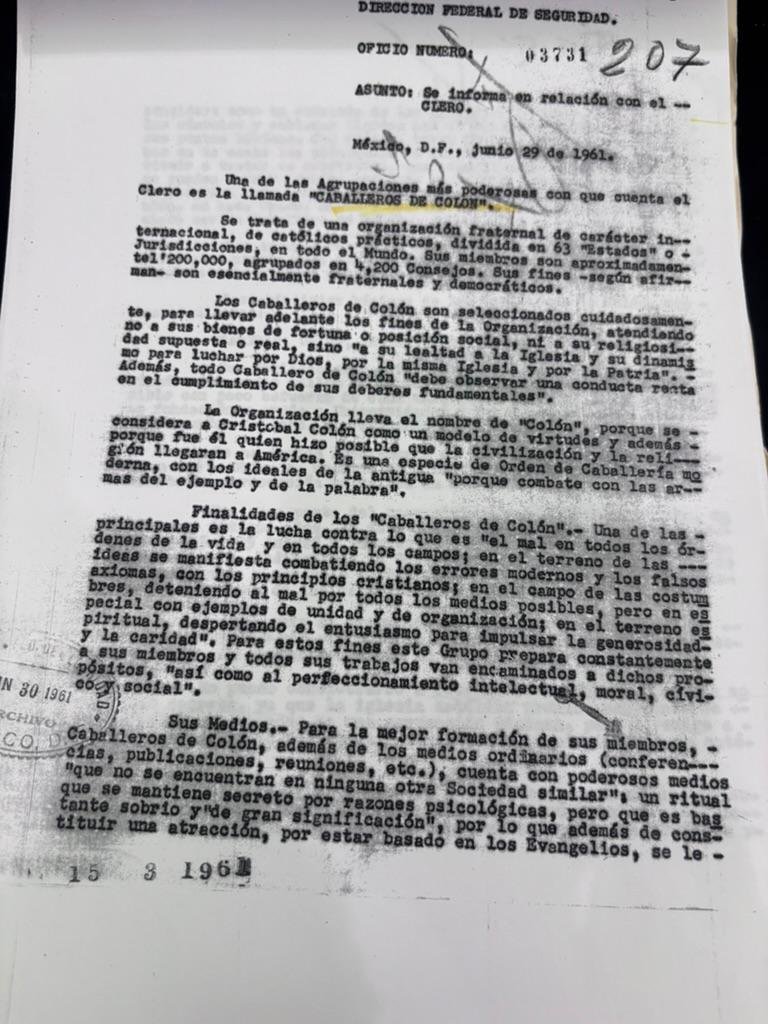
A June 29, 1961 DFS report describing the Knights of Columbus as “one of the most powerful groups the clergy has.” Photo: Contralínea
The Links to Acción Nacional
The files of the defunct “political police” document the presence of leaders and militants of Acción Nacional in spaces shared with the Order and other traditionalist organizations. Those gatherings show that religious militancy and party participation converged around a common agenda: to expand the political influence of Catholicism and to combat some of the foundations of the secular State.
One of those convergences was recorded in September 1971, during a tribute to Agustín de Iturbide held before some 1,100 people at the Cine Teatro Metropólitan in Mexico City. Taking part in the event were members of the Knights of Columbus, the Mexican Traditionalist Movement, the Bernardo Bergöend Group, and militants of Acción Nacional.
Among the speakers was Edmundo Gurza, a member of the traditionalist group and a regional PAN leader in Torreón, Coahuila, who accused “Masonic governments” of altering Mexico’s history to suit their interests.
At the same gathering, the historian Celerino Salmerón denied Vicente Guerrero’s participation in drafting the Plan of Iguala and called for combating what he defined as an “intellectual system of lies established in Mexico.” The vindication of Iturbide over Guerrero, José María Morelos, Valentín Gómez Farías, and Benito Juárez was not merely a dispute about the past; it confronted the liberal tradition that underpinned the separation of Church and State.
The DFS reported attendance at the ceremony in memory of Iturbide at around 600 people, and identified among the leading figures José González Torres, former national president of the PAN and one of the most visible Catholic leaders within the party. Other documents included in the files show that ecclesiastical sectors were calling for people not to support the political forces that defended the provisions of the 1917 Constitution deemed by the Church to be “persecutory.”
Taken together, the documents show a political community in which leaders and militants shared events, adversaries, and objectives. Within that network, the PAN appears as the most visible partisan channel for sectors of the Catholic right that sought to recover influence over education, the interpretation of history, and the decisions of the State.
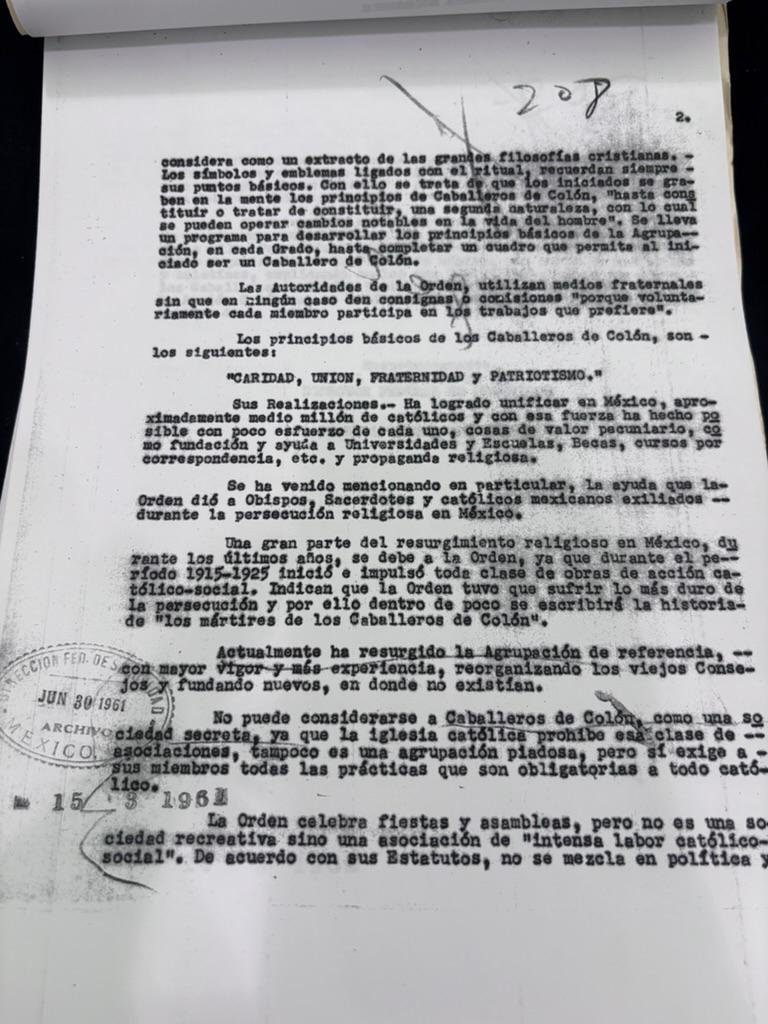
The DFS report details the Order’s aims, methods, and Mexican membership. Photo: Contralínea
A National Network With International Connections
The influence of the Knights of Columbus rested on a territorial structure made up of professionals, businessmen, political leaders, and members of the Catholic hierarchy. According to the DFS reports, the Order grew from around 8,000 members in 1964 to 10,000 in 1966, spread across more than a hundred councils. The directories included in the files identified local representatives—called Grand Knights—in more than 60 towns across the country.
In the leadership, José Cárdenas Stille stood out, identified as supreme director of the Knights of Columbus in Mexico and as the first Mexican to hold one of the 21 posts in the worldwide leadership. In Guadalajara there also appeared Adolfo Rojas, registered as Grand Knight and head of the local organization. These appointments show a structure that linked the regional councils with the national leadership and, in turn, with the international governance of the Order.
The organization gathered resources through individual contributions and directed them to schools, universities, scholarships, literacy campaigns, and aid for priests. It also had access to business, religious, and governmental spaces. At its 1964 Acapulco convention it brought together nearly 2,000 delegates, along with Catholic hierarchs and international leaders; the closing was headed by former president Miguel Alemán Valdés, then head of the National Tourism Council.
The presence of Alemán Valdés shows that the relationship with the PRI regime was not one of permanent confrontation, despite the DFS’s surveillance. The Order also maintained dialogue with foreign representatives. During the 1965 visit to Mexico of John McDevitt—an international leader known as the Supreme Knight—agents recorded the attendance of the ambassadors of the United States, Canada, and the Philippines, as well as the Vatican’s apostolic delegate.
Its membership in a structure headed from the United States broadened that capacity for action. This allowed the Knights of Columbus to mobilize resources and carry Mexican matters into foreign political arenas, as happened during the crisis caused by the salinity of the Colorado River, which damaged agriculture in the Mexicali Valley and generated a bilateral conflict during the 1960s.
The problem worsened from 1961, when the farmers of the Wellton-Mohawk district in Arizona built a system of 94 deep wells to extract brackish water from the subsoil and reclaim their own lands. The drainage liquid was discharged into the Colorado River before it crossed the border at the Morelos Dam. As a result, the salinity of the water used by Mexican farmers rose from around 900 parts per million to levels exceeding 2,700 parts per million.
According to the reports included in the file, the flow deposited more than 5,000 tons of salt daily in the Mexicali Valley and affected an area estimated at 450,000 acres, equivalent to around 182,000 hectares. The loss of productivity left hundreds of farmers without harvests, access to credit, or sufficient means of subsistence.
The conflict also opened a dispute over the interpretation of the 1944 Water Treaty. The United States maintained that the volume allocated to Mexico had to be delivered regardless of its origin, while the Mexican government argued that the water had to be suitable for agricultural and municipal uses. Mexico further questioned whether drainage artificially extracted from wells in Arizona could be counted as part of the natural flow of the Colorado River.
The DFS recorded the fear that left-wing organizations—among them the Independent Campesino Central—would capitalize on the discontent of the ejidatarios and call for protests in front of the United States Consulate.
In response, the Knights of Columbus incorporated the conflict into their agenda after discussing it at the national convention in Acapulco. The representative for Baja California, Marín Vázquez Gudiño, brought the problem to the international assembly held on August 20, 1964, in New Orleans, where the delegates approved the creation of a special commission to travel to Washington and request a meeting with President Lyndon B. Johnson.
The documents attest to the approval of the commission, although they do not confirm whether its members managed to meet with Johnson or what results the effort produced. Even with that caveat, the episode shows how the Mexican representation could activate the Order’s U.S. structure and seek access to the White House to influence a bilateral matter.
The initiative reveals the existence of a channel of influence parallel to official diplomacy, sustained by relationships built on both sides of the border. The power of the Knights of Columbus did not come from a mass membership comparable to the PRI’s labor and campesino federations, but from the combination of private resources, internal discipline, and access to companies, dioceses, parties, diplomats, and foreign authorities.
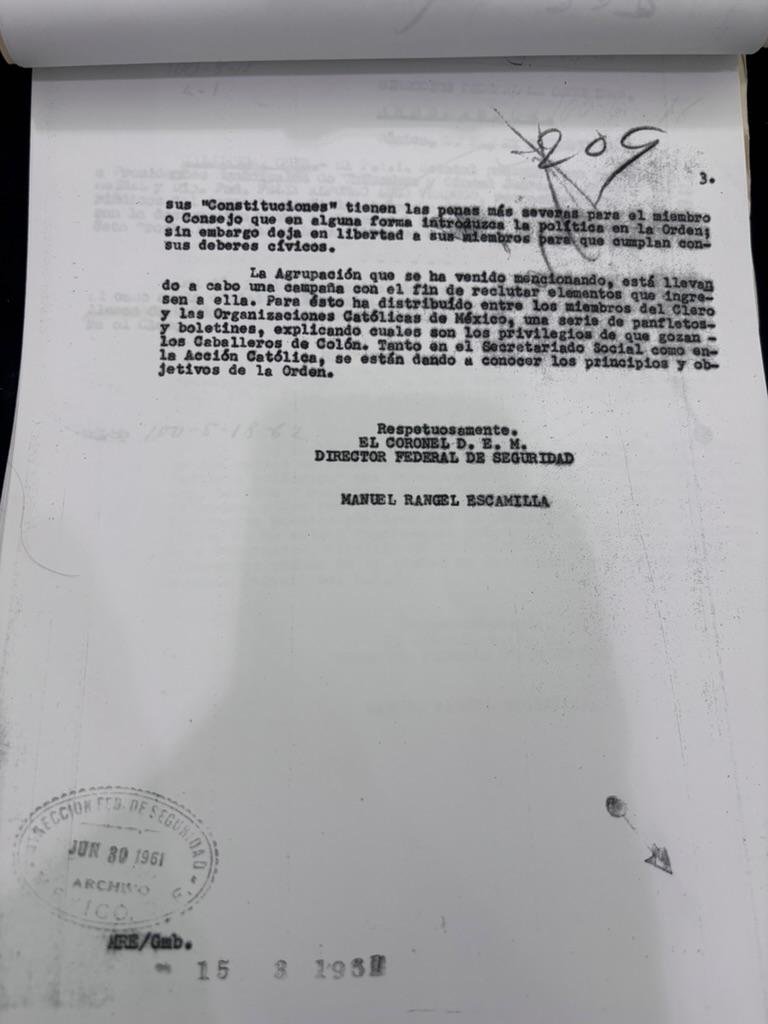
The report, signed by DFS director Colonel Manuel Rangel Escamilla. Photo: Contralínea
The Conservative Agenda That Remains in Force
The structure of the Knights of Columbus also served to promote an agenda that went beyond religious ceremonies and charitable works. Their positions covered education, the interpretation of national history, the content broadcast by the media, and, later, sexual, reproductive, and identity rights.
One of their main areas of dispute was education. The files recorded the rejection by the Order and other ecclesiastical sectors of the secular provisions of Article 3 of the Constitution. That opposition was part of a broader conflict against the liberal tradition that underpinned the separation of Church and State.
During the 1960s, the agenda extended to cinema, radio, and television. The Knights of Columbus took part in campaigns against what they called “pornography” and “immorality,” under the idea that Catholics had to intervene in politics to steer it according to their principles. In the following decades, their spokesmen also came out against the legalization of abortion and artificial birth control.
That agenda retains expressions in the present, since on June 25, 2026, the Edelmiro Traslosheros Assembly 416 of the Knights of Columbus came out against the reform aimed at ensuring that girls, boys, and adolescents can obtain a birth certificate consistent with their self-perceived gender identity. The group asked the Congress of Puebla not to approve the amendment, even though it stemmed from a ruling by the Supreme Court of Justice of the Nation that declared it unconstitutional to absolutely exclude minors from that procedure.
The forms of intervention have changed, but a recognizable ideological core remains: the defense of a traditional conception of the family, religious participation in legislative debates, and opposition to the expansion of rights related to sexuality, reproduction, and identity. The position taken in Puebla shows that this agenda was not confined to the files that the DFS compiled, but continues to move into the legislatures and legal disputes of the present.
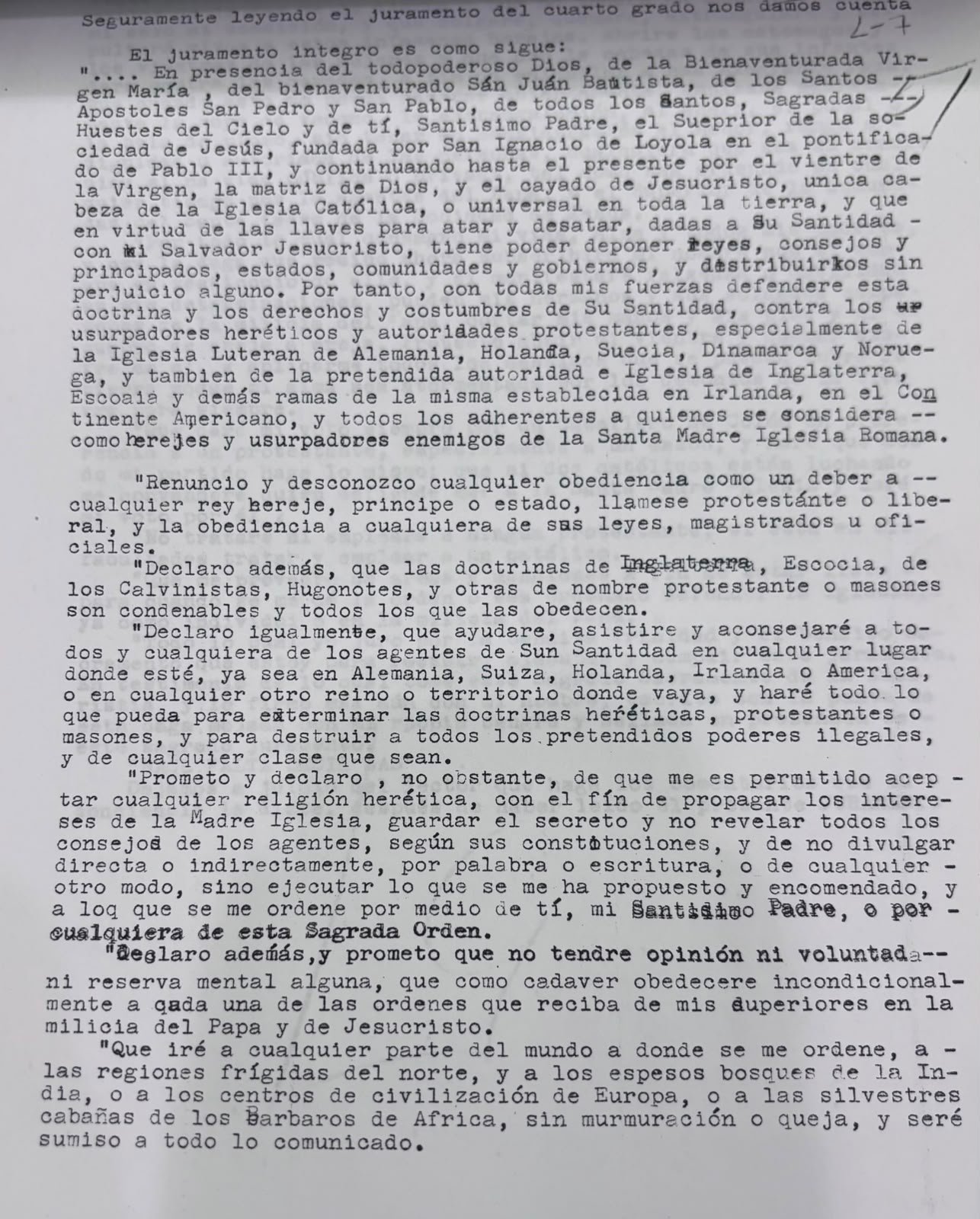
The “Fourth Degree Oath” transcribed in the DFS file. Photo: Contralínea
Surveillance From Power
The files cannot be separated from the institution that produced them. The DFS acted as the political police of an authoritarian PRI regime and, in the case of the Knights of Columbus, its reports reveal assessments produced in the midst of confrontation with an organization connected to PAN members.
That tension appears in a report dated June 29, 1961, signed by the director of the DFS, Manuel Rangel Escamilla. The document described the Knights of Columbus as “one of the most powerful groups the clergy has” and attributed to it the ability to mobilize or “unify” nearly half a million Catholics in Mexico to finance schools, universities, scholarships, and religious propaganda.
The report noted that the Knights of Columbus could not be considered a secret society and that its statutes prohibited introducing politics within the Order, under penalties for those who violated that provision. At the same time, it acknowledged that its members were free to fulfill their “civic duties,” which left open the possibility of combining religious membership with political participation on an individual basis.
The DFS paid special attention to its mechanisms of internal formation. According to the report, the Order held a ritual reserved “for psychological reasons,” whose “sober” and “highly meaningful” character functioned as a means of attraction and cohesion. Formation advanced through different degrees and drew on symbols and emblems to fix the organization’s principles in the initiates until they became, according to the report, a “second nature” capable of producing “notable changes in a man’s life.” At the same time, the document noted that participation was voluntary and that the authorities used fraternal means, without recording mechanisms of coercion.
The file also contains a text presented as the “Fourth Degree Oath,” which attributed to the Order’s members the intention of combating Masons and Protestants, disobeying governments deemed hostile to the Church, and obeying their superiors’ orders without question. At the end, it stated that the initiate had to sign the oath with his name, written with the tip of a dagger “dipped in my own blood.”
The organization itself and U.S. authorities denied that the text was authentic. However, those denials do not fully resolve the doubts about the document either. The same is true of the fact that the DFS preserved and transcribed it: its appearance in their archives does not prove that the oath was pronounced or that the described ceremony actually took place. The file leaves open questions about its origin and provides no testimony from those who would have participated, authenticated internal documents, or other elements that would allow confirmation of what is recounted there.
The political context of the era also requires reading the document with caution. The DFS watched with suspicion an organization linked to sectors of the PAN opposition, so that confrontation may have influenced the way it interpreted their reserved practices. But there are also no grounds to assert that the text was deliberately invented or altered.
What the available documents do show is that the alleged oath was part of the information the political police gathered and used to assess the Knights of Columbus. Even the agent who made the transcription avoided asserting that it was authentic and closed the document with a phrase that passed that judgment on to the reader: “We leave it to the reader’s judgment to make the comments that his conscience dictates.”
The authenticity of the text remains unproven because the file contains no direct testimony, authenticated internal documents, or other elements that would allow one to affirm that the oath was pronounced or that the described rites were practiced by the Order. Nevertheless, the archives do offer evidence of another dimension of the Knights of Columbus: conventions, directories, speeches, participants, and political relationships that make it possible to reconstruct part of their activity in Mexico.
The files on the religious organization attest to an organized Catholic right, articulated through local councils, private resources, international relationships, and the ties of some of its members to the PAN.
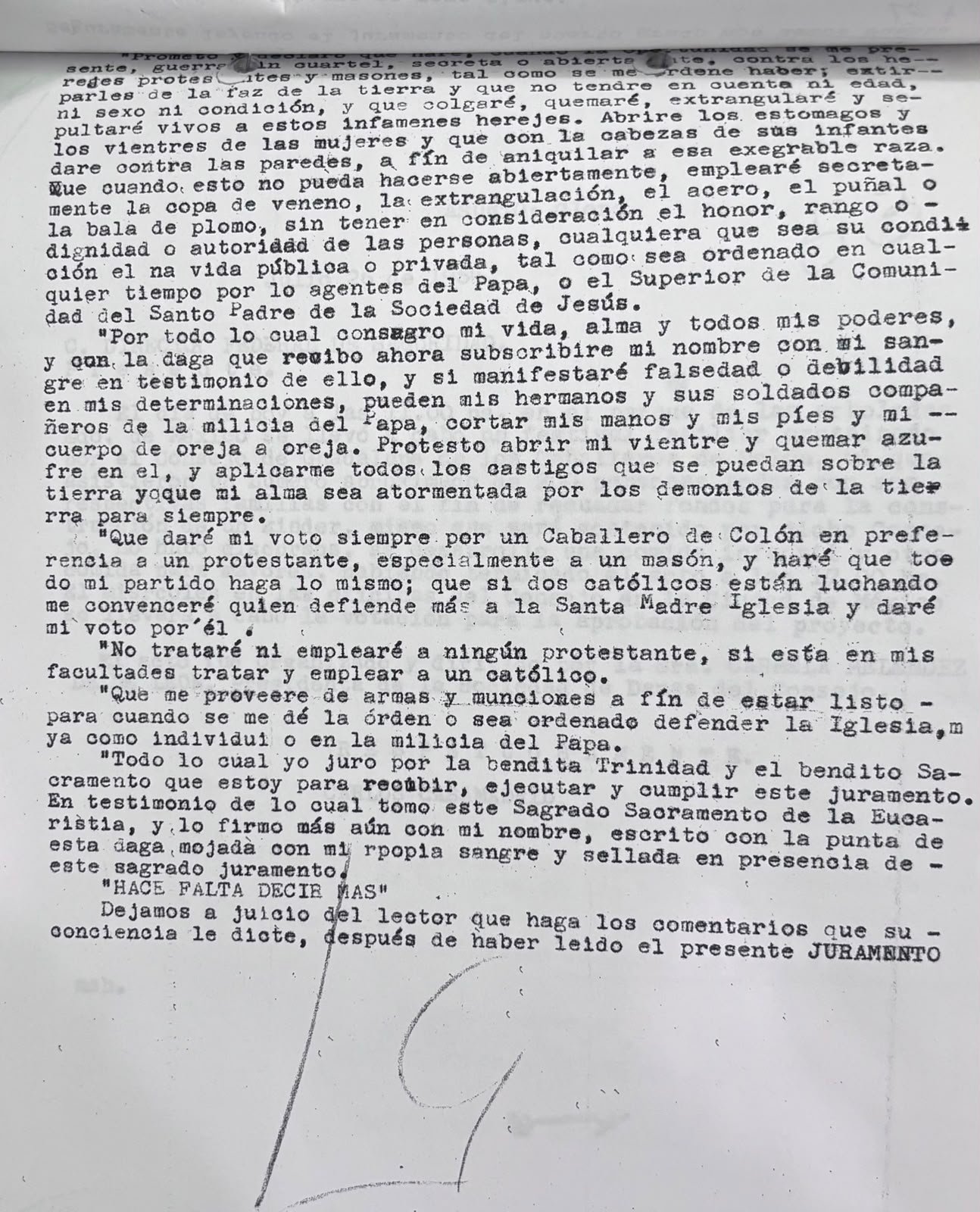
The second page of the “Fourth Degree Oath” preserved by the DFS. Photo: Contralínea
-
DFS Documented Ties Between the Far-Right Knights of Columbus and the PAN
September 4, 2026
Declassified DFS files show how the far-right Knights of Columbus built a network in Mexico linking PAN members with businessmen, Catholic hierarchs, and foreign leaders.
-
People’s Mañanera September 3
September 4, 2026September 4, 2026
President Sheinbaum’s daily press conference, with comments on governability, violence prevention, missing persons, migrant protection, and public approval.
-
Gustavo Petro Talks with Sheinbaum About the “New Political Reality” of the Americas
September 3, 2026September 3, 2026
The former Colombian president met with Sheinbaum at the National Palace and warned of US interference in Latin America’s elections ahead of Mexico’s 2027 and 2030 votes.
The post DFS Documented Ties Between the Far-Right Knights of Columbus and the PAN appeared first on Mexico Solidarity Media.
From Mexico Solidarity Media via This RSS Feed.