

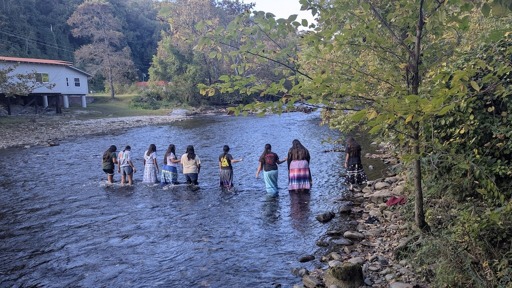
Before the proceedings began, the young women carried Longperson into the room with them, water gathered from the mountain headwaters and held in traditional pottery. The chamber filled beyond capacity, supporters spilling into the lobby. When the vote came, the council passed the resolution unanimously. The crowd and the council rose in standing ovation. On Jan. 8, 2026, the Eastern Band of Cherokee Indians (EBCI) Tribal Council convened in Cherokee, in what is today the U.S. state of North Carolina, to consider a resolution brought forward by the NAIWA Daughters, the youth arm of the North American Indian Women’s Association, made up of a group of Indigenous girls between the ages of 10 and 17. The resolution recognizes the inherent legal rights of the Longperson, or Ganvhidv Asgaya, the interconnected waterway system whose headwaters rise in the Great Smoky Mountains and travel more than 1,270 kilometers (790 miles), branching through multiple states before its “feet,” as the Cherokee describe it, reach the Gulf of Mexico. To the Tribe, Longperson (formerly Long Man) is a living entity of great cultural and spiritual significance. Zailiana Blythe, from NAIWA Daughters, speaks to the Council at the podium. Image from EBCI Tribal Council live-stream recording. “The room was heavy with the presence of Ancestors and community alike,” said Jasmine Smith, NAIWA Daughters chair and co-founder, describing the moment in a keynote speech at the Bioneers Conference in Berkeley, California. She delivered her speech wearing the moccasins of her Ancestor Ruth Littlejohn. “That day crystallized…This article was originally published on Mongabay
From Conservation news via This RSS Feed.