

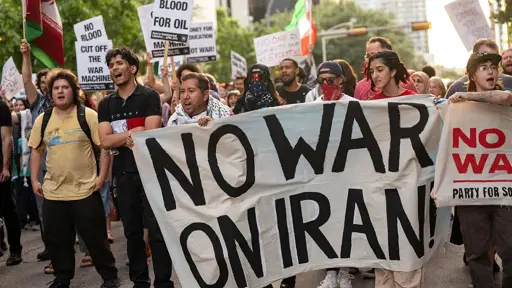
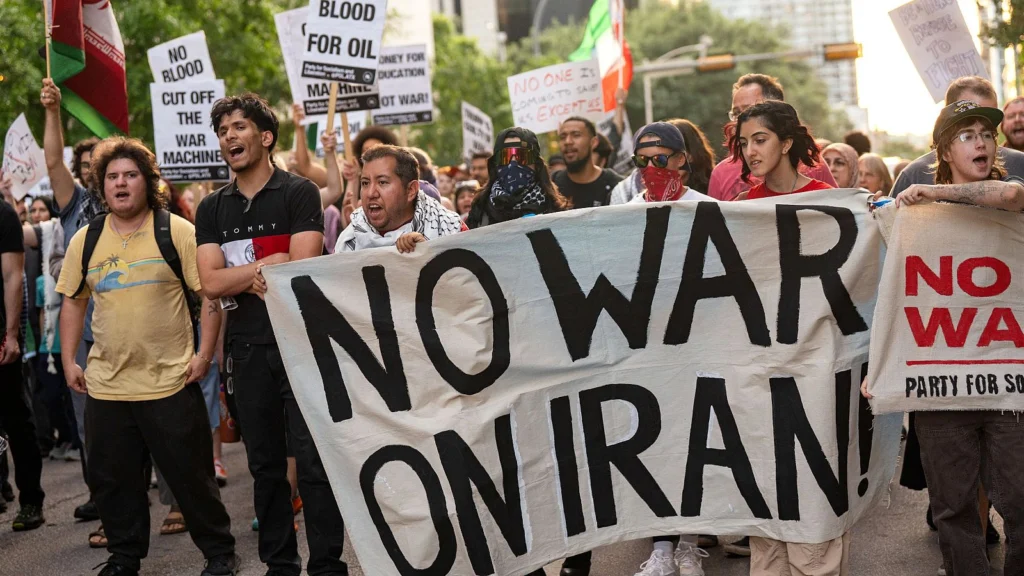
Military engagements intensify across the Middle East as diplomatic channels remain completely stalled.
The U.S.-Israeli war on Iran has fundamentally altered the political landscape of West Asia. What began as an intensification of long-standing regional hostilities has escalated into direct military engagements across multiple fronts.
RELATED:
Strait of Hormuz To Remain Closed Until U.S. Fulfills Commitments: Iran
Over the past months, joint U.S. and Israeli military operations have targeted Iranian strategic infrastructure, command networks, and nuclear facilities.
Concurrently, Iranian armed forces and affiliated regional networks have conducted sustained retaliatory strikes using ballistics, long-range drones, and anti-ship missile systems.
Statistical assessments indicate that the scale of the confrontation has surpassed previous regional conflicts in the twenty-first century. According to tracking data, strategic installations in major urban centers, as well as critical logistical networks in the Persian Gulf, have sustained measurable physical damage.
The overarching rationale presented by U.S. and Israeli centers is to prevent Iran from achieving strategic nuclear parity and to neutralize its regional defensive capabilities. Conversely, Iranian officials frame their actions as a defensive response against violations of state sovereignty and international law.
The Status of the Strait of Hormuz and Maritime Security
The Strait of Hormuz, a maritime corridor measuring approximately 21 miles wide at its narrowest point, remains the primary operational focal point of the military conflict.
Historically handling approximately 20 percent of global petroleum consumption and over 30 percent of the world’s seaborne liquefied natural gas (LNG), the waterway is now subject to severe operational constraints.
Over the past months, commercial transit volume through the strait has dropped by an estimated 70 percent compared to pre-conflict baselines.
Iran’s Islamic Revolutionary Guard Corps (IRGC) Navy has implemented a strict regime of maritime inspection and selective blockades targeting vessels associated with Western powers and their regional allies.
Using coastal anti-ship missile batteries, naval mines, and fast-attack craft based along the Iranian coastline, Tehran has restricted access to commercial shipping lanes.
In response, a coalition led by the U.S. Navy has deployed naval assets to secure commercial transit through international waters, leading to frequent tactical encounters and damage to several commercial tankers.
The disruption of this key shipping channel has altered international maritime routing. Insurance premiums for vessels entering the Persian Gulf have increased by more than 400 percent since the onset of hostilities, forcing many international shipping lines to redirect cargo around the Cape of Good Hope, adding more time between Asia and Europe, compounding supply chain delays and driving up operational costs across global shipping networks.
‘HORMUZ WILL NOT REOPEN’ — ‘no matter how much US STRUGGLES’
Iran security source TELLS RT: maritime traffic through strait presently BELOW 3%
IRAN’S POLICY: If our oil CANNOT BE EXPORTED, oil of any US partner/accomplice will NOT be exported either pic.twitter.com/pDV3Ysjpbk
— RT (@RT_com) September 1, 2026
Diplomatic Efforts and Broken Agreements
Over the past four months, several diplomatic initiatives aimed at de-escalating the military conflict have collapsed due to conflicting strategic demands.
Third-party mediators, including Qatar, Oman, and Switzerland, facilitated initial discussions to establish humanitarian corridors and temporary maritime truces.
Early diplomatic channels, in April 2026, produced temporary draft proposals focused on halting strikes against oil refining facilities and commercial maritime traffic in exchange for a U.S. economic sanctions reduction.
However, these preliminary understandings broke down when military operations resumed along border regions and naval trade routes.
On June 17, a 14-point memorandum of understanding was signed at the distance. The agreement stipulated an immediate ceasefire, the reopening of the Strait of Hormuz, and 60 days for discussing the nuclear program.
This memorandum did not last, as one of its first points was the suspension of military operations on all fronts, including Lebanon. Two days after the signing, the Israeli army continued attacking positions in Lebanon, triggering a chain of retaliatory strikes.
The failure to secure verifiable commitments from both sides resulted in the suspension of formal talks, leaving backchannel communications as the sole remaining avenue for crisis management.
Recent diplomatic efforts led by Pakistan have stalled, as both sides maintain non-negotiable prerequisites for entering formal ceasefire negotiations.
The United Nations Security Council has held multiple emergency sessions on the crisis, but persistent ideological and strategic divisions among member states have prevented the adoption of binding resolutions demanding an immediate cessation of hostilities.
Latest Positions of the United States, Israel, and Iran
The strategic posture of the United States centers on degrading Iran’s long-range ballistic missile stockpiles, naval capabilities, and nuclear infrastructure.
U.S. policymakers maintain that military pressure, combined with stringent maritime and financial enforcement, is necessary to restrict Tehran’s power projection across West Asia.
Trump’s administration has reinforced its regional troop presence, deploying tactical aircraft squadrons and naval strike groups to airbases in Gulf partner nations to ensure deterrence and protect allied military installations.
Israel maintains a zero-tolerance posture regarding Iranian military deployments along its northern borders and the expansion of Iran’s strategic capabilities.
Israeli political and defense leadership continues to execute targeted aerial campaigns against weapon assembly plants, underground command bunkers, and regional allied forces.
The government in Tel Aviv emphasizes that long-term security requires the complete dismantling of regional non-state military infrastructure and the permanent prevention of nuclear weapons development in Iran.
On the other hand, Iran’s official position emphasizes national defense, asymmetric deterrence, and the total withdrawal of foreign military forces from the Persian Gulf region.
Iranian state leadership maintains that its missile programs and defensive strategy remain non-negotiable components of its national security architecture.
Tehran continues to condition any halt in military operations on the immediate cessation of Western air strikes, the lifting of economic blockades, and formal legal guarantees recognizing its sovereignty over territorial waters and airspace.
President Trump says the US is ready to strike Iran again as Tehran retaliates against US attacks.
Analyst Ross Harrison says Washington has inflicted significant damage, but its strikes have failed to achieve its broader political objectives. pic.twitter.com/S9MxWtpePL
— Al Jazeera English (@AJEnglish) September 2, 2026
Perspectives and Stances of Neighboring Countries
Neighboring countries across West Asia and the Gulf Cooperation Council (GCC) face significant economic and security pressures due to their proximity to active combat zones.
Member states including Saudi Arabia, the United Arab Emirates, Qatar, and Kuwait have officially declared neutrality in the armed conflict.
These nations have restricted Western military forces from using their sovereign airspace or domestic airbases to launch offensive operations against Iranian targets, fearing direct retaliatory strikes on their critical infrastructure.
Despite these neutral declarations, border disruptions and intercepted strikes have damaged energy generation and water desalination facilities across several Gulf states.
Officials in Oman and Qatar continue to advocate for immediate de-escalation, pointing to the vulnerabilities of shared natural gas fields and regional desalination networks that provide essential public utilities.
Conversely, governments bordering the eastern Mediterranean, such as Jordan, face internal domestic opposition while balancing security commitments with regional stability requirements.
Countries bordering Iran to the north and east, including Iraq, Pakistan, and Turkey, have experienced secondary economic shocks, border closures, and increased refugee flows.
Iraq has called for regional security summits, emphasizing that spillover effects threaten its domestic energy sector and national sovereignty.
Broader regional consensus among neighboring states reflects a shared concern that extended military operations will permanently destabilize regional trade networks and endanger long-term economic development initiatives.
Global Economic Fallout
The ongoing conflict has generated systemic disruptions across the global political economy, primarily affecting international energy, shipping, and agriculture markets.
Crude oil benchmark prices have experienced sharp volatility, with Brent crude rising significantly above baseline projections due to supply constraints in the Persian Gulf.
Reduced export capacity from key producing nations has forced industrial economies to rely on emergency petroleum reserves and secondary suppliers, driving up domestic fuel and utility costs worldwide.
Extended container shipping durations have created severe delays in the transport of consumer goods, industrial machinery, and raw materials between Asia, Europe, and the Americas. Additionally, the Persian Gulf region serves as a major exporter of urea and nitrogen-based fertilizers; reduced production outputs have triggered cost increases in agricultural sectors globally, threatening global food security and inflating baseline food prices.
In conclusion, seven months of direct military conflict between the U.S.-Israeli axis and Iran have failed to yield a decisive political or military resolution. Instead, the confrontation has destabilized critical maritime routes, halted diplomatic engagement, and imposed severe macroeconomic burdens on both developing and developed economies.
As neighboring nations attempt to manage domestic stability and global markets adjust to long-term supply chain disruptions, the crisis underscores the broader economic and strategic risks associated with military escalation in West Asia.
Sources: teleSUR – Al Jazeera – Al Mayadeen – TASS – TRT World – Anadolu Agency – Xinhua – CGTN – Press TV – BBC – CNN – El Orden Mundial – RT
From teleSUR English via This RSS Feed.