

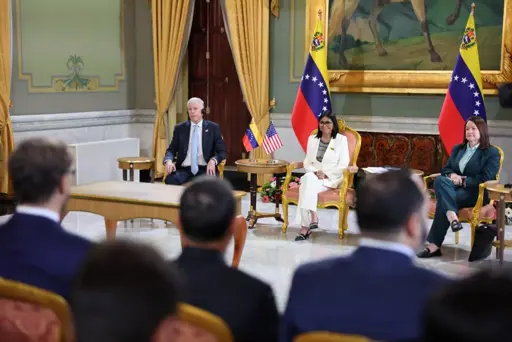
Acting President of Venezuela Delcy Rodríguez has led the signing of agreements with the US empire’s secretary of energy, Chris Wright, to promote joint hydrocarbon production projects between companies from several countries and the Venezuelan publicly owned oil company Petróleos de Venezuela (PDVSA), as well as to finalize details around the energy agreement reached by both governments on August 29.
Among the companies that signed the energy agreements this Wednesday, September 2, were the Italian ENI and the US empire-based Chevron, as well as Asper Energy, General Electric, and Primavera Infinita.
Speaking during the ceremony, Rodríguez claimed that the production boost will translate into more jobs, higher wages, public services, hospitals, food, and the wellbeing of a country that as a whole seeks prosperity and a better future. “That is the horizon Venezuela aspires to: its development,” she said.
She remarked the importance the contracts signed will have in the life of every Venezuelan, while expressing her certainty that regions where the investments will be made can be activated in a short time.
Rodríguez reiterated her invitation to Venezuelan youth to return to their homeland and contribute to the national spiritual and material rebirth of Venezuela, to the achievement of a country united in peace, reconciliation, and prosperity.
The agreements signed during the ceremony also include the recovery and modernization of the electrical sector. That latter project, signed between state utility company CORPOELEC and US empire-based General Electric, will increase electricity production and distribution, Rodríguez claimed, to foster new capacities and ensure that the production increase in oil and gas does not overload the power system.
She highlighted that both Chevron and ENI have remained in Venezuela even in the most difficult moments and that Venezuela is not starting from scratch, because in recent months it has modified its legal framework to ensure the protection of future investments.
During her announcement, the acting president shared her hope that the signed agreements will contribute to the global energy balance, stating that this is a historic agreement.
“I vindicate more each day the political and diplomatic channel to relate with the US,” Delcy Rodríguez said, who advocated for a win-win formula that benefits everyone. She insisted that it is the only mechanism to relate and reap mutual benefits.
Prior to the signing of these agreements, the acting president held a separate ceremony for the signing of agreements with executives from ENI and Chevron.
Restoring electrical grid will generate more than a thousand jobs
Executives from several international companies reported positive impacts that the agreements will generate. The director of General Electric Vernova, Roger Martella, claimed that the cooperation agreements signed with Venezuela will create more than a thousand jobs for local labor.
“A large part of this agreement is that from day one we move to hard work,” Martella said. “We require more than one thousand people to restore the electrical grid and for that Venezuela will provide the workforce.” He added that his company has sent resources to support more than 40,000 people affected by the June 24 earthquake.
Chevron to invest over $7 billion
The chairman of the board and chief executive officer of multinational Chevron, Michael K Wirth, reported that the company foresees an investment in excess of seven billion dollars, with the objective of doubling its Venezuela’s operational capacity and reaching production of 500,000 barrels per day of oil within the next five years.
Wirth acknowledged the efforts of Delcy Rodríguez and the Venezuelan government for establishing conditions that favor industrial stability, as well as the country’s workforce. He highlighted that their professionalism and resilience have been key to concluding this energy agreement.
“The world needs more reliable and affordable energy. Venezuela, with its extraordinary resources and its very talented people, helps us achieve that objective,” Wirth said, explaining that Chevron has maintained a sustained presence in the country despite illegal US sanctions.
ENI: ‘We have enormous confidence in Venezuela’
ENI Chief Executive Claudio Descalzi celebrated the signing of the participation contract in five additional projects, which cover assets of large strategic magnitude. These include the Perla Gas Field, possessing potential in excess of 25 TCF (trillion cubic feet) of gas, as well as the Corocoro Field, which has an estimated recovery factor of three to six TCF of resources. Both areas will allow consolidation of long-term operational development schemes to energize the nation’s energy infrastructure.
He said that signing the agreement implies enormous responsibility, because investment and production are necessary, but that the company will be able to do so because it has “enormous confidence in Venezuela.”
He confirmed that they agreed to present the formal development schedule in October, with the goal of starting the first operational phase in December. The plan is designed to reach the goal of adding one million barrels per day to current oil production, thereby doubling it.
Aspect Holdings highlights quality of Venezuelan technical sector
The founder and chairman of Aspect Holdings, Alex Cranberg, said that the agreement signed with PDVSA will allow studying new exploratory areas and discovering resources in the Orinoco Belt, the Gulf of Venezuela, and other territories. He also highlighted the quality of Venezuelan technical sector, naming the vast technical knowledge and education rooted in developing the sovereignty of the nation as so-called “human capital.”
“We have excellent top-level technicians and we have learned a great deal from them,” he said. “We bring a lot of knowledge and capital.” He added that the company seeks to stay in the country for a long time and work on environmental care and communities.
Cranberg further expressed his solidarity with the Venezuelan people for the tragedy of the earthquakes. “We are open to being part of the solution to this pain, and we can provide medical aid,” Cranberg said, claiming that “this agreement is work with you and for you.”
Primavera: develop workers under a sustainable, safe model
The representative of the company Primavera, Manuel Iribarren, emphasized that the company wishes to contribute to Venezuela’s energy development by generating “clean, reliable, and low-cost energy,” under a sustainable and safe model that benefits communities, workers, and the country as a whole.
He claimed that the corporation’s agenda responds to three guidelines given by Acting President Rodríguez: “take advantage of the Venezuelan people’s knowledge to develop the workers, promote the return of Venezuelans who are abroad, and bring the best technology to the oil sector.” He highlighted that this moment is crucial for Venezuela, and thus is the opportunity to take these steps.
PDVSA: Venezuela offers legal certainty to attract investment
PDVSA President Héctor Obregón reported that production from mixed companies with Chevron will increase from 250,000 to 420,000 barrels per day in the first stage of these energy agreements.
In the second phase, it is estimated to surpass 700,000 barrels per day with Chevron’s mixed companies. In addition to this is the agreement with ENI to develop the Junín 5 field, which Obregón claimed foresees an initial increase of 200,000 barrels per day. He explained that other contracts in the western basin and the Orinoco Petroleum Belt would further contribute increases near or above 70,000 barrels per day.
Obregón stated that this growth is possible after several structural changes, such as the partial reform of the Hydrocarbons Law, the enactment of its regulations, and the adjustment of the Participation Productive Contracts (Contratos de Participación Productiva, CPPH) to international standards.
(Telesur) with Orinoco Tribune content
Translation: Orinoco Tribune
OT/JRE/AU
From Orinoco Tribune via This RSS Feed.