

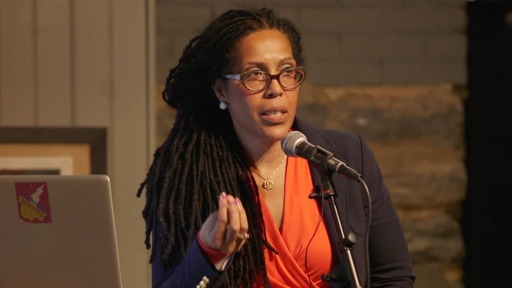
When I learned that Dr. Johanna Fernández had passed away, I remembered the first piece of advice she ever gave me, when I was younger and more confused about what to do with my incipient academic career. “I want you to always go where you feel loved,” she told me, adding that I should call her if I ever needed help figuring out where that might be.
At the time, about two and a half years ago, she was in remission from a cancer that she did not let slow her down.
A few weeks later, she stood with students at the Gaza Solidarity encampments at Columbia, The City University of New York (CUNY), the New School, and New York University. Even in painful convalescence, she brought her microphone and revolutionary energy, sharing the histories of the Young Lords, the Black Panthers, and other radical movements whose records and memories she spent her life preserving.
At each encampment, Dr. Fernández patched former Black Panther and political prisoner Mumia Abu-Jamal through to her phone from Mahanoy Correctional Institution to speak with student protesters. I remember receiving her call while dug in at the NYU encampment on Mercer Street. Together, she and Mumia moved us to tears in the shadow of the raids and mass arrests of students at Columbia and CUNY in the nights before.
While I was briefly in jail, after getting arrested along other student protestors, I thought of her words: always go where you feel loved. I chose to study at the CUNY Graduate Center so I could glue myself to her hip and, one day, commit myself to the kind of radical public scholarship she championed.
Reading the tributes to her now, I think of how many others must have dialed her number seeking the same guidance: young historians, fellow revolutionaries, community leaders, scholars, and figures like Mumia Abu-Jamal, whose archive she painstakingly helped preserve.
So much history passed through her home, in the company of her cats (Cutie and Patootie) and beneath portraits of Karl Marx, Assata Shakur, and Angela Davis.
Dr. Fernández believed that everyday working people should see themselves in history as its products and its makers and, most importantly, as the only ones capable of creating a kinder and more compassionate world — a world based on social equality and human solidarity. Among her most important convictions was that preserving and remembering are themselves deeply political acts.
Her acclaimed book, The Young Lords: A Radical History, drew on roughly one hundred oral histories of Young Lords veterans and records recovered through years of Freedom of Information Act (FOIA) battles with the New York Police Department (NYPD). It advanced the history of the civil rights era while helping to expose the machinery of police surveillance and political repression used to sabotage civil rights groups — radical and mainstream.
Her 2014 FOIA lawsuit against the NYPD helped reveal an extraordinary repository of surveillance records documenting the spying and harassment of antiwar protesters, student activists, and civil rights organizations — reminiscent of the McCarthyite witch hunt that Trump/Rubio have recently unleashed. It unearthed evidence on the involvement of the NYPD in the assassination of Malcolm X — the outstanding revolutionary leader of the Black liberation movement in the United States.
One of the last projects she worked on was the Latinx Freedom Movement Archive and Exhibition Project, a national public-history initiative presenting and preserving civil rights activism among Latinos and Latinas. Last April, she and Dr. Felipe Hinojosa, professor of history at Baylor University, brought veterans of the Young Lords, Chicano movement, Brown Berets, Puerto Rican independence, and other organizations to the CUNY Graduate Center, in a conference collecting their oral histories and personal archives for future generations.
“Most Americans — even many historians — do not know the historical origins of Latinos in the United States or the depth of their contributions to the unfinished project of American democracy,” Johanna said in an announcement of the conference. “From the 1848 annexation of Mexican territory to the 1898 U.S. colonization of Puerto Rico — from student walkouts and labor organizing to bilingual education victories — Latino communities have long fought to expand democratic rights and the meaning of freedom for all.”
The conference marked the launching of the Latinx Freedom Movement project.
The New York exhibition — soon to be joined by others in Chicago, Los Angeles, Washington D.C., and Houston — is on display through August 20 at The Shed in Hudson Yards as a fitting tribute to her conviction that scholarship should serve the public and should always be in conversation with the battles of the working class and its allies in our time.
Dr. Johanna Fernández helped illuminate a road to liberation that is already well trodden. May we follow the path she gave her life to help us find. And may we always go where we feel loved.
The post A Tribute to Radical Historian Dr. Johanna Fernández appeared first on Left Voice.
From Left Voice via This RSS Feed.