

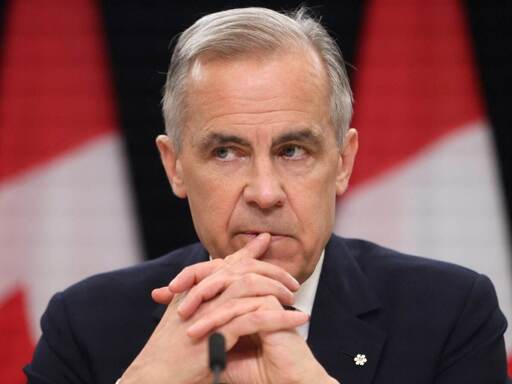

As part of an ongoing campaign to unmask the real-world risks behind Canadian prime minister Mark Carney’s upcoming Canada Investment Summit, The Many vs. The Money Coalition releases its latest dossier exposing the government’s push to transform Canada into a global hub for war financing and weapons manufacturing.
Canada’s war bank
In glossy investor decks, Carney is pitching Canada as a secure, fast-tracked harbour for defence investment, anchored by a yet-to-be-realised plan to house the headquarters of the new $116bn Defence, Security, and Resilience Bank (DSRB) in Toronto.
But while Ottawa promises global financiers smooth sailing, organised communities across the country are blocking factory gates, confronting corporate executives, and building a direct-action “People’s Arms Embargo” to disrupt the weapons supply chain on the ground.
Behind Carney’s pitch of “sovereignty and rearmament,” global capital faces rising reputational liabilities, regulatory minefields, and nationwide resistance:
Severe public backlash and moral hazard
Carney is courting international institutions to fund the DSRB, a NATO-linked bank designed to bypass parliamentary oversight and use public money to de-risk private weapons investments.
As Canadians face soaring grocery prices, housing unaffordability, and crippling healthcare cuts, Ottawa’s plan to pledge billions to a war bank while asking everyday families to stomach austerity is triggering intense, widespread public outrage with over a hundred civil society organisations signing an open letter opposing the plan.
Taxpayers refuse to shoulder the financial risks for private arms dealers making record profits.
Carney’s war bank flops on the international stage
Not only is domestic opposition growing, but Reuters just reported that no major economies, aside from Canada, have committed to participate in the institution. And this is just weeks ahead of the deadline.
Carney has stuck his neck out for a risky new financial body that none of his often cited “middle power” allies seem interested in joining.
Direct action and supply chain vulnerabilities
As shown by coast-to-coast mobilisations targeting over 40 facilities connected to weapons giants like Elbit Systems and Raytheon ELCAN, Canadian communities are actively enforcing a “People’s Arms Embargo”.
From factory blockades to corporate inbox shutdowns, the network sustaining weapons manufacturing in Canada is facing increasing disruption.
Corporate deception and export liabilities
Despite federal claims of “pauses” on arms exports to Israel, investigative findings reveal a continuous pipeline of Canadian military goods, including F-35 components, explosives, and ammunition, shipped directly to active conflict zones, often surreptitiously routed on commercial passenger flights.
Capital entering Canadian defense firms faces mounting legal exposure, UN Genocide Convention scrutiny, and intense public exposure.
Trade-war entrapment and US supply chain risk
Pitching defence expansion as an act of economic self-defence against the ongoing US trade war is a dangerous fiction. Canada’s military industry is overwhelmingly integrated into US prime contractors.
With escalating 50% tariffs and chaotic cross-border trade friction, investing in Canadian defence manufacturing doesn’t build sovereignty. It traps global capital in a volatile, US-dominated supply chain subject to sudden Washington trade retaliation.
Rachel Small, Canadian lead for World Beyond War, said:
Mark Carney is trying to sell global investors on the fantasy of a war economy, but Canada is not a blank check for arms dealers.
While families across this country struggle to pay rent and put food on the table amid the economic turmoil fuelled by Trump, Carney is talking about ‘elbows up’ and then awarding billions of dollars in military contracts to American arms manufacturers.
And with his investor summit he is spending lavishly to bring hundreds of the richest CEOs on the planet to Toronto to parade a $116bn war bank designed to fund and accelerate a global arms race and funnel public money directly to arms manufacturers.
Leveraging a trade war crisis to double down on a war economy isn’t defence, it’s a recipe for stranded capital and fierce community resistance.
As shown throughout this campaign, Carney can sell the opportunity, but he cannot sell the outcome. Capital invested in Canadian weapons expansion is not entering a safe haven. It is entering an active landscape of direct action, trade instability, and organised community opposition.
Featured image via the Canary
By The Canary
From Canary via This RSS Feed.