

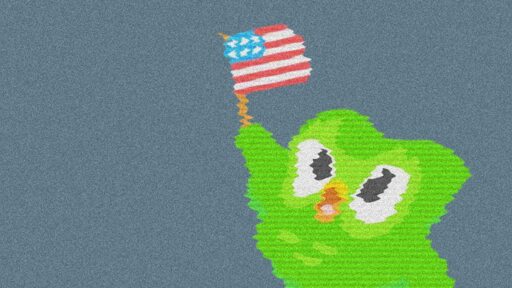
Duolingo’s green owl has become one of the most recognizable corporate mascots on the planet. It sends reminders, guilt-trips users over their streaks, and sells itself as a cheerful gateway to language learning across borders.
But for Iranians, the owl now speaks the language of U.S. imperialism.
As of September 1, Duolingo’s English Test is unavailable not only inside Iran but reportedly to people using Iranian identity documents anywhere in the world. Iranian students seeking admission, scholarships, visas, or a path into international education are being made to pay for Washington’s sanctions regime. Duolingo’s corporate restriction follows the suspension of a U.S. Treasury authorization that had allowed certain educational services in Iran.
This is not a technical inconvenience. It is another mechanism of imperialist pressure whose costs are imposed on Iranian students, workers, and poor people — not on the officials Washington claims to target.
An Owl of Empire
The Duolingo English Test is accepted by thousands of universities internationally. For students preparing applications, it can be a requirement for a degree, scholarship, visa, or job. The company’s restriction is reportedly not confined to people physically in Iran; it also applies to users with Iranian identity documents abroad.
The consequences are immediate. A student who has prepared for months can lose an application cycle. A family that has saved for testing fees may be asked to finance travel to another country for a different exam. A young person looking for a route into higher education finds one more border placed in front of them.
Washington calls sanctions “targeted.” But the target is never only a government.
The Iranian officials and capitalists that U.S. politicians claim to be punishing have resources, foreign currency, and connections. Workers, students, migrants, and poor families do not. They are the ones who encounter the sanction as a higher price, a refused bank transfer, a blocked service, or a cancelled examination.
That is the class content of sanctions. Economic warfare shifts the cost of an imperialist conflict onto those with the least ability to avoid it. The imperialist owl does not merely remind users to practice French or Spanish. It reminds us that U.S. sanctions reach into every corner of everyday life.
Sanctions Are War by Other Means
Sanctions are routinely sold as an alternative to military action. But with U.S. bombs once again falling on Iran, it is clear that sanctions are not an alternative to war — they are one of its forms. The Trump administration’s “Operation Economic Outcast” seeks to expand secondary sanctions across aviation, shipping, technology, gold, and digital assets, while restricting Iran’s economic ties with neighboring countries. Alongside military attacks, it aims to deepen Iran’s isolation and impose enough suffering on ordinary people to force political concessions.
That social cost is borne by people who have no say in Washington’s policy and no control over the decisions of the Iranian state. Annual inflation has reached 66 percent, while food prices have risen 128 percent in a year; cooking oil has surged 383 percent and eggs 294 percent. The consequences are borne by the student unable to take a test, the worker facing falling real wages, the family struggling to receive money or medicine from abroad, and the young person whose future is narrowed by a policy designed in the offices of the U.S. bipartisan regime.
There is nothing peaceful about strangling an economy. There is nothing democratic about treating a nationality as a reason to deny someone education. And there is nothing progressive about an anti-war politics that condemns bombs while accepting the slow violence of sanctions.
The U.S. working class has no interest in financing this policy. Money that could fund schools, housing, healthcare, and public transit is poured into military escalation and the infrastructure of empire. Meanwhile, workers in Iran are made to pay for a confrontation between states and ruling classes.
The same political forces that say Iranian students cannot take a language test will tomorrow insist that airstrikes, naval deployments, and military threats are unfortunate but necessary. Even as the form changes, the imperialist logic does not.
Break the Streak, Oppose the Sanctions
The Duolingo restriction offers an opening. It makes visible what sanctions are designed to conceal: their victims are not abstractions. They are people trying to learn, study, migrate, communicate, and build a future.
The task is to turn outrage into organization. We should denounce Duolingo’s exclusion of Iranian users by abandoning our streaks and making our boycott visible. Student organizations should demand that universities reject sanctions-driven barriers and guarantee alternatives for Iranian applicants. Academic unions should oppose the exclusion of Iranian youth from education. Iranian students and diaspora communities should connect with with antiwar, labor, and student organizations capable of turning outrage into pressure.
And most decisively, workers’ organizations and the latent antiwar movement against the most unpopular war in U.S. history must demand an end to sanctions and all U.S. intervention against Iran.
A Duolingo boycott alone will not end the sanctions regime. But it can expose the contradiction at the heart of the imperialist story: the powers claiming to defend freedom are narrowing the freedom of Iranian students to study, travel, and decide their own future. We should not let the issue disappear because the sanction arrives through a cute app interface.
Duolingo should restore access for Iranian learners immediately. No sanctions, no military threats, no U.S. war on Iran. For the international solidarity of workers and youth against imperialism!
The post The Imperialist Owl: Duolingo is Sanctioning Iranians appeared first on Left Voice.
From Left Voice via This RSS Feed.