

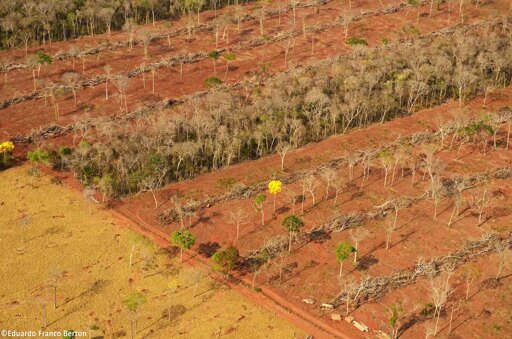
On July 31, politicians and agribusiness leaders from Bolivia and Brazil gathered in the eastern Bolivian city of San Ignacio de Velasco. There, Bolivian President Rodrigo Paz signed an agreement to begin technical studies for a highway connecting San Ignacio de Velasco to Marfil, a point on the border with Brazil. A second section of the road will extend into Brazil toward the municipality of Vila Bela da Santíssima Trindade. Experts told Mongabay the project will cause severe environmental damage, driving deforestation and land-use change to make way for soy fields and cattle ranches on the Bolivian side. San Ignacio de Velasco lies in the heart of the Bolivian Chiquitania, a region of vast tropical dry forests. The municipality has 67,103 inhabitants, according to the 2024 census. On July 31, its small airfield briefly became an international airport as some 15 private planes landed there. Except for the Bolivian presidential plane, every aircraft belonged to Brazilian businesspeople and politicians. Among them was Eraí Maggi, known in Brazil as the “soy king.” Planes from Brazil arrive in San Ignacio de Velasco for the signing of the highway agreement. Image courtesy of the Bolivian government. San Ignacio de Velasco, which holds 3.4 million hectares (8.4 million acres) of Chiquitano forest, or 6.2% of Bolivia’s total forest cover, has become the country’s epicenter of deforestation, according to reporting by Nómadas magazine in 2025. The Institute for Socio-Economic Research (IISEC) at the Bolivian Catholic University (UCB) found that between 2017 and 2023, agricultural expansion…This article was originally published on Mongabay
From Conservation news via This RSS Feed.