


German authorities have blamed Russia for a drone attack on a cargo plane at an airport in Leipzig in early August, marking a new escalation in tensions towards the Russian Federation. Chancellor Friedrich Merz’s administration summoned Russian diplomats and announced new sanctions following these accusations.
Russia has denied involvement and responded by summoning the German chargé d’affaires in Moscow. “It was stressed that the German Government’s decision to use this contrived pretext to close the Russian Consulate General in Bonn and the Russian House of Science and Culture in Berlin is viewed as yet another step towards the complete dismantling of the bilateral relationship painstakingly built by generations of Russian and German politicians and diplomats,” the Russian Ministry of Foreign Affairs stated on September 2. “It was emphasized that Berlin deliberately resorted to an outright provocation aimed at escalating Russian-German relations.”
Read more: Thousands join Berlin’s Peace Days to support antimilitarism and solidarity
Back in Germany, the accusations against Vladimir Putin’s administration were followed by reassurances of unwavering support to Ukrainian authorities. German claims of hybrid warfare against EU countries rippled throughout the bloc, prompting renewed concerns from progressive analysts and activists about European rearmament – especially given Germany’s prominent role in promoting it.
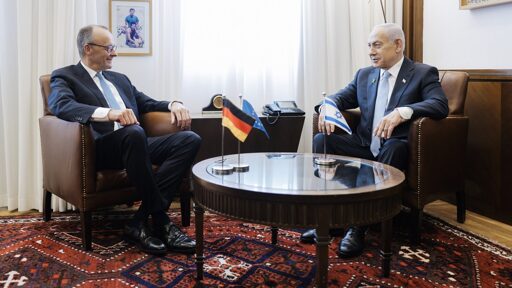
Germany’s support for the war in Ukraine continues to be accompanied by military cooperation with Israel. In response to a parliamentary inquiry from the left party Die Linke, the government reported it had approved military exports to the occupation entity worth approximately USD 930 million in the first half of 2026. According to Anadolu Agency, German military exports to Israel were four times higher than in 2025 and included naval projects, small arms, drones, and joint projects considered strategically important for the German armed forces.
Further cooperation between German industry and Israel’s arms producers is proceeding despite the ongoing genocide in Gaza. Local peace initiatives and progressive parties have emphasized that this approach exposes the contradictions of European rearmament at the expense of public services and civilian industry. Among these voices is the Osnabrück Peace Initiative, currently campaigning to prevent a Volkswagen factory in Lower Saxony from being repurposed to produce Iron Dome components in cooperation with Israel’s Rafael Advanced Defense Systems.
Volkswagen, affected by Germany’s industrial crisis, is looking into pivoting toward military production – an approach European officials claim will drive the region’s reindustrialization. While the plan to partner with Rafael has faced resistance from the very beginning, company management appears eager to move forward and has approached the Lower Saxony government with a partnership proposal worth hundreds of millions of euros.
Read more: Germany’s ‘summer of reforms’ to accelerate militarization
Local activists have decisively rejected the false binary between unemployment and military production. They insist that authorities’ plans to launch more arms factories show they have learned nothing from past wars. In Osnabrück, which hosted arms factories during World War II and suffered Allied bombardment as a result, peace groups reiterated they would continue campaigning against the plans. “When arms factories are once again established in the city some 80 years after the last war, one can only despair at the decision-makers’ disregard for history,” they told Anadolu Agency.
From BT News via This RSS Feed.