

By WBW Japan Chapter Co-Coordinator Gerry Yokota, World BEYOND War, September 3, 2026
When the prospect of Ukraine joining NATO became a topic of discussion four years ago, most Japanese people viewed the alliance as irrelevant to Japan. However, there have been large shifts in the global landscape since then. We have seen the establishment of a Japanese government mission to NATO and the participation of Japanese foreign and defense ministers in NATO summits. Furthermore, NATO participated in RIMPAC 2026 this summer, even though the U.S. and Canada are the only two member countries that actually have borders on the Pacific. The depth of Japan’s involvement is undeniable. Is it not essential, then, for us to understand the true nature of NATO? Co-authored by representatives from CODEPINK and World BEYOND War, this book offers crucial insights into NATO’s role in perpetuating wars waged across the globe. It provides abundant evidence to backup the statement that Jeffrey Sachs makes in the Preface: “NATO is a clear and present danger to world peace and a war machine that has run amok, beyond the democratic control of the citizens of its member nations.”
The book comprises the following 11 chapters:
- When and Why Was NATO Formed?
- NATO Expansion
- NATO’s History of Aggression
- NATO in Ukraine, but No Ukraine in NATO?
- NATO “Partners” around the Globe
- Who Makes the Decisions and Who Pays?
- How Does NATO Relate to the UN and International Law?
- NATO and Nuclear Weapons
- What Are the Divisions within NATO?
- What Are NATO’s Plans
- What Are the Alternatives?
In the following sections, I will highlight interesting points from each chapter to explore the “true nature” of NATO that the authors aim to convey.
In Chapter 1, the authors explain when and why NATO was formed. NATO was established in 1949 by twelve nations. Its first Secretary General, Lord Ismay, wryly described its purpose as “to keep the Soviet Union out, the United States in, and Germany down.” Article 5 of the treaty stipulates that, in the event of an armed attack against a member state, all members agrees to take action to restore the security of the North Atlantic region. The authors point out that this clause has been invoked only once—following the 9/11 terrorist attacks in 2001. Since Afghanistan had not attacked any NATO member state, the application of this clause is viewed as a form of abuse that masked the gap between stated principles and actual motives. In this context, “democratic values”—which the alliance was meant to protect—were conflated with capitalism, while communism and socialism were treated as undemocratic. The authors attribute this perspective to the political climate of postwar Europe, where communist and socialist parties—having played leading roles in the resistance against Nazism and fascism—were garnering significant electoral support. The authors also discuss the role NATO played in prolonging colonialism, citing as an example its support for France during the Algerian War of Independence (1954–1962). They further present numerous cases demonstrating that economic privatization was a key condition for NATO membership. For instance, Joe Biden informed Poland that, to be considered for membership, it would have to privatize its state-owned enterprises. The authors also reveal how NATO has served U.S. economic interests by supporting the American arms industry; notably, the lobbying group known as the “U.S. Committee to Expand NATO” was led by a vice president of Lockheed Martin.
Chapter 1 then surveys the history of the Warsaw Pact, which was formed in 1955 following West Germany’s accession to NATO. Interestingly, a year before the Warsaw Pact was established, the Soviet Union had inquired about the possibility of joining NATO itself. In 1990, East Germany withdrew from the Warsaw Pact in preparation for reunification with West Germany. The Warsaw Pact was formally dissolved on July 1, 1991—just before the collapse of the Soviet Union itself. Many observers had predicted that the demise of the Warsaw Pact would also signal the end of NATO, but that prediction proved incorrect. NATO rejected the “peace dividend” and instead chose to reap the “dividend of power” (the expansion of military superiority).
Chapter 2 traces the history of NATO expansion following the dissolution of the Warsaw Pact. In the 1980s, Spain; in the 1990s, Germany, Poland, Hungary, and the Czech Republic; in the 2000s, nine more, including three former Soviet states; two in the 2010s; and two after 2020. The authors cite Putin’s 2007 remarks, in which he labeled NATO expansion a “serious provocation” and expressed dissatisfaction with the alliance’s deployment of frontline troops near the Russian border. Putin asked, “Against whom is this expansion directed? And what became of the assurances our Western partners gave us after the dissolution of the Warsaw Pact?” The authors note that the joining of the last two countries, Finland and Sweden, reveals that their image as neutral state was only a façade obscuring their highly developed arms industry. They especially view Finland’s accession as a betrayal of the respected tradition the country had built as a “global peacemaker”—a legacy symbolized by former President Martti Ahtisaari’s 2008 Nobel Peace Prize.
Chapter 3 details NATO’s involvement in Bosnia, which began in 1995, and the subsequent support for the aggressive use of military force by the United States in Kosovo, claiming it was to protect victims of ethnic cleansing. But many, including former NATO Secretary-General Lord Carrington, criticized the intervention, arguing that instead of preventing ethnic cleansing, it actually triggered it. Furthermore, the authors contend that the Kosovo conflict served as a template for the endless wars U.S. leaders have since waged around the world. The twenty-year war in Afghanistan—which concluded in August 2021 with the Taliban’s return to power—is cited as a prime example. The chapter concludes with an expression of deep skepticism regarding recent moves by the U.S. and NATO to redirect their dysfunctional war machine against far more heavily armed adversaries like Russia and China.
Chapter 4 focuses on Ukraine, beginning by reviewing the 2010 election of Viktor Yanukovych, who ran on a platform of neutrality, and the Western support for the 2014 uprising that ousted him. It focuses on NATO’s role in the post-coup administration. The new government deployed units of the National Guard—a newly formed paramilitary force that included recruits from far-right groups—to attack the self-proclaimed republics. The authors note that NATO forces trained the neo-Nazi-led Azov Regiment in the use of U.S. weaponry. Furthermore, the chapter outlines how the U.S. undermined the Minsk II agreement (brokered by France and Germany in 2015) and how the UK blocked an agreement mediated by Turkey between Russia and Ukraine. That agreement would have seen Russia withdraw from all newly occupied territories in exchange for a simple pledge from Ukraine to abandon its ambitions for NATO membership and to refuse the stationing of NATO military bases or missile facilities on its soil.
Chapter 5 explains how NATO partners are organized into groups covering regions such as “Europe and Central Asia” and “West Asia and North Africa”; Japan is included in the “Other” category together with Mongolia, South Korea, Japan, Australia, and New Zealand. The chapter pays particular attention to Israel. There have previously been moves to integrate Israel more deeply into NATO to leverage its advanced weapons systems; NATO members have purchased billions of dollars’ worth of Israeli weaponry and have shown interested in its AI development. However, following October 7, 2023, rifts began to emerge within NATO regarding issues such as UN General Assembly votes on a ceasefire resolution and Israel’s allegations of UNRWA’s involvement in the Hamas attacks. According to the authors, these developments have dampened the momentum toward closer ties between NATO and Israel.
Chapter 6 focuses on NATO’s 2006 decision requiring member states to allocate at least 2% of their GDP to military spending, offering a critical discussion of the humanitarian needs sacrificed to meet this expenditure target.
Chapter 7 examines the UN Charter and identifies two major threats to the peaceful resolution of international disputes: the fact that the United States has refused to sign the majority of the eighteen key human rights treaties (having ratified only five), and the abusive exercise of its veto on the UN Security Council. The chapter also discusses unilateral vs. targeted sanctions. It specifically highlights the absurdity of NATO declaring the January 2024 attacks on Yemen by the United States and the United Kingdom to be “defensive” in nature.
Chapter 8 provides an overview of nuclear weapon holdings among NATO members and their involvement in the sale of F-35 fighter jets. Noting the divisions within NATO regarding the TPNW—and the fact that five NATO partner nations have ratified it—the authors suggest that an anti-nuclear movement is gaining a foothold within the alliance. Chapter 9 cites further evidence of internal discord, such as France’s dissatisfaction at being excluded from the submarine sale to Australia under the AUKUS framework, and considers the possibility that the United States might abandon NATO should it find other means to dominate the global stage. It is suggested that these weak points may be fruitful sites for intervention.
In Chapter 10, the authors reiterate their deep concern regarding NATO’s increasingly hostile stance toward Russia and China. They specifically point to the assertion in NATO’s “2022 Strategic Concept” that “China’s stated ambitions and coercive policies challenge our interests, security, and values,” as well as the alliance’s efforts to strengthen ties in the Indo-Pacific region.
The final chapter, Chapter 11, challenges the argument that further NATO expansion is the only appropriate response to Russia’s military actions. The authors point out that arms races and acts of intimidation merely perpetuate a vicious cycle and could well become a primary factor fueling Russian militarism. They warn that joining a military alliance exposes a country to the risk of being targeted by all of that alliance’s adversaries. They also cite examples of successful nonviolent resistance, including unarmed civilian resistance in Ukraine. Furthermore, they urge a recognition of the danger posed by NATO, noting that it serves as a convenient cover for justifying U.S. military aggression—particularly given the lack of accountability involved. They quote the following statement issued by a counter-summit—comprising groups such as CODEPINK and World BEYOND War—held in Washington, D.C., in July 2024 to coincide with the meeting marking NATO’s 75th anniversary:
“NATO is a force that drives militarization and war-mongering, destabilizes regions, and disregards international law. Its very existence heightens the risk of war, including nuclear conflict. Its hostile stance toward the few major global military powers that are not members fuels arms races and conflicts. The member states’ pledge to join one another’s wars, combined with NATO’s tendency to intervene against perceived enemies far beyond the North Atlantic, creates a risk of global catastrophe. We envision a world without NATO—a world where resources are dedicated to eradicating poverty, hunger, disease, and homelessness; where we live in harmony with the environment; and where conflicts are resolved diplomatically through the United Nations, the only international body representing the entire globe.”
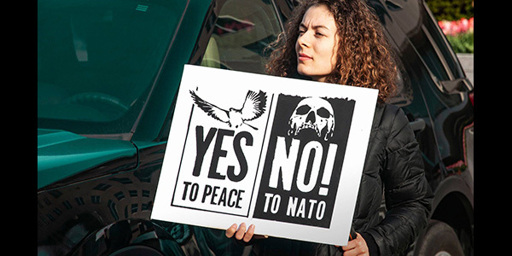
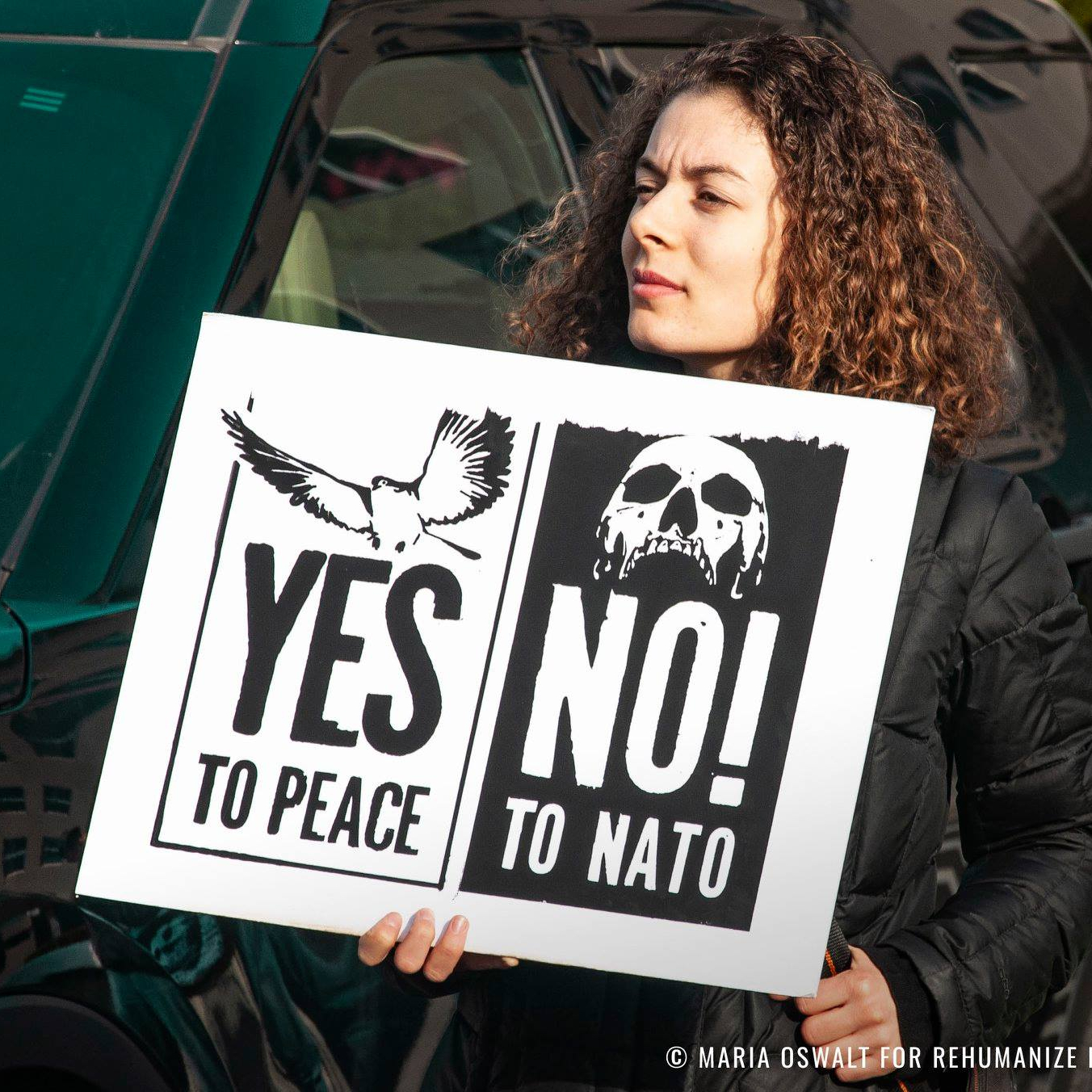
Finally, the book calls for building a global movement in opposition not just to specific conflicts but to all wars, urges recognition of NATO as the world’s largest war-waging alliance, and concludes with the appeal: “No to NATO, no to war.”
The post Book Introduction: NATO: What You Need to Know by Medea Benjamin and David Swanson appeared first on World BEYOND War.
From World BEYOND War via This RSS Feed.