

Spain’s prime minister says there is no solid evidence Morocco planned or carried out the mass migrant entry into Ceuta.
Spain’s Prime Minister Pedro Sánchez has ordered the release of all official reports on the migration crisis in Ceuta while rejecting claims that Morocco planned or carried out the mass entry of more than 70,000 people into the Spanish autonomous city within hours.
RELATED: Spain Heat Mortality Breaks Record with Over 5,200 Deaths
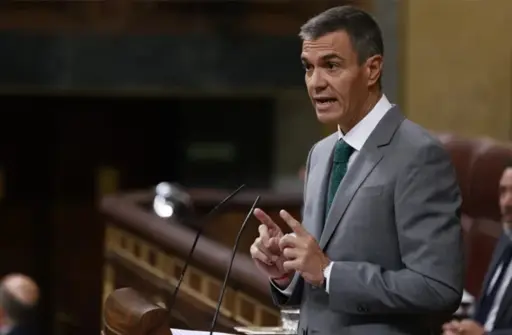
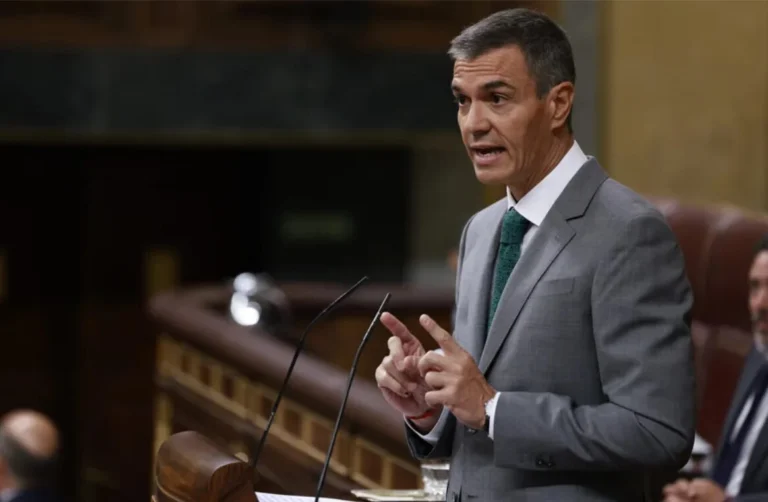
Sánchez made the announcement Thursday during an extraordinary appearance before Spain’s Congress, where he defended his government’s handling of the crisis and sought to address mounting pressure over Morocco’s alleged involvement.
“The government has nothing to hide on this matter,” Sánchez said, insisting that all available information could be made public for scrutiny by the media and citizens.
“To date, no one has provided the Spanish government with solid evidence that Morocco carried out the episode,” he said.
EN DIRECTO
El jefe del Ejecutivo, @sanchezcastejon, comparece, a petición propia, en el @Congreso_ES, para informar de la gestión del Gobierno en relación con los hechos ocurridos en Ceuta y sobre la situación actual en la ciudad autónoma.https://t.co/Mj58EZccnk
— La Moncloa (@desdelamoncloa) September 3, 2026
Text Reads: The head of the Executive, @sanchezcastejon, appears, at his own request, before the @Congreso_ES, to report on the Government’s management in relation to the events that occurred in Ceuta and on the current situation in the autonomous city.
No warning of the scale of the crisis
Sánchez said the events should not be understood as a single-cause incident but as “a phenomenon with many causes.” He rejected claims that the government had received extraordinary warnings in the days before the mass entry.
The prime minister said officials had reviewed reports, messages and verbal notes from Spain’s National Intelligence Centre, the country’s security forces and Frontex. None, he said, went beyond routine warnings or descriptions of available data, and none anticipated either the scale or likelihood of what ultimately occurred.
Sánchez acknowledged that “things failed” within the intelligence services and that available resources were overwhelmed by the magnitude of the situation. He also warned that new technologies were creating “new hybrid threats” that governments were still learning to detect and counter.
His appearance came amid heightened tensions following demonstrations in Spain over the government’s handling of the crisis and the release, hours earlier, of a police report that intensified criticism.
The report, submitted by police to Judge María Tardón, described the mass entry on July 30 and 31 as “planned” and identified among its organizers people linked to Moroccan security forces. According to the report, such an operation would have required high-level planning well beyond the capabilities of criminal smuggling networks.
Sánchez reiterated that there was no evidence the crisis had been “designed or executed” by Moroccan authorities. If “solid” evidence emerged, he said, the government would respond “with total firmness.”
“This government is not afraid to confront foreign powers when circumstances have required it,” Sánchez said, while stressing that any action would be based on “proven, corroborated facts.”
Spain-Morocco tensions
Sánchez also revealed that the Spanish government summoned Morocco’s ambassador, Karima Benyaich, on Aug. 21 over what it called “unacceptable” statements by two Moroccan ministers concerning the sovereignty of Ceuta and Melilla.
He said bilateral cooperation with Morocco would have to change and announced a review of existing coordination and warning mechanisms with the neighboring country to establish additional safeguards.
At the same time, Sánchez stressed the importance of maintaining good-neighborly relations.
He also reaffirmed Spain’s sovereignty over Ceuta and Melilla, saying the two cities would remain Spanish “in perpetuity.”
“For centuries these cities have been Spanish, and since that treaty they have been so by diplomatic agreement; and I assure you that, on the part of the Spanish government, they will continue to be so until the end of time,” Sánchez told lawmakers.
To underscore the state’s commitment to the two autonomous cities, Sánchez announced that King Felipe VI would visit Ceuta and Melilla in the coming weeks.
The monarch is expected to convey the state’s “absolute commitment” to the cities. The visits would be Felipe VI’s first official trips to Ceuta and Melilla; the last Spanish monarch to make an official visit to the two cities was King Juan Carlos.
From teleSUR English via This RSS Feed.