

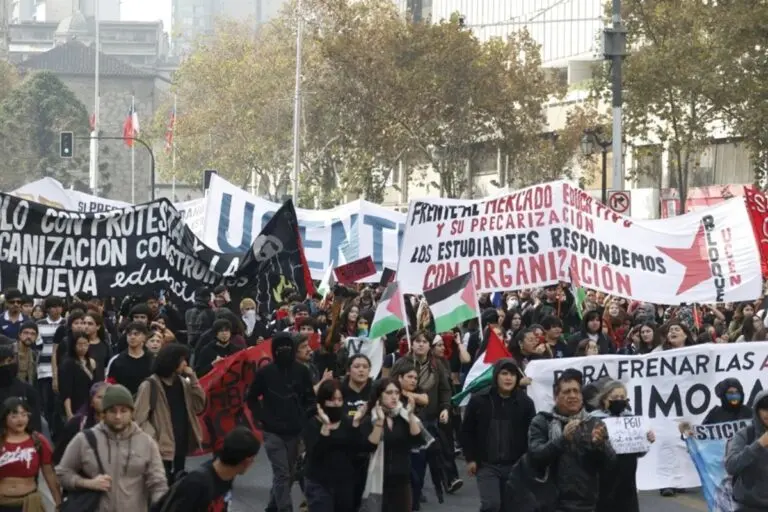
Chilean secondary students have called a Sept. 3 protest in Santiago against President José Antonio Kast’s economic and security agenda.
Chilean secondary students have called a protest in Santiago on Thursday against President José Antonio Kast’s government, seeking to expand the mobilization nationwide over policies they say threaten social rights and strengthen state powers of repression.
RELATED: Chilean Study Shows That Some Plants Can Grow Quickly and Tolerate Water Stress
The Assembly of Secondary Students (ACES) has called the demonstration at Baquedano metro station, near the square that became a focal point of Chile’s 2019 social unrest. Organizers are also protesting the Madrid Forum, a far-right gathering scheduled for Sept. 3 and 4 in Santiago.
Youth groups Vencer and Rebelión have urged student organizations across Chile to join the mobilization and use it as a launching point for a broader campaign that could lead to a nationwide strike.
The protest follows two major student mobilizations since Kast took office. On April 29, secondary students marched in Santiago against government austerity measures, including budget cuts affecting education and school meals. On May 14, they protested 14 measures promoted by the government, including the elimination of food programs administered by the National Board of School Aid and Scholarships.
Chile aprueba polémica ley contra la violencia en las escuelas
El Parlamento de Chile aprobó el proyecto de ley Escuelas Protegidas, una iniciativa impulsada por el Gobierno de José Antonio Kast para endurecer las penas contra delitos cometidos en colegios. La medida…
— teleSUR TV (@teleSURtv) June 3, 2026
Text Reads: Chile Approves Controversial Law Against Violence in Schools
Chile’s Parliament approved the Escuelas Protegidas bill, an initiative driven by José Antonio Kast’s Government to toughen penalties for crimes committed in schools. The measure faces strong opposition rejection for criminalizing minors and violating constitutional equality.
aa
Students warned that cuts to those benefits would directly affect vulnerable families amid a difficult economic situation.
The groups behind Thursday’s action say the mobilization should extend beyond schools and universities where student organizations are already active. They are calling for assemblies and discussions in more educational institutions and cities to examine how the government’s policies could affect students, their families and the right to organize and protest.
They also oppose measures they say would expand the state’s powers of social control under the banner of public security. The groups cite the “Protected Schools” initiative, which they say would criminalize young people, as well as a proposed constitutional reform that they argue would grant exceptional powers for eight months, amounting to a “civil dictatorship.”
The organizers point to recent incidents involving Carabineros as evidence of what they describe as a repressive approach. They cite an incident in Quellón in which officers allegedly forced a group of students to strip, as well as the Aug. 17 killing of rapper Vegetal by members of the same police force.
How to strengthen the student movement?
The organizers say expanding the mobilization will require reaching students who are not currently involved in student organizations. They propose discussions among students, assemblies in educational institutions and coordination between schools to identify shared concerns and determine how the Sept. 3 protest can be broadened.
They say these discussions could address the implications of Kast’s agenda for students and their families, as well as the potential consequences of a more repressive security agenda for the right to organize and demonstrate.
The groups also view the organizing process as a way to sustain the movement beyond Thursday’s protest. They say discussions in schools could create new links among students and bring additional sectors into organized activity.
The Sept. 3 mobilization is being presented as a starting point for building assemblies and organizing committees and for developing a unified national strike movement. The organizers say their objective is to bring together students and other sectors willing to mobilize against the government’s agenda.
From teleSUR English via This RSS Feed.