

My grandchild was traumatized because he saw how soldiers killed his father.
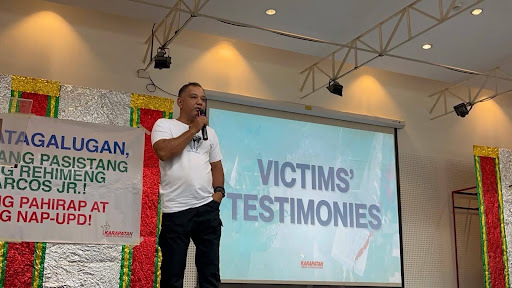
LOS BAÑOS, Laguna — During the 77th anniversary of International Humanitarian Law (IHL), victims of rights violations, indigenous peoples, and human rights defenders gathered at the University of the Philippines Los Baños on August 28 to expose the continuing impact of militarization on Southern Tagalog communities.
Organized by Karapatan-Southern Tagalog and allied organizations, the human rights forum titled “Panaghoy at Pag-asa: Documenting Truth, Demanding Justice,” provided a venue for survivors and affected communities to share testimonies of militarization, displacement, land grabbing, and state repression.
The event brought together Dumagat and Mangyan Indigenous Peoples, peasant communities, rights defenders, and supporters from various sectors. Their stories, though rooted in different struggles, showed the impact of militarization and impunity on marginalized communities.
Mother’s call for justice
Among those who spoke was Narcisa Dela Cruz, a Dumagat resident of Tanay, Rizal and the mother of Randy Dela Cruz and aunt of Puroy Dela Cruz, both of whom were killed during the Bloody Sunday operations in March 2021.
Dela Cruz recounted how military presence continues to dominate life in their community years after the killings. “Our barangay remains under tight military surveillance,” she said. “Whenever we return home, soldiers are constantly watching us. They accuse us of being connected with leftist groups.”
“I am not afraid because I have done nothing wrong,” she said. “All I want is justice for the death of my son.”
The emotional burden of the killings, she said, goes beyond the victims. Her grandchild witnessed Randy’s death and continues to suffer from trauma.
“I cannot accept that my son was killed by the military,” she said. “My grandchild was traumatized because he saw how soldiers killed his father.”
Dela Cruz also spoke of the continued military deployment in their community, stressing that soldiers would interrogate residents and would insist that they are linked to the New People’s Army (NPA).
Land grabbing
Noli Tamisan of the Mangyan-Iraya from Sitio Malatabako, Occidental Mindoro recounted their efforts to defend a 32-hectare area that he said is part of their ancestral domain.
He said that the community erected a barricade in 2024 to stop Peaceland, a private entity, from taking over the land.
For a month, community members remained within the barricaded area. The standoff, however, was met with police and military intervention.
“Our struggle became more difficult because of arrests that violated our rights,” Tamisan said.
He said that several community members, including himself, were detained and charged with trespassing. “We continue to live in fear because military surveillance remains widespread in our area.”
Continuing persecution
Erlindo Baez, a human rights advocate from Batangas and one of the survivors of the Bloody Sunday raids, said that the roots of repression in his community can be traced to struggles over land.
Since 2010, farmers in San Juan, Batangas have experienced land grabbing and economic marginalization, he said.
“Faced with these conditions, we fought back and demanded justice,” Baez said. “As a result, our area became heavily militarized.”
Baez said that the consequences extended to his family. His son was arrested and charged with what he described as fabricated cases.
More than five years after Bloody Sunday, Baez said that he continues to seek justice for victims and accountability for those responsible.
International attention
The forum was also attended by Signe Poulsen, representative of the Office of the United Nations High Commissioner for Human Rights (OHCHR) Southeast Asia Regional Office.
Addressing survivors and victims’ families, Poulsen stressed the importance of documenting abuses and ensuring accountability.
“It takes great courage for people to speak about the most difficult days of their lives,” she said.
Poulsen said that the United Nations has long monitored the human rights situation in the Philippines and stressed that accountability remains essential to achieving peace.
“The experiences shared here need to be brought to the attention of the world,” she said. “We need accountability for human rights violations because accountability is essential to peace.”
Poulsen described the Bloody Sunday incident as a “one-sided attack” in which activists and human rights defenders were targeted.
She also highlighted land rights as a critical human rights issue, particularly for indigenous peoples and other marginalized communities. “Protecting these rights benefits not only indigenous peoples and national minorities but society as a whole.”
Defending rights
Daisy Macapanpan from Protect Sierra Madre pointed to ongoing concerns over large-scale projects and militarization in communities affected by infrastructure and development initiatives. “We must unite and continue resisting because attacks on our rights persist.”
For Karapatan Southern Tagalog, the gathering served not only as a venue for testimony but also as a call for collective action. “As we conclude this human rights forum, we must remember the importance of collective struggle,” said Jonas Nikolai Borja of Karapatan Southern Tagalog. “We should continue inviting all sectors across our region to join us and demonstrate that the people of Southern Tagalog are united in defending our rights.” (AMU, DAA)
The post Southern Tagalog communities call for justice on IHL anniversary appeared first on Bulatlat.
From Bulatlat via This RSS Feed.