

Marcos Jr. administration relies on unrealistic standards defining who is poor.
MANILA – Did poverty decline in the country? For Kadamay, an alliance of the urban poor, Filipinos are still struggling every day to survive.
Last week, the Philippine Statistics Authority (PSA) reported that poverty incidence in all regions declined from 2023 to 2025. Filipinos classified as poor are said to have dropped from 15.5 percent in 2023 to 9.7 percent in 2025, or from roughly 17.5 million to 11.1 million poor people.
The Department of Social Welfare and Development (DSWD) said that this shows the impact of the Marcos administration’s poverty alleviation programs.
Kadamay stressed that the statistics do not represent the collective experience of the urban poor “where they suffer from high prices of electricity, food, commodities, and oil while earning low salaries.”
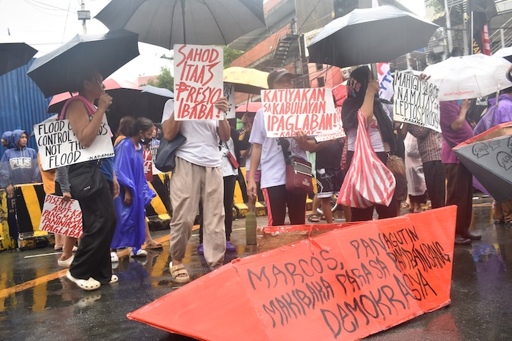
On August 28, Kadamay and other groups held a national day of accountability after parts of Luzon suffered from severe flooding following a series southwest monsoon rains.
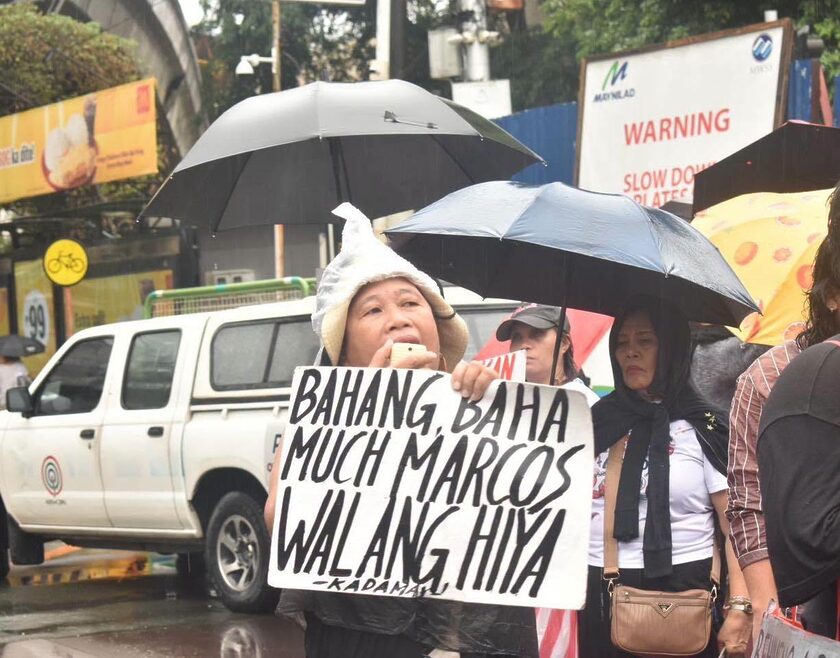
“Where did the government get those statistics? Is the lower poverty threshold of 97 pesos [$1.56] per day enough for Filipinos? There’s no legitimate measure of poverty rather than the lived experience of urban poor communities who are starving due to lack of access to their basic needs,” Mimi Doringo, Kadamay secretary-general, said.
Despite the rains, the groups pushed through with the mobilization in Mendiola and denounced the Marcos Jr. administration for showcasing recent statistics despite lack of accountability to hold those who are implicated in the anomalous flood-control projects.
Not better
Elvira Hiangan, 62, said that she did not feel that their lives were better in the past years as prices of goods remain high. She said that her four children stopped their education due to financial constraints and lack of opportunity.
Hiangan is a housewife who also looks after her six grandchildren as some of her children are single-handedly raising their kids.
“The taxes we pay are so high, but his [Marcos Jr.] programs for the poor are not sustainable and just trap us further in poverty,” Hiangan told Bulatlat.
Hiangan’s husband who works as a construction worker is not paid enough to cover their basic needs. She said that they even skip meals because of her husband’s insufficient salary.
“He is only earning a salary ranging from P500 to P700 ($8 – $11.30). Due to rainy weather, he can’t go to work.”
Hiangan’s family also experienced severe flooding for many years living in Sitio Bakal, Barangay Silangan, Quezon City.
Mimi Doringo. (Photo by Aaron Ernest Cruz/Bulatlat)
“We are having a hard time sleeping when it continuously rains at night because our area is easily flooded,” she said.
Hiangan is one of the many people living in urban areas who are affected by botched or ghost flood-control projects.
The Center for Women’s Resources (CWR) said that the government’s figures represent a serious distortion of the extent of poverty in the Philippines. “By relying on a poverty threshold that does not adequately reflect the real cost of living or the income required for families to meet their basic needs and live with dignity, the government effectively narrows the definition of who is considered poor. This makes poverty appear smaller on paper than it is in people’s everyday lives.”
The group said that there may be millions of Filipinos classified as non-poor because their income falls slightly higher than the official poverty threshold. But CWR said that they continue to struggle to afford adequate food, housing, healthcare, education and other basic needs.
“The government is celebrating how many people have crossed the poverty line, but it is not asking the more important question: What kind of life can a Filipino family actually afford after crossing that line?” CWR Executive Director Cham Perez said in a statement.
Ibon Foundation said that the Marcos Jr. administration relies on unrealistic standards defining who is poor because their methodology uses the least-cost basket. This means that they only use cheaper goods to compute whether a Filipino household can afford it. The non-food needs are not considered in the computation.
“Poverty reduction should not mean merely keeping people barely above a statistical line. The government must create the conditions for sustained and broad-based improvements in living standards by strengthening the domestic economy and developing engines of growth that generate stable, decent-paying jobs,” Ibon said in a statement.
Ibon stressed that the 2025 annual per-capita poverty threshold is only P35,121 ($567), or P96.22 (less than $2) per person per day. For a family of five, this amounts to just P14,634 ($2,345) a month. “This means a family earning even slightly more than this is officially considered non-poor, without considering the high costs of food, housing, electricity, transportation, education, healthcare and other basic expenses.”
Meanwhile, Doringo said that the poor’s suffering in the past week’s heavy rains caused widespread flooding.
Doringo added that instead of aiding the vulnerable sectors affected by flooding, they are being blamed for what happened. “We are not the trash, the real trash here is the administration, which continuously neglects the urban poor’s demands for the right to livelihood and access to their basic needs.”
“The lies of this administration only fuels the anger of the people to demand for accountability and to put an end to corruption,” Doringo said. (With reports from Anne Marxze D. Umil) (DAA)
The post Declining poverty stats far from reality amid flooding, high prices appeared first on Bulatlat.
From Bulatlat via This RSS Feed.