

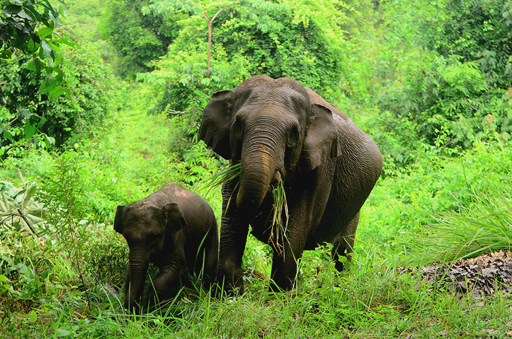
On the island of Sumatra, Indonesia, in the buffer zone of a national park, a women-led farming group has come up with a solution to reduce encounters with elephants. Deforestation and oil palm encroachment have stripped Tesso Nilo National Park of more than three-quarters of its old-growth forest. This has forced the park’s roughly 150 Sumatran elephants (Elephas maximus sumatranus) into frequent, costly clashes with local communities, report Mongabay Indonesia contributor Suryadi and Mongabay’s Yenni Kwok. To prevent elephants from coming too close, some villagers elsewhere in Indonesia resort to setting out poison bait or putting up electric fences. However, in the village of Lubuk Kembang Bunga in Tesso Nilo’s buffer zone, the Batang Nilo Women’s Forest Farmer Group, known as Perbani, has championed an alternative for protecting their crops: dense fences made of citrus trees, a natural repellent for elephants. “Before we had the citrus trees, elephants always ate our oil palm fruits,” Ernita, a 33-year-old farmer and Perbani member, told . “Praise be to God, since we planted the citrus trees, the elephants haven’t eaten our oil palm fruits.” To foster peaceful coexistence, the group elsewhere plants elephant-friendly fruit trees like jackfruit, its cousin cempedak, and stink beans, known in Indonesian as petai. Yuliantony, the executive director of the Tesso Nilo National Park Foundation (YTNTN), the community-based organization that proposed the citrus initiative, said women are often overlooked in conservation efforts, although they frequently have in-depth knowledge of local ecology. “That is why it is important to involve…This article was originally published on Mongabay
From Conservation news via This RSS Feed.