

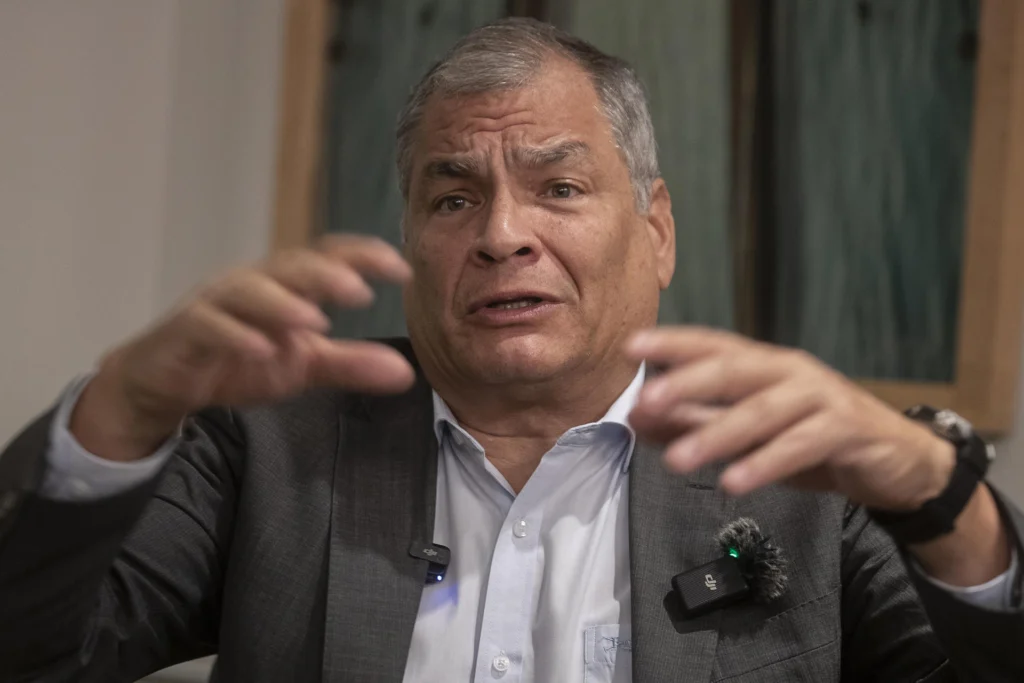
Former Ecuadorian President Rafael Correa has demanded a formal apology and the transfer of ex‑Vice President Jorge Glas to Mexico as conditions for restoring diplomatic relations between both nations.
Rafael Correa, who governed Ecuador from 2007 to 2017, told in an interview in Mexico City that normalization after two years of diplomatic rupture depends on concrete steps by President Daniel Noboa’s administration.
He listed an apology to the Mexican State, reparations for the damages caused by the police incursion into the embassy in April 2024 -ordered by Ecuadorian authorities-, and the handover of Glas, who had been granted political asylum by Mexico.
RELATED: Health Worsens for Ecuador’s Ex‑Vice President Glas in Prison
Correa described the April 2024 police incursion into the Mexican embassy as a “grave violation of international norms.” Correa argued that such an unprecedented breach of diplomatic sovereignty requires not only an apology but also reparations for damages caused.
“He must hand over Jorge Glas to Mexico to see if bilateral relations can begin to be restored,” Correa said. He insisted that Noboa offer “a great apology” to the Mexican government before any dialogue can advance.
Former President Rafael Correa, who governed Ecuador from 2007 to 2017, stated that the normalization of relations between his country and Mexico requires concrete actions by Daniel Noboa’s government, including a formal apology, compensation for damages caused by the raid on the… pic.twitter.com/yr7s0FBbqN
— teleSUR English (@telesurenglish) September 3, 2026
For her part, President Claudia Sheinbaum reiterated in July that her government will not reestablish ties while Noboa remains in office, emphasizing that “any country would have broken relations if its embassy was invaded.” She said the rupture of relations remains in force because of the assault on the embassy.
“Any country in the world would have broken relations if someone invades its embassy; that is the first thing in Ecuador’s case, and that continues,” Sheinbaum declared during her daily press conference.
The standoff also weighs on Glas, who remains in custody. A judge in Ecuador denied a request to improve the food and medical care provided to the former vice president.
Regional Battle Ahead
Beyond bilateral tensions, Correa situated the Ecuador‑Mexico dispute within a broader Latin American political context. He highlighted Mexico and Brazil as the region’s largest left‑governed economies, contrasting them with the recent rise of conservative forces. According to Correa, the right-wing has effectively exploited public fears over insecurity and organized crime, using them as electoral tools.
To counter this trend, Correa urged progressive movements to reclaim narratives around “order,” “discipline,” “security,” and “firm hand”, but framed within respect for human rights, intelligence, and social development. “We have the reason. Sometimes we lack the passion,” he remarked, calling on the left to inspire citizens emotionally while defending values such as freedom and efficiency.
Rafael Correa plantea condiciones para que Ecuador y México retomen relaciones
Correa pidió al gobierno de Daniel Noboa ofrecer disculpas, reparar los daños ocasionados por la irrupción en la Embajada de México en Quito y entregar al exvicepresidente ecuatoriano Jorge Glas. pic.twitter.com/9hzsuhBnRF
— La Resistencia Aguascalientes (@Resistenciags) September 2, 2026
Text reads: “Rafael Correa sets conditions for Ecuador and Mexico to resume relations. Correa asked the government of Daniel Noboa to offer apologies, repair the damage caused by the irruption at the Mexican Embassy in Quito and deliver former Ecuadorian Vice President Jorge Glas.”
Correa also shifted responsibility onto the electorate. He rejected explaining political changes solely through the actions of leaders or external powers. For him, Latin America suffers from a lack of political culture, and citizens must reflect on what is placed before them.
“The irresponsible voter, the novelty-chasing voter, the unconscious voter is no longer a victim but an accomplice,” he affirmed. That citizen responsibility, he concluded, is essential for democratic consolidation in the region.
The diplomatic rupture between Ecuador and Mexico remains unresolved. While Mexico holds firm against Noboa’s government, Correa’s intervention underscores both the gravity of the embassy incident and the wider ideological battles shaping Latin America’s political landscape.
From teleSUR English via This RSS Feed.