

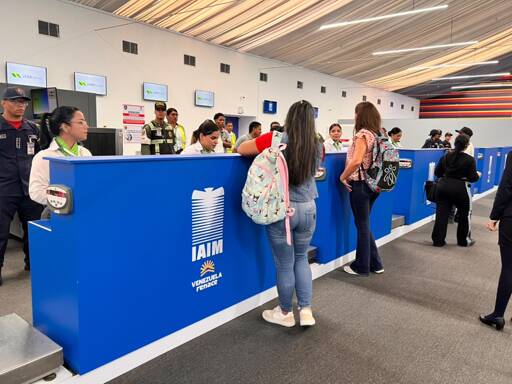
Mérida, September 2, 2026 (venezuelanalysis.com) – Venezuela’s Simón Bolívar International Airport, located in Maiquetía, La Guaira State, officially resumed commercial flight operations on Tuesday through newly constructed temporary terminals.
Air connections resumed more than two months after a powerful double earthquake struck central and coastal Venezuela on June 24, causing severe structural damage to the Simón Bolívar Airport, including fractured runways.
The initial phase of renewed operations relies on four modular, temporary terminals erected in the airport’s external parking areas. Spanning more than 10,000 square meters, the temporary structures house fully functional services for ticketing, baggage drop and retrieval, security checkpoints and migration control.
Venezuelan authorities have also set up shuttle buses to take passengers from the modular gates to the aircraft on the tarmac. They have also issued operational guidelines for passengers and organized a security deployment in the airport grounds and surrounding areas.
Before official operations began, national aviation authorities executed four operational simulations to test passenger circulation routes, security protocols, luggage handling, and overall system readiness.
During an official inspection, Minister of Transportation Francisco Garcés outlined the operational milestones, technical parameters, and long-term recovery timeline for the nation’s main aviation hub.
“There is full operationality from these temporary terminals, with capacity to accommodate 720 departing and 496 arriving passengers in the international area, and 480 and 472, respectively, in the domestic sector,” Garcés stated during a media briefing. “We have made a strong effort to maintain rigorous international standards for user comfort and safety, completing this complex logistical solution in record time.”
Garcés explained that the current facilities restore approximately 25 percent of the airport’s pre-earthquake operational capacity, with projections of expanding to 40 percent within the next two months and 60 percent by the end of the year.
Meanwhile, engineering teams continue comprehensive structural repairs on the main permanent terminals, with full reconstruction scheduled for the first quarter of 2027.
On September 1, the opening day of the temporary facilities featured eight scheduled flights split equally between domestic and international routes, with the inaugural flight departing to Valera, Trujillo State.
Air carriers currently operating or scheduling their immediate return to Maiquetía include national lines Conviasa, Laser Airlines, Estelar, Avior and Venezolana, alongside international operators such as American Airlines, Iberia, and Copa Airlines.
Throughout the two-month shutdown following the June 24 seismic events, national and international air transit was diverted through smaller, regional airports across the country, including Barcelona (Anzoátegui State), Valencia (Carabobo State), and Maracaibo (Zulia State).
Alongside the reopening of Venezuela’s main air hub, the acting Delcy Rodríguez government has continued to address housing rehabilitation and structural reconstruction in damaged urban centers.
In La Guaira State, Rodríguez oversaw the formal handover of 210 fully repaired apartments in the Ana Victoria community. The rehabilitation works under the Plan Venezuela Renace allowed displaced families to return to their homes after two months in temporary shelters.
Additional structural works in La Guaira include “tetra-houses” in Catia La Mar and public infrastructure reconstruction near the El Trébol highway interchange.
Concurrently, Rodríguez announced the delivery of direct financial assistance and low-interest loans to 104 condominium boards and 1,216 individual housing units in the Chacao and Altamira areas of Eastern Caracas.
“We have begun an inspection process; I know it may take some time, but it is important because we are in a phase of changing the seismic resistance standards for construction,” she said.
Disbursed through joint public and private banking channels, individual loans can be up to US $5,000, while funding for common area repairs can reach $20,000.
These funds enable residents and homeowner associations to address structural issues on buildings categorized under yellow and red risk tags, ensuring compliance with updated seismic resistance construction standards.
Edited by Ricardo Vaz in Caracas.
The post Venezuela: International Airport Reopens Post-Earthquake with Temporary Terminals appeared first on Venezuelanalysis.
From Venezuelanalysis via This RSS Feed.