

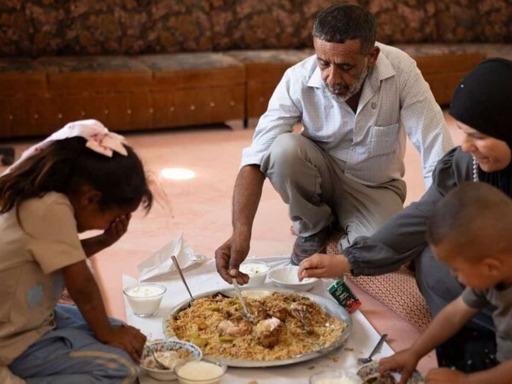

The UN World Food Programme (WFP) is cutting its food assistance in the occupied West Bank by half, starting this September. This is because it does not have enough money to keep going at the current level. The move comes as the agency says food insecurity in the territory has more than doubled since 2023, with about 900,000 people now unable to reliably meet their food needs.
Rural communities will be hit the hardest by cuts to WFP food assistance
400,000 of the most vulnerable people in the West Bank have benefitted from WFP cash and vouchers, food parcels, livelihood programmes and nutritional support. But 200,000 will now lose access to this vital assistance. WFP says the cuts will hit rural communities the hardest.
According to WFP, more than three-quarters of West Bank households have experienced a significant decline in income since 2023. Food and fuel prices remain among the highest in the Middle East. So many families are forced to reduce the number and quality of their meals just to survive. The same analysis found more than 10 percent of Palestinians had poor food consumption. And one third of families could not afford a nutritious diet because of the rapidly deteriorating economy.
Although not traditionally thought of as a region experiencing a food crisis, increasing pressures have now changed the situation in the West Bank. Two years ago, just over 10 percent of the population was food insecure. But today, more than 25 percent of the population of the West Bank- or almost a million people, are in that category.
The surge in food insecurity is driven by a combination of violence, movement restrictions, forced displacement, and economic collapse. This is a time when Palestinians in the occupied West Bank are more in need of assistance than ever before. But aid is now being cut.
Economic turmoil in West Bank
Before October 2023, around 140,000 Palestinians from the West Bank were given permits by their occupier to work in ‘Israel’… But for nearly three years these permits have not been issued. The 3.4 million Palestinians in the West Bank are struggling with lack of jobs and opportunities. The unemployment rate among those aged 15 and above is around 28 percent. And the average daily wage for employees in the West Bank is about 134.3 NIS. This is the equivalent of around £33.
As well as work permits for Palestinians ending, the Israeli occupation is also intentionally strangling the Palestinian Authority (PA) economically. It has been left unable to pay full salaries to its roughly 150,000 public sector employees for over three years.
115,000 of the approximately 700,000 families living in the West Bank still depend on agriculture for their livelihoods. Farming, herding and olives also providing partial income and food security. But access to land is increasingly being blocked. Israeli occupation forces (IOF) issue military orders, while settlers expand their illegal settlements, and use violence and intimidation to keep Palestinians away.
More than 40,000 Palestinians forced from their homes by the occupation since January 2026
Palestinians have been left without a regular source of income. They also have to cope with the constant threat of violence and arrest. The occupation is doing everything it can to forcibly displace them, and ethnically cleanse the West Bank of them. Settler violence has forcibly displaced around 107 communities, or 5900 Palestinians, in the occupied West Bank since January 2023.
Tens of thousands of Palestinians have also been displaced from the West Bank by the occupation’s military. A total of 40,965 Palestinians were displaced between January 2025 and June 2026, including more than 15,600 children. More than 33,000 of these were refugees, displaced from Jenin Tulkarm and Nur Shams refugee camps during Operation Iron Wall. And they remain unable to return as movement restrictions have repeatedly been extended.
WFP Gaza operations also under pressure
The funding crisis is not limited to the West Bank.In Gaza. The WFP supports about 1.5 million people in the enclave, including one million who receive monthly food assistance. But in July 2026, the agency reduced the cash value of its assistance by 40 percent. 375,000 people, some 75,000 families, have been affected. WFP warns that further cuts in Gaza will be unavoidable unless additional funding is secured.
The Israeli occupation is failing to uphold the terms of the “ceasefire” agreement. It continues to maintain a blockade on aid entering the Strip, meaning two-thirds of the population still face critical and emergency levels of hunger. For them, a further reduction of WFP aid would be catastrophic.
Over the next six months from September 2026, WFP says it urgently requires an additional $386 million to serve an estimated two million food insecure people across Gaza and the West Bank. Without that money, the agency will be forced to make further reductions.
The shortfall in funding reflects a deliberate political squeeze on UN humanitarian operations in Palestine. Since 2025, major Western donors — led by the US — have drastically cut or suspended contributions to UN agencies working in the occupied Palestinian territory. At the same time, ‘Israel’ has been working to isolate these bodies, and prevent them from operating in Gaza and parts of the West Bank.
US and ‘Israel’ do not want UN agencies operating in Palestine
Neither the US or ‘Israel want the UN to remain the main provider of assistance to Palestinians. The US introduced legislation, in July 2026, called the Replace UNRWA with Real Humanitarian Assistance Act. This directs the State Department to develop a plan to dismantle UNRWA and transfer its functions to non-UN governments and NGOs.
Similar ideas have been made by pro-Israel lobby groups, and by the US-backed “Board of Peace,” which claimed there is “no place” for UNRWA in a post-war Gaza. Actions by Israeli occupation forces on the ground, such as seizing UNRWA facilities, repurposing sites for municipal or defence uses, and restricting UN operations, are all aimed at replacing UN-mandated agencies.
As voluntary contributions dry up and political pressure mounts, agencies such as WFP are forced to scale back, even as needs of Palestinians greatly increase. This means that as the West Bank and Gaza tip deeper into hunger, fewer people get less help. Donors are pulling money from UN agencies not because the crisis is over, but because they prefer aid that fits political goals instead of meeting human needs.
Palestinians are being stripped of their land, their income and their freedom of movement. For families already living on the edge, further cutting off support to them will only make an already desperate situation worse.
Featured image via UN News
By Charlie Jaay
From Canary via This RSS Feed.