

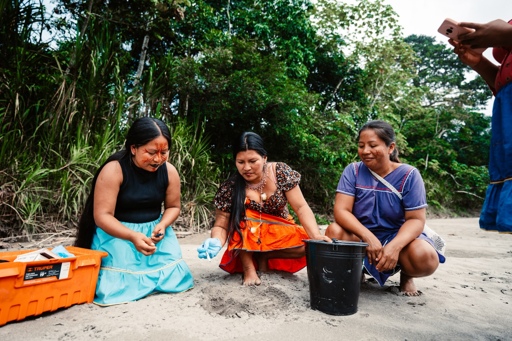
On the banks of the Aguarico River in the Ecuadorian Amazon, a group of Indigenous Siekopai women are combining traditional knowledge and modern technology to help a threatened native turtle recover. Their efforts center around charapa turtles (Podocnemis unifilis), also known as the yellow-spotted Amazon River turtle, Mongabay Latam’s Astrid Arellano reported. The animal’s populations have declined due to hunting adult turtles, harvesting eggs from nests and pollution from garbage, oil and gasoline. “Sometimes we see plastic, garbage bags,” Janeth Piaguaje, a Siekopai community leader of the project, told Mongabay Latam. “We also see dead animals floating down the river. We can’t control all of that, but we do make a significant effort to clean the beaches where we work.” Boat traffic is also eroding riverbanks, and climate change has caused water levels to rise, flooding the flats where turtles make their nests. Charapa turtles are listed as vulnerable by the IUCN, the global conservation authority. To help the turtles recover, a group of seven Siekopai women, who call themselves Tari Nomiowa’i, or “turtle women,” patrol the riverbanks looking for turtle tracks and nests. When they find nests, the women carefully collect the eggs, a skill Piaguaje said she learned from her father. “He taught me how to handle the eggs, how to see on what dates and in what months the turtles lay their nests,” she said. The women document the date, time, location and number of eggs in each nest using the Epicollect5 app, a field data collection tool. Then they take the eggs…This article was originally published on Mongabay
From Conservation news via This RSS Feed.