

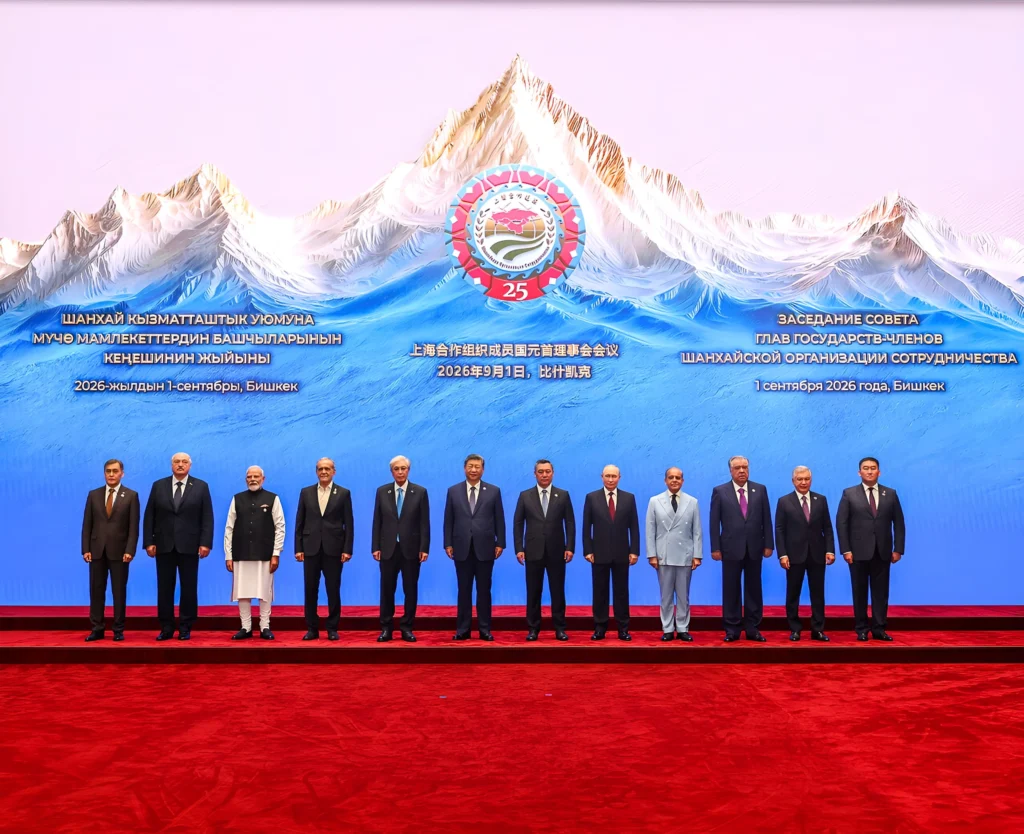
New framework expands regional counter-terrorism efforts and Eurasian logistics networks.
The 26th Meeting of the Council of Heads of State of the Shanghai Cooperation Organisation (SCO) took place from August 31 to September 1, 2026, in Bishkek, Kyrgyzstan.
Hosted by Kyrgyzstan President Sadyr Japarov at the Yrys Ordo Congress Hall, the gathering coincided with the SCO’s 25th anniversary. The event operated under the official theme, “25 Years of the SCO: Together for Sustainable Peace, Development and Prosperity”.
RELATED:
Anti-Sanctions Coalition: 3 Powerful Nations Defiantly Propose Revolutionary Global Shield
The summit convened leaders and high-level delegations from its ten full member states, alongside representatives from observer countries, dialogue partners, and international bodies such as the United Nations.
Key attendees included Chinese President Xi Jinping, Russian President Vladimir Putin, Indian Prime Minister Narendra Modi, Pakistani Prime Minister Shehbaz Sharif, Iranian President Masoud Pezeshkian, and Belarusian President Alexander Lukashenko.
The two-day summit concluded with the signing of the Bishkek Declaration. This joint document outlines collective stances on regional security, counter-terrorism, trade facilitation, and economic integration.
The 2026 summit served as a platform to evaluate the group’s growth over the past quarter-century and to set policy goals for intra-Eurasian trade, energy security, and security cooperation.
Origins and Structural Framework of the SCO
The Shanghai Cooperation Organisation dates back to April 1996 with the establishment of the Shanghai Five mechanism, composed of China, Russia, Kazakhstan, Kyrgyzstan, and Tajikistan.
Initially formed to address border security, demilitarization, and regional confidence-building following the dissolution of the Soviet Union, the Shanghai Five deepened its structural cooperation over the subsequent five years.
On June 15, 2001, during a summit in Shanghai, China, the original five nations, joined by Uzbekistan, officially declared the creation of the Shanghai Cooperation Organisation (SCO).
The founders established the SCO Charter in 2002, which entered into force in September 2003, laying out the institutional blueprint, operational mechanisms, and foundational goals.
The primary SCO founding objectives, reflected in the Shanghai Spirit, centered on strengthening mutual trust and neighborly relations among member states, promoting cooperation in trade, energy, transportation, and culture, and jointly maintaining regional peace and security, respect for diverse civilizations, and the pursuit of common development
Unlike traditional military alliances, the SCO Charter explicitly specifies that the organisation is not a military-political bloc directed against other states or international bodies.
The SCO membership structure has expanded significantly since 2001. The original six founding members (China, Russia, Kazakhstan, Kyrgyzstan, Tajikistan, and Uzbekistan) expanded in 2017 with the admission of India and Pakistan.
The Islamic Republic of Iran officially became a full member in 2023, followed by the Republic of Belarus in 2024, bringing the total number of full members to ten.
In addition to these full members, the SCO maintains formal ties with two observer states, Afghanistan and Mongolia, as well as 15 dialogue partners, including Türkiye, Saudi Arabia, the United Arab Emirates, Egypt, Qatar, Armenia, and Azerbaijan.
Institutionally, the SCO operates through two main permanent bodies. The SCO Secretariat, headquartered in Beijing, China, serves as the primary executive organ handling administrative and coordination functions.
The Regional Anti-Terrorist Structure, headquartered in Tashkent, Uzbekistan, serves as the central body for coordinating member efforts against terrorism, separatism, and extremism. Decisions within all SCO bodies are reached through consensus among full member states.
This is what the map of the new world looks like.
At the Shanghai Cooperation Organisation summit in Bishkek, leaders of 10 member states gathered, including China, Russia, India, Iran, and Pakistan.
At the center of the scene, Chinese President Xi Jinping stands in the middle…
— China pulse
(@Eng_china5) September 1, 2026
Agenda Items and Geopolitical Context of the Bishkek Summit
The SCO 2026 Bishkek Summit convened amid significant global economic volatility, shifting supply chains, and rising geopolitical tensions.
SCO leaders focused on addressing security vulnerabilities, economic fragmentation, climate challenges, and technological governance.
A primary agenda item was the mitigation of security risks stemming from terrorism, separatism, and extremism, which the SCO formally classifies as the three evils.
The SCO delegations discussed the expanding operational scope of the Regional Anti-Terrorist Structure and evaluated mechanisms to counter cross-border terrorist movements, online radicalization, and the proliferation of synthetic drugs.
The SCO Summit agenda also incorporated discussions on international information security and cyber defense coordination across member nations.
Economic cooperation formed a second critical pillar of the Bishkek proceedings. SCO member states reviewed strategies to facilitate cross-border trade, modernize regional port facilities, and streamline transport corridors.
Key discussions centered on reducing reliance on third-party currencies in regional transactions, increasing the use of national currencies in cross-border settlements, and strengthening interbank cooperation.
Environmental policy and digital transformation also received prominent attention on the SCO summit agenda. Leaders addressed joint climate change adaptation strategies, biodiversity management, and sustainable energy development.
On the technological front, discussions focused on regional data integration, expanding computing capacity, and developing shared frameworks for artificial intelligence governance.
Outcomes, Agreements, and The Bishkek Declaration
The SCO summit concluded with the adoption of the Bishkek Declaration alongside 27 separate institutional, economic, and security agreements.
The declaration reaffirmed the foundational principles of the SCO Charter, emphasizing non-alignment, non-interference in domestic affairs, and opposition to unilateral coercive measures or economic sanctions that bypass the United Nations Security Council.
In the realm of security, member states approved a protocol amending the 2002 SCO Charter and established regulations for the new Universal Center for Countering Security Challenges and Threats, expanding the organization’s collective framework against transnational crime, narco-terrorism, and cyber threats.
The SCO summit also adopted two strategic programs extending to 2030: one focused on combating general drug addiction and another targeting the spread of synthetic drugs and chemical precursors.
An international information security plan covering the 2026–2028 period was formally endorsed to enhance technical coordination among SCO member governments.
Economic and environmental outcomes included the approval of a 2026–2030 roadmap for developing ports and logistics centers, aimed at improving overland and maritime connectivity across Eurasia.
Leaders established the SCO Green Technology Corridor program for 2026–2030, signed a government-level memorandum on climate change cooperation, and adopted a joint action plan for biodiversity management spanning 2026–2031.
On digital infrastructure, SCO member states signed a joint memorandum on artificial intelligence and approved a concept for developing regional computing capacity and data centers.
The Bishkek Declaration addressed critical international developments, explicitly condemning military strikes on the territory of the Islamic Republic of Iran and citing risks to regional stability and international law.
The SCO declaration called for the peaceful resolution of West Asian conflicts solely through diplomatic channels and emphasized the necessity of a comprehensive settlement regarding Palestine.
Additionally, the Bishkek document noted the conclusion of Kyrgyzstan’s presidency and confirmed the transfer of the rotating SCO chairmanship to Pakistan for the 2026–2027 cycle, designating Lahore as the SCO Tourism and Cultural Capital for the upcoming year.
Ten countries, including China, Russia, and India just condemned as “illegal” the US-Israeli war on Iran — and affirmed Palestinian sovereignty and Tehran’s right to a nuclear program while they were at it.
Sri Lankan journalist @shiranperuma breaks down the Bishkek… pic.twitter.com/rZRt4Xhe6B
— BreakThrough News (@BTnewsroom) September 1, 2026
Key Excerpts and Analysis of Presidential Speeches
Addresses delivered during the Bishkek Summit highlighted the distinct security, economic, and political priorities of individual SCO member nations while emphasizing shared commitments to regional stability.
Chinese President Xi Jinping focused his address on global governance reform, sustainable development, and regional security initiatives. He advocated for deeper integration of the Belt and Road Initiative with the national development strategies of Eurasian partners.
On the other hand, Russian President Vladimir Putin emphasized financial independence and the expansion of sovereign economic mechanisms across Eurasia. His remarks centered on alternative trade infrastructure and counter-sanctions resilience.
Moreover, Iranian President Masoud Pezeshkian condemned unilateral economic measures and highlighted the role of regional bodies in safeguarding sovereign equality.
At the same time, Indian Prime Minister Narendra Modi and Pakistani Prime Minister Shehbaz Sharif addressed regional connectivity and counter-terrorism. Prime Minister Modi highlighted the importance of transparent infrastructure projects that respect sovereignty and territorial integrity, while emphasizing zero tolerance toward cross-border terrorism.
Prime Minister Shehbaz Sharif emphasized the imperative of collective action against all forms of terrorism, called for peace in West Asia, and underscored Pakistan’s commitment to advancing regional trade corridors as it assumes the rotating SCO chairmanship for the 2026–2027 period.
The Role of the SCO in Global Multipolarity
The adoption of the Bishkek Declaration during the SCO summit, paired with nearly 30 functional agreements across security, transport, climate, and digital governance, reflects the growing institutional maturity.
Rather than functioning as a rigid military alliance, the SCO operates as a regional platform focused on economic coordination, border security, counter-terrorism, and political consultation.
The SCO summit in Bishkek demonstrated that Eurasian nations are increasingly relying on intra-regional frameworks to resolve security challenges, expand local-currency trade, and build infrastructure independently of external power dynamics.
From development and security to people-centered cooperation and dialogue, the proposal focuses on strengthening cooperation and promoting a more equitable international… pic.twitter.com/LhVSugwhuB
— teleSUR English (@telesurenglish) September 1, 2026
Sources: The Indian Express – World Bank Open Data – Official Secretariat of the Shanghai Cooperation Organization- TASS – CGTN – Anadolu Agency – Associated Press – Xinhua News Agency – TASS – Euronews – Press TV – Al Mayadeen – Al Jazeera
From teleSUR English via This RSS Feed.