

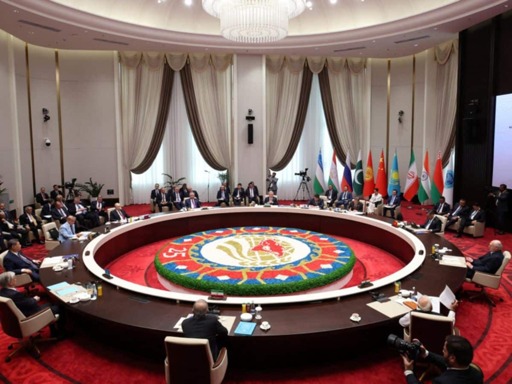

The Shanghai Cooperation Organisation (SCO), uniting India and Pakistan, condemned military strikes against Iran in a joint statement called the “Bishkek Declaration,” on September 1 following the 25th annual SCO summit in Bishkek, Kyrgyzstan.
The statement said:
Member states expressed serious concern about developments in the Middle East and around the Islamic Republic of Iran, and reiterated the SCO’s condemnation of the military strikes against Iranian territory that have caused numerous civilian casualties and severely damaged the country’s economy.
Such actions violate the UN Charter and the principles and norms of international law, posing a serious risk to world peace, security and stability.
Member states expressed their sincere condolences to the Iranian government and people for the tragic death of Ali Khamenei, Supreme Leader of the Islamic Republic of Iran, and also extended their sincere sympathies to the families of the other victims.
Member states reaffirmed their support for the sovereignty and territorial integrity of the Islamic Republic of Iran, advocated for a political and diplomatic solution to the conflict, and welcomed all efforts conducive to de-escalating the regional situation.
Member states pointed out that only a comprehensive and just solution to the Palestinian question can achieve peace and stability in the Middle East.
The declaration explicitly condemns military strikes on the territory of the Islamic Republic of Iran, which is more forceful than the March statement, which simply said the use of force was “unacceptable.”
However, even the Bishkek Declaration fell short of naming the culprits of the war of aggression on Iran — the US and Israel.
Al Jazeera also noted that the SCO declaration opposed unilateral coercive measures that violate UN and WTO rules and could negatively impact the global economy. However, it did not specifically mention US sanctions on Iran or Western sanctions on Russia.
The summit was attended by Chinese President Xi Jinping, Russia’s President Vladimir Putin, Iranian President Masoud Pezeshkian, Indian Prime Minister (PM) Narendra Modi, and Pakistani PM Shehbaz Sharif, among other leaders of SCO member nations. Turkish President Erdogan also attended the SCO summit, of which Turkey is a “dialogue partner.”
SCO Members Find Common Ground on Iran
Shiran Illanperuma, Tricontinental Institute for Social Research, speaking to BreakThrough News, said:
The fact that all of the countries present, including India, Pakistan, Russia, and China, have signed on to condemning the illegal US-Israeli attacks on Iran. They have also affirmed Palestinian sovereignty. These are not small developments. There are very real differences in foreign policy among these countries, yet for them to come together and agree on these fundamental issues affecting our part of the world, in the Global South and Asia, is, I think, very significant.
Illanperuma noted that all countries present, including India, Pakistan, Russia, and China, signed on to condemning the illegal US-Israeli attacks on Iran. They also affirmed Palestinian sovereignty. He emphasized that these were not “small developments.”
He added:
These statements demonstrate, I think quite blatantly, that Iran is not alone. Iran is not isolated. The US and the US-led sort of Global North block have the financial power to sanction and economically try to isolate Iran. That is true. They have the military power to bomb its civilian infrastructure. That is true. But politically they are really not able to coerce the rest of the world from denying the legitimacy of the existing Iranian government.
Upsetting pictures for Washington
Einar Tangen, a Senior Fellow at the Taihe Institute, said in an interview that nothing upsets Washington more than seeing the leaders of Russia, India, and China laughing and exchanging words in a group setting, making it “very clear that their communications are strong and that they are very much interested in each other.”
He added:
I’m just saying that the picture that I saw and the impression I got was the three—Modi, Xi, and Putin—laughing, shaking hands, being very cordial. As I said, this is the stuff of nightmares in Washington DC. The two most populous countries, together with the country that has the most resources, coming together when the US desires them to be apart.
They want India to be a doorstop against China. They want to split Russia and China apart because China is obviously a peer competitor—or I shouldn’t say peer anymore—it vastly outproduces the United States, and they need resources. And guess what? Russia is a huge resource nation. Having this combination is exactly what Donald Trump fears.
New York Times admitted that Trump “painted himself into a corner,” as he cannot simultaneously pressure Iran while keeping China on its side, because China is Iran’s economic lifeline. It said:
Trump has painted himself into a corner. The administration is struggling to square two seemingly irreconcilable goals: tightening pressure on Iran and maintaining its truce with China.
The article was headlined: “Summit With Russia, India and Iran Shows Leverage Wars Have Given Xi of China.”
As Trump alienates allies left and right, Russian, Chinese, and Iranian leaders meet to reaffirm their own partnership. https://t.co/Ds1yznrLjw
— Kenneth Roth (@KenRoth) August 31, 2026
NYT is saying the quiet part out loud.
Featured image via PressTV
By Nandita Lal
From Canary via This RSS Feed.