

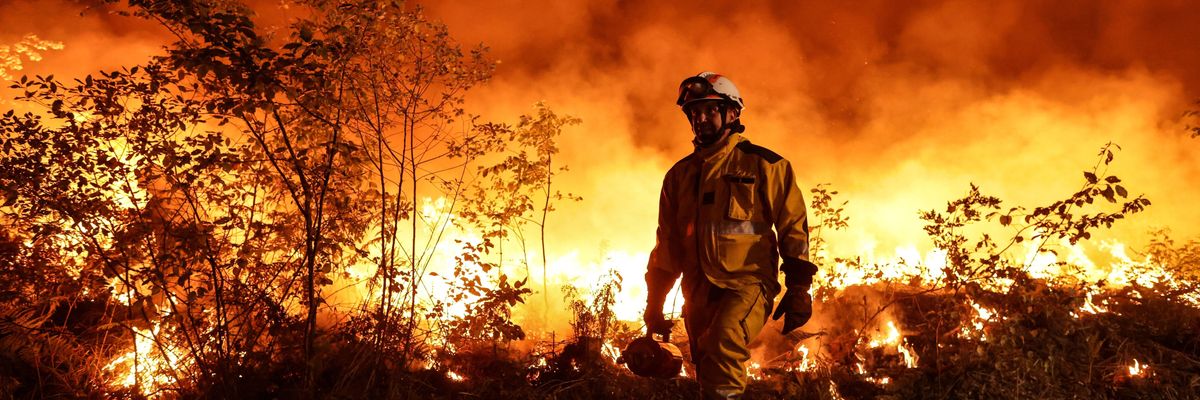
The world has officially moved past the point where preventing a temperature rise above 1.5°C will be possible, scientists said in a United Nations report released Wednesday, which made clear that communities can expect sea levels to continue rising, heatwaves to intensify, and hurricanes, wildfires, and flooding to become more frequent and dangerous—all climate impacts that experts have long warned about as policymakers have failed to rapidly draw down greenhouse gas emissions.
But the authors of the report, published by the UN Environment Program (UNEP) and titled “Limiting Overshoot,” emphasized that the inevitable temperature rise must not be viewed as a point of no return, and that steps can and must be taken to ensure the overshoot of the 1.5°C goal is only temporary.
The best-case scenario is now a peak global temperature of 1.8°C, said the report’s dozens of authors, with an "overshoot, peak, and decline” pathway still possible before the end of this century if policymakers ensure that planet-heating fossil fuel emissions are drastically reduced—starting immediately.
The report is the first ever to establish the inevitability of overshooting the 1.5°C goal that countries were tasked with working toward when the Paris climate agreement was signed in 2015, and to chart a path toward ensuring the planet can ultimately make its way back down to 1.5°C—hopefully limiting the time above the threshold to a few decades.
If the world remains above 1.5°C over preindustrial temperatures long-term, said UNEP Executive Director Inger Andersen, “there are no good outcomes.”
Last year, global temperatures were already about 1.3°C to 1.4°C above the preindustrial average, The Washington Post reported, and the effects on the Earth have been made clear as wildfires have engulfed parts of Canada and South America; a glacial collapse led to flooding that killed more than 1,000 people in Nepal last week; and extreme heat killed more than 1,000 people across Europe this summer.
"Across the globe, extreme heatwaves are already proving that climate impacts will strike faster, hit harder, and last longer—costing more lives and causing deeper disruption,” said Andersen. “Now is the time we must double down on climate action. We can—and must—get on the right path. By cutting greenhouse gas emissions, strengthening resilience and adaptation, and ensuring exceedance of 1.5°C is as small and short as possible.”
The scientists said planet-heating fossil fuel emissions must be slashed by 55% by 2035 and almost entirely eliminated by the middle of the century to limit the global temperature rise to 1.8°C above preindustrial levels.
Climate scientist Joeri Rogeli of Imperial College London, a lead author of the report, told the Post that swift action is crucial, as “for every five years that humanity delays reducing emissions… the peak temperature the world will ultimately face rises by at least a 10th of a degree.”
The scientists emphasized that avoiding the 1.5°C limit would have been a less daunting goal than reversing the temperature rise. Policies that continue allowing oil, gas, and coal companies to extract fossil fuels will make both goals difficult to achieve.
The report was released weeks after President Donald Trump terminated offshore wind energy projects in the US—the latest of several renewable energy projects he’s killed—and moved to take ownership of Venezuelan oil fields. Recent global climate summits have been attended by an outsized number of corporate lobbyists for fossil fuel industries, weakening the climate commitments that have come out of the meetings.
Fenton Lutunatabua of 350.org Pacific noted that the report was also released as Pacific countries meet at the 55th Pacific Islands Forum Leaders Meeting.
“All eyes are on one of the world’s largest fossil fuel exporters, Australia, and how they act on this urgent warning,” said Lutunatabua. "The climate crisis is here and any delay in mitigation, in phasing out coal, oil, and gas, will only make our adaptation pressures harder and more expensive to bear.”
The report emphasizes that even if the world is able to reduce planetary heating once global temperatures shoot above 1.5°C, some impacts of continued fossil fuel extraction will be irreversible, including the melting of glaciers and the extinction of some species.
But UN Secretary-General António Guterres was among those who said “an overshoot of ambition” is now required to mitigate the damage as much as possible.
“This summer’s scorching heat, raging wildfires, and deadly floods are a warning of what lies ahead. We must make the overshoot above 1.5 degrees as small and short as possible,” said Guterres.
Along with rapidly cutting emissions, the report calls “carefully governed carbon dioxide removal (CDR)—the process of removing carbon from the air and storing it through afforestation or other means—an essential part of the mix.”
CDR methods—from planting forests to act as carbon sinks to technological fixes—come with limitations and are potentially reversible. Forests that are planted could be destroyed by wildfires, while CDR technology is largely unproven and can be energy-intensive—negating many of the benefits.
“Overall, even optimistic CDR scaling is unlikely to deliver a temperature reversal beyond a few tenths of a degree this century,” reads the report. “This emphasizes the importance of focusing on reducing greenhouse gas emissions.”
Richard Betts, a climate scientist at the University of Exeter and another report author, told the Post that CDR cannot be relied upon as a “get-out-of-jail-free card.”
At 350.org, head of campaigns and networks Savio Carvalho said that "there is no version of ‘limiting overshoot’ that doesn’t start with ending new coal, oil, and gas expansion today.”
“This report confirms what communities on the frontlines of the climate crisis have been telling us for years: that delay is not a neutral act, it is a decision,” said Carvalho. “We’ve just watched a glacier collapse bury Himalayan communities under mud and water, and we’re watching Pacific nations lose land to the sea in real time. UNEP is right that overshoot doesn’t have to mean surrender: The size and length of that overshoot is still being written by the decisions governments make this year, on fossil fuel phase-out, technology transfer, and on finance for the countries least responsible and most exposed.”
Murat Kurum, Türkiye’s minister of environment, urbanization, and climate change and the president-designate of the 31st UN Climate Change Conference (COP31), said the upcoming summit scheduled for November “must turn this urgency into concrete action.”
“Every fraction of a degree matters, and every year spent in overshoot increases climate risks and the potential for irreversible losses," said Kurum. “The Overshoot Report makes clear that exceeding 1.5°C should not be seen as a new destination, but as a pathway we must urgently work to minimize and reverse. This requires rapid and sustained emissions reductions, alongside ambitious adaptation to protect people, communities, and ecosystems.”
“We need to accelerate global electrification, reduce methane emissions from waste, strengthen the climate resilience of cities, and enhance the resilience of marine and coastal ecosystems,” he added. "The choices we make today will determine how high temperatures peak, how long they remain there, and how safely we can return to 1.5°C.”
From Common Dreams via This RSS Feed.