

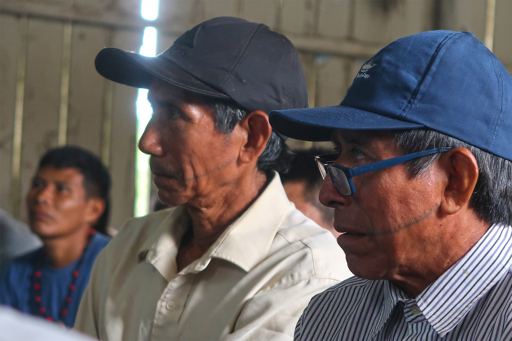
REQUENA, Peru — Until a century ago, few Matsés had ever been in contact with a white person before. The Indigenous people lived in a remote area of the Amazon Rainforest, along the border of Peru and Brazil, in seminomadic forest settlements between the Javari, Yaquerana and Gálvez rivers. There, wild meat was abundant — and they could hide from outsiders and rival groups. Roberto Necca Tumi Unan had just returned from a swim in the river when Mongabay arrived at his rectangular wooden stilt house for an interview. He’s one of the community’s last surviving elders, born before first voluntary contact with the outside world in the 1960s. Necca recalled how, on a few rare occasions, while cutting hunting trails through the dense jungle undergrowth alongside older men from his family, they would hear the alien sounds of outsiders. The men would quickly vanish into the undergrowth, covering themselves with damp leaves so the outsiders wouldn’t find them. “That had been a great fear for us because confrontation between mestizos and the Matsés before contact was dangerous,” he said. The Matsés, tired of conflict and displacement, said they chose to make contact with missionaries from the Summer Institute of Linguistics (SIL), an evangelical nonprofit, in 1969. While this initial contact brought some peace, it also marked the beginning of a decades-long struggle against deadly diseases. By 1981, the Matsés population, who had settled in Yaquerana district, in Peru’s Loreto department, was plagued by severe epidemics of influenza and pneumonia.…This article was originally published on Mongabay
From Conservation news via This RSS Feed.