

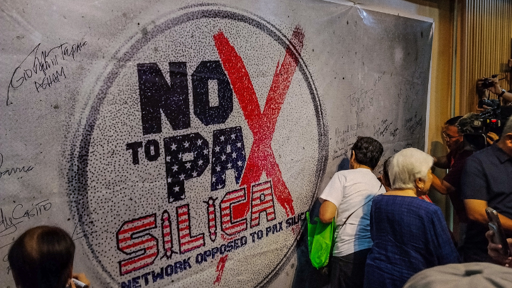
“We must prioritize the people, not foreign profits.”
MANILA — Indigenous peoples, farmers, scientists, environmental advocates, faith leaders, students, and progressive organizations launched the Network Opposed to Pax Silica (NO to Pax Silica) on Aug. 31, warning that the Marcos, Jr. administration’s participation in the United States-led initiative could threaten ancestral lands, food security, environment, and national sovereignty.
The coalition was launched at the Mary Hill School of Theology in Quezon City amid growing public debate over Pax Silica and the proposed Economic Security Zone (ESZ) in New Clark City, Tarlac.
The network described its formation as the beginning of a nationwide campaign to scrutinize the project and mobilize communities that may be affected by its implementation.
The launch came weeks after government agencies intensified efforts to promote Pax Silica as a flagship industrial and technology initiative linked to artificial intelligence (AI), semiconductors, advanced manufacturing, and critical minerals under the Luzon Economic Corridor. Government officials said the project could attract billions of dollars in investments and generate more than 130,000 jobs.
The Bases Conversion and Development Authority (BCDA) identified a site in New Clark City for what it describes as an AI-native industrial acceleration and manufacturing hub under the Pax Silica framework.
The coalition questioned whether the project would benefit ordinary Filipinos or primarily serve foreign strategic and corporate interests.
“Pax Silica: Development for whom?” became the central question raised throughout the program.
Displacement
Representatives of Indigenous communities said that they learned about Pax Silica through social media rather than through direct consultations.
Apung Petronila Capiz-Muñoz, chieftain of Sitio Sapang Kawayan in Capas, Tarlac, said that government authorities have yet to explain the project to affected communities.
She also recounted experiences of military red-tagging directed at Indigenous residents who raised concerns about the project.
Capiz-Muñoz said that many Aetas fear the possible loss of ancestral lands and livelihoods.
“How about us Indigenous peoples and fellow farmers?” she asked. “We all know that the land is our life. What will happen to our livelihood?”
She said that the uncertainty surrounding the project deepened anxiety among communities that depend on farming and ancestral lands for survival.
“I cannot accept it,” she said. “I hope Pax Silica will not push through. What will happen to the next generations?”
The coalition said that the proposed Economic Security Zone could affect approximately 1,620 hectares of agricultural and ancestral lands in Capas, Tarlac.
It warned that industrial expansion and land conversion could displace farming families and Indigenous communities while weakening local food production.
Environmental impact
Environmental advocates challenged the lack of transparency surrounding the project.
Beauty queen and environmental advocate Beatrice Millan-Windorski said that no publicly available Environmental Impact Assessment has been released for Pax Silica.
“As one of the world’s 18 megabiodiverse countries, we should not bear the brunt of a development with no transparency or clear data on environmental impact,” she said.
Millan-Windorski said that communities deserve access to information before the government proceeds with large-scale industrial projects.
She warned that hyperscale data centers and related infrastructure could place additional pressure on water, energy, and land resources.
“What we do know is that data centers generate a heat island effect and consume immense amounts of energy, water, and resources,” she said.
She also cited reports that farmers in Barangay O’Donnell had been asked to leave lands they had cultivated for generations and warned that hundreds of families could face displacement if the project proceeds.

Photo by Dulce Amor Rodriguez
Antonio Dizon of Ban Toxics raised similar concerns. He warned that the country could become a dumping ground for electronic waste generated by high-technology industries.
“Our country is already experiencing the severe effects of the climate crisis and biodiversity loss,” Dizon said. “We must prioritize the people, not foreign profits.”
Struggle over resources
Scientists who joined the launch framed the debate as a question of who will control critical resources needed for emerging technologies.
Giovanni Tapang, chair emeritus of Agham-Advocates of Science and Technology for the People, said that Pax Silica involves competition over minerals, energy, water, semiconductor production, data processing, and artificial intelligence infrastructure.
Tapang questioned whether the country’s mineral wealth would support national industrialization or serve foreign supply chains.
He said that industrial development should strengthen domestic production and address local needs rather than respond mainly to geopolitical competition between major powers.
Sovereignty
Teodoro ‘Teddy’ Casiño, chairperson of Bagong Alyansang Makabayan, said that Pax Silica must be understood within the broader strategic rivalry between the United States and China.
Casiño said that AI, semiconductor production, and critical minerals have become central to global geopolitical competition.
He warned that the Philippines could become entangled in conflicts between major powers through projects linked to strategic supply chains.
“What role is the Philippines being prepared for in the conflict between the United States and China?” he asked.
The Philippines joined the Pax Silica initiative in April. The framework seeks to strengthen supply chains for AI technologies, semiconductors, and critical minerals among participating countries.
Recent Senate hearings also examined concerns related to sovereignty, land use, environmental impacts, and resource requirements, while government officials acknowledged that key terms of the proposed project remain under discussion.
Nationwide campaign
The coalition said that it will conduct public education campaigns, community consultations, organizing efforts, and mobilizations in the coming months.
Members called on Indigenous peoples, farmers, workers, environmental groups, scientists, faith-based organizations, students, and other concerned sectors to participate in discussions on the future of Pax Silica.
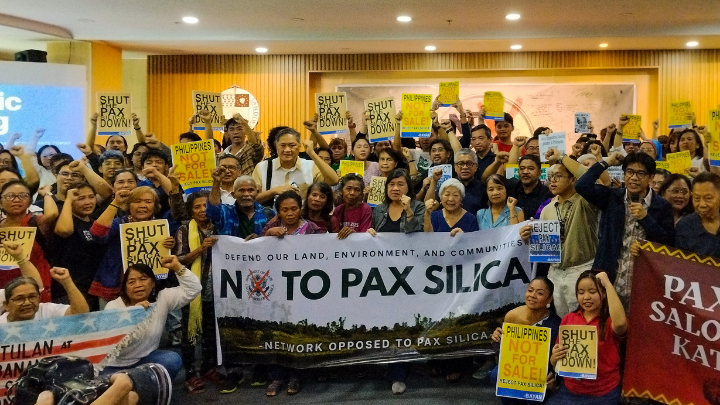
Representatives and members of various organizations raise their fists during the launching of the Network Opposed to Pax Silica (NO to Pax Silica) on August 31, 2026. By Dulce Amor Rodriguez/Bulatlat
In a joint statement, the network said that development should not come at the expense of communities whose lives depend on the land and resources targeted for industrial expansion.
“Development cannot mean taking land from Indigenous peoples and farmers, exhausting our water and energy, and handing strategic resources over to foreign corporations,” the coalition said. “The Filipino people have the right to know what is being negotiated in their name, who stands to benefit, and what communities will lose.” (DAA)
The post Indigenous communities, advocates launch network opposing Pax Silica appeared first on Bulatlat.
From Bulatlat via This RSS Feed.