

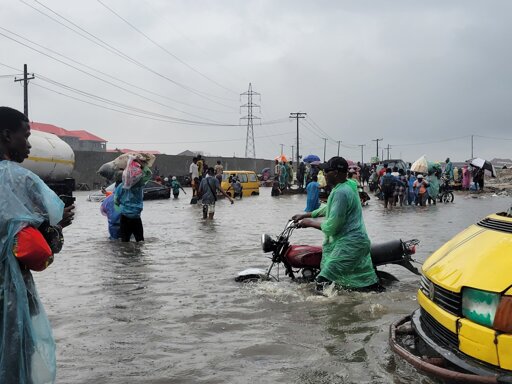
In July, following relentless bursts of rainfall, flash floods covered pockets of Lagos, disrupting commerce and traffic in Nigeria’s commercial capital. Experts have found that the city now faces increased flood risk due to human-induced climate change. Other recent studies have identified another common factor exacerbating flooding risk in Lagos: rapid urbanization. In a study published in June, for example, a team of researchers examined satellite images of Lekki, a densely populated Lagos district, from 2015 to 2025. Their analysis showed that vegetation cover in the neighborhood had decreased by 13% in the last 10 years, while water bodies had reduced by 6%. Meanwhile, within the same timeline, settlements had risen by 10% on natural land cover, which was “causing an increase in flooding events in the area,” the authors concluded. The study is the latest in a series of investigations linking worsening flooding across Nigeria’s coastal cities to eroding wetlands. A study published in February found that between 1984 and 2023, areas with buildings and infrastructure in Lagos expanded by 38%. Meanwhile, forest cover had declined by 32% and water bodies reduced by 11%, “reducing the natural flood buffering capacity of Lagos Megacity,” the authors wrote. With the persisting loss of vegetation and wetlands, the authors predicted, more than 60% of Lagos’ urban areas will be affected by extreme flooding by 2050. Mark Ofua, the West Africa representative for Wild Africa, a conservation nonprofit, said that a real estate boom was to blame for the increasing ecological loss.…This article was originally published on Mongabay
From Conservation news via This RSS Feed.