


Bullets:
Chinese mines are electrifying their equipment fleets, and enjoy massive advantages in operations costs compared to mines running diesel machines.
Autonomous (self-driven) Chinese electric trucks replace three drivers, each, which means hundreds of millions of dollars in annual cost savings that are foregone by Western mining operators.
Huawei and ZTE build the 5G telecom infrastructure, and other Chinese firms install the fast-charging technologies that enable smart mining.
Those companies are banned in most Western countries.
Inside China / Business is a reader-supported publication. To receive new posts and support my work, consider becoming a free or paid subscriber.
Report:
Good morning.
High energy prices are scrambling up all the math for buyers of capital equipment. Last week we showed how the soaring costs for diesel fuel are causing big problems for farmers in North America, even though the United States and Canada have oil and natural gas gushing out of the ground. Energy is a global market, and the wars in the Persian Gulf and Europe have taken a lot of the global refining and logistics capacity offline.
China does not have surplus fossil fuel generation, and decades ago began the process of building power sources based on renewables—wind and solar—and electrifying their ground transportation systems. Today China leads the world in the production of electric vehicles, and are taking over markets everywhere else they’re allowed to go.
Chinese companies are also electrifying buses, farm tractors, and the very heavy trucks used in mining. And in doing so, mines that run Chinese equipment have enormous advantages, over mines elsewhere that use diesel.
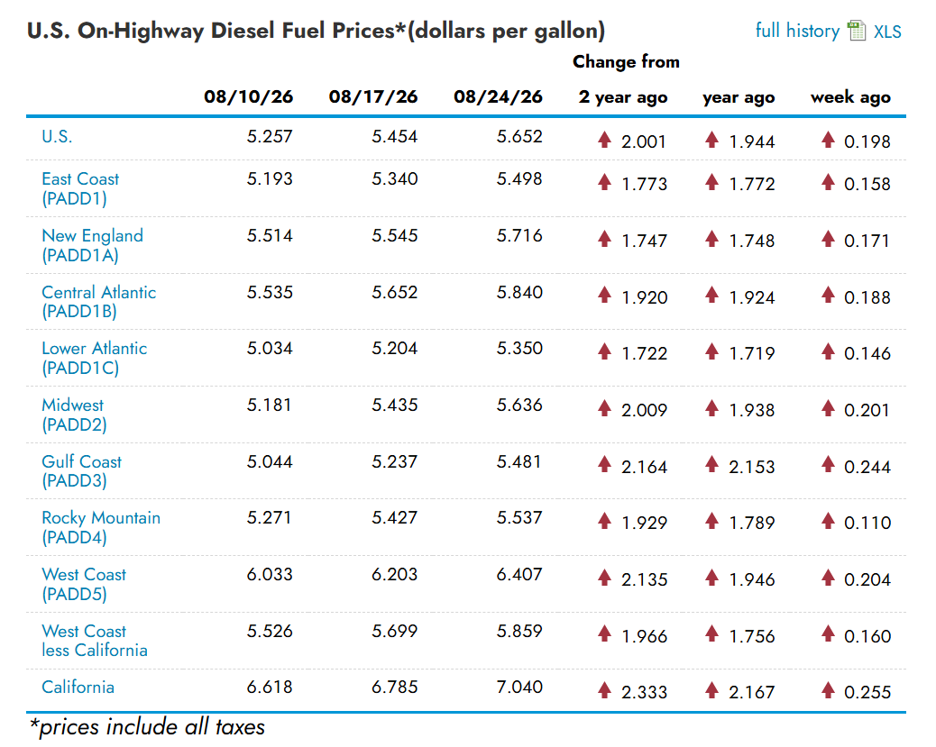
Diesel costs are blowing out, even in the United States, because there aren’t enough refineries for it. Average diesel prices in the US are up over $2 a gallon from two years ago. That is a 60% jump in two years.
So as we go through these examples, we need to remember that any company buying new diesel equipment today is signing up for years of diesel fuel purchases, at price points that are determined by events completely outside his control. He may see oil rigs pumping away on even his own property, but fuel costs are based on what is happening elsewhere in the world.
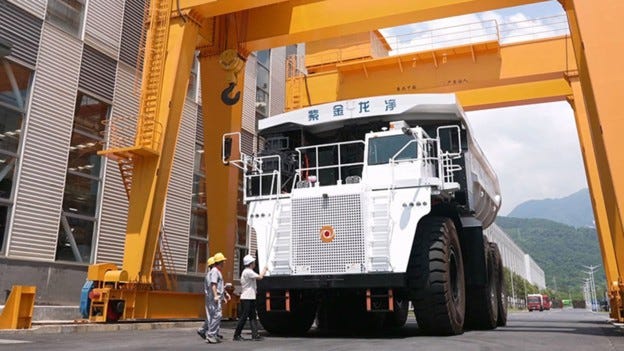
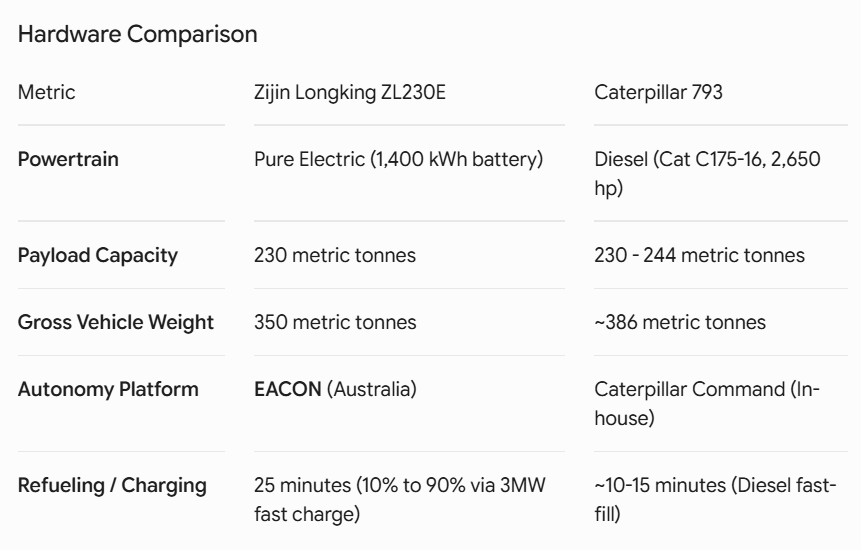
This is the world’s largest electric mining truck; it’s produced by Longking. The payload is 230 tons, and it is built in partnership with an Australian company, for large open-pit mining operations. In terms of payload and power, it’s comparable to the Caterpillar 793 diesel mining truck. The Chinese electric truck takes 25 minutes to refuel, compared to about half that for the Cat.
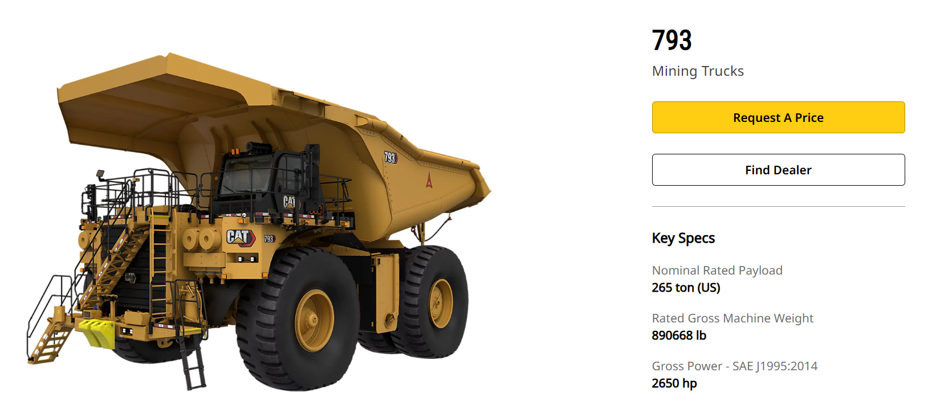
We’re comparing apples-to-apples, best we can. And the historical baseline comparison is for diesel fuel at $1 per liter. The Cat-793 cost of fuel is $150 per hour. The Chinese electric truck is $45.00 per hour.
Run them for a full year, and the operating cost savings for the electric model are $630,000 per year. Across a typical mine deploying 50 vehicles, it’s over $31 million a year saved by switching to electric.
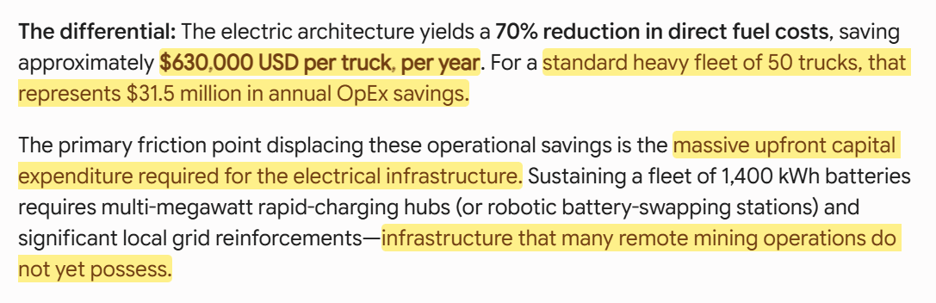
There is an important disclaimer, that mines running fleets of electric vehicles need to first build out the charging infrastructure to support fast charging, and mining operations outside China typically will not have that, unless partnered with Chinese companies that build it, which is a point we will come back to.
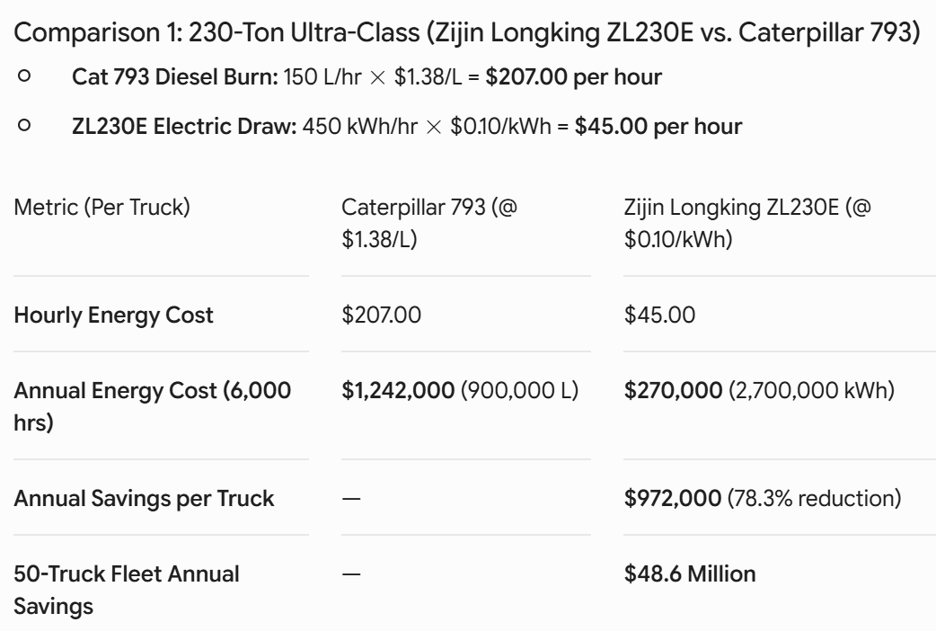
But today, the actual diesel fuel cost is $1.38 per liter, not $1.00. The price jump for diesel doesn’t affect the electric equipment, at all—hourly power is still $45. But the Caterpillar now is slurping down $207 an hour, instead of $150. Annual savings per truck jump to almost a million dollars, with fleet savings of $48.6 million per year:
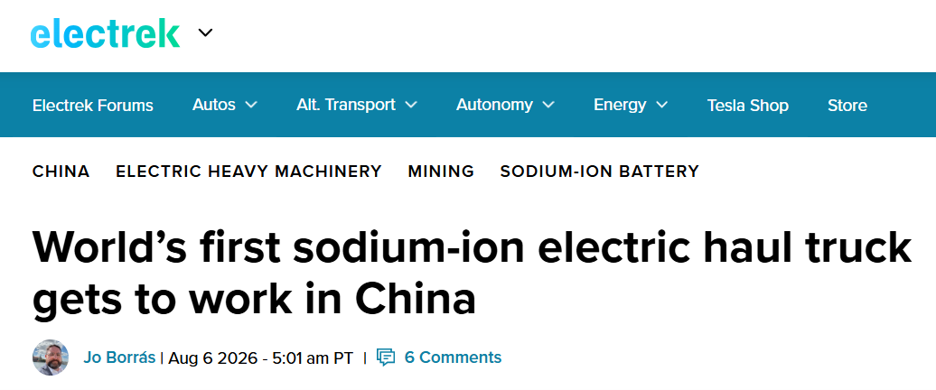
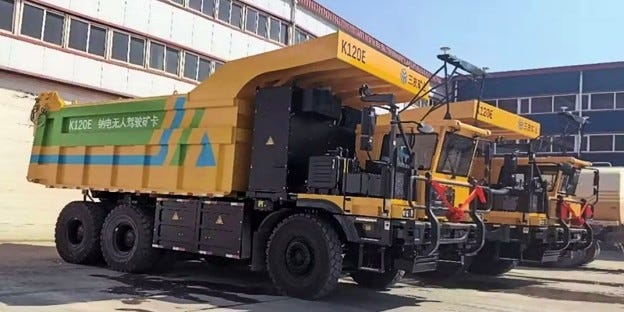
For Western mining operators, things just got a lot worse, on news from another Chinese company. Tonly Heavy Industry manufactures mining trucks that are powered by sodium-ion batteries, so are not reliant on the supply chains of lithium. Electric trucks enjoy major operational advantages over diesel, because of how they perform in extreme cold.
Electric trucks that are put on cold-weather mines are replacing diesel equipment that needs a lot of work just to get going. Minus-15C is 5 Fahrenheit, and diesel trucks are five times more difficult to start, compared to at 25 degrees. Just keeping the trucks rolling in cold climates is a full-time job for maintenance crews.
And cold weather has a similar effect on people, who are simply not nearly as productive. Tonly’s electric mining trucks are built for autonomous operations—self-driving—which is another factor that blows up the cost economics of Western mines. Eight hundred of those trucks are on their way to Xinjiang coal mines. Payloads are 90 tons, and those batteries feature a swapping system—seven minutes to have the trucks fully charged again, which is less time than it takes diesel operators to refuel:
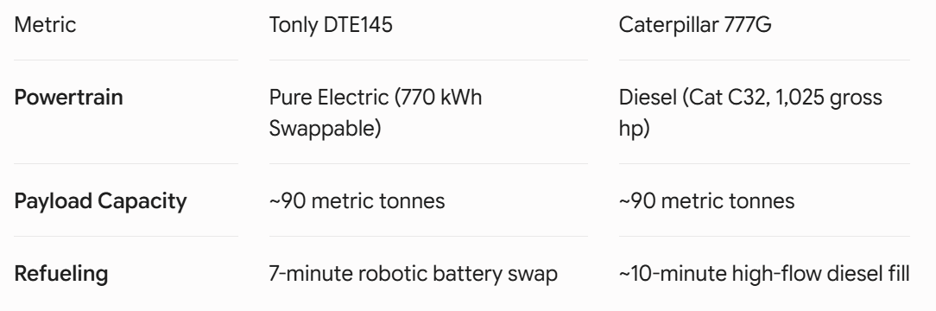
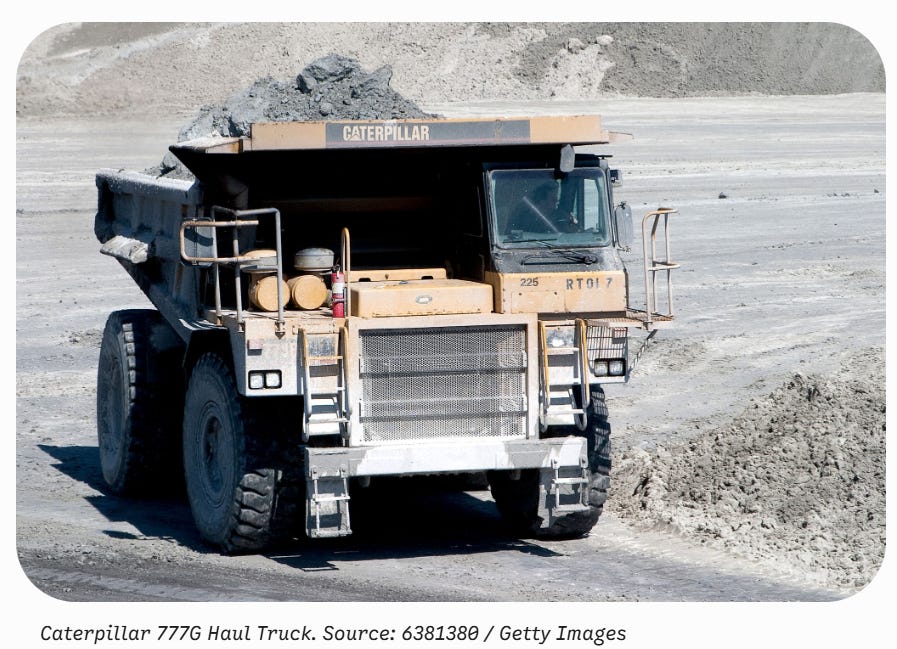
Nearest competitor to the Tonly is the Caterpillar 777G in terms of payload and power specs. At $1.38 per liter—that’s today’s average diesel price in the United States, the Cat operators spend $62 an hour for fuel. Powering the Tonly costs $12 an hour. Fuel costs are five times higher for the diesel equipment. Over a single year, it works out to over $300,000 in extra costs, per—on each truck, on a mine running the -777G’s, compared to the Tonly’s.
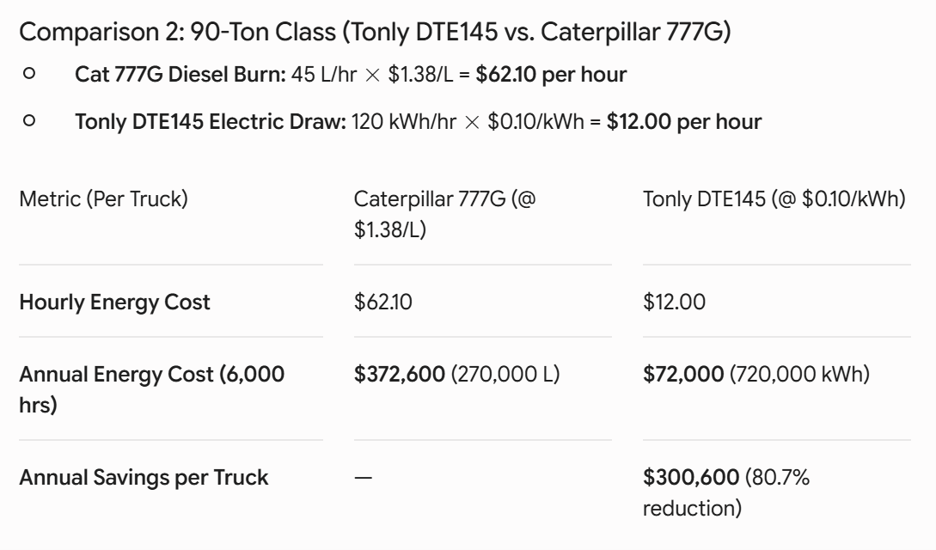
Then comes the labor cost. Eight hundred autonomous trucks replace 3,600 drivers. We’re accounting here for lower labor costs in Xinjiang, compared to the United States. Those 800 trucks displace 3,600 Chinese truck drivers and save $75.6 million. In the US, drivers earn much more, and replacing the drivers there would save $468 million a year.
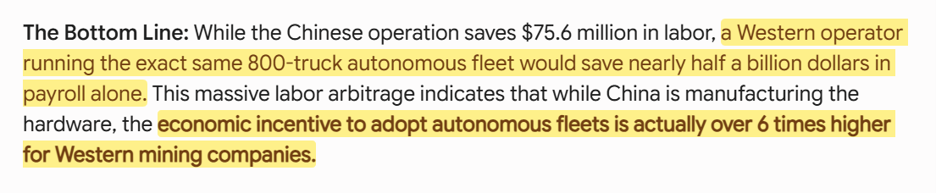
Bottom line: for a large mining operation, the economic advantages to switching to autonomous trucks is a savings there of about half a billion dollars, in labor costs. For the fuel, 800 trucks times that $300,000 difference is another $240 million. China is electrifying their mining operations, and are automating the driving.
But the incentives to do all that are actually far higher outside China. Economic incentives are over 6 times higher for Western mining companies—on just the autonomous mining question. Then they’ve got the higher fuel costs.
For big mining companies, there are nearly a billion reasons, every year, to switch over from diesel, to autonomous electric trucks. But they can’t. Here’s the problem. The infrastructure needs to be onsite, and Western governments have banned the infrastructure.
We did a feature on this last year: the first mine to switch to autonomous electric trucks was in Nei Mogu, where the weather gets very cold, and stays cold for a long time. For the networks for the self-driving trucks, Huawei built a local 5G telecom system with near-zero latency. The trucks run 24/7.
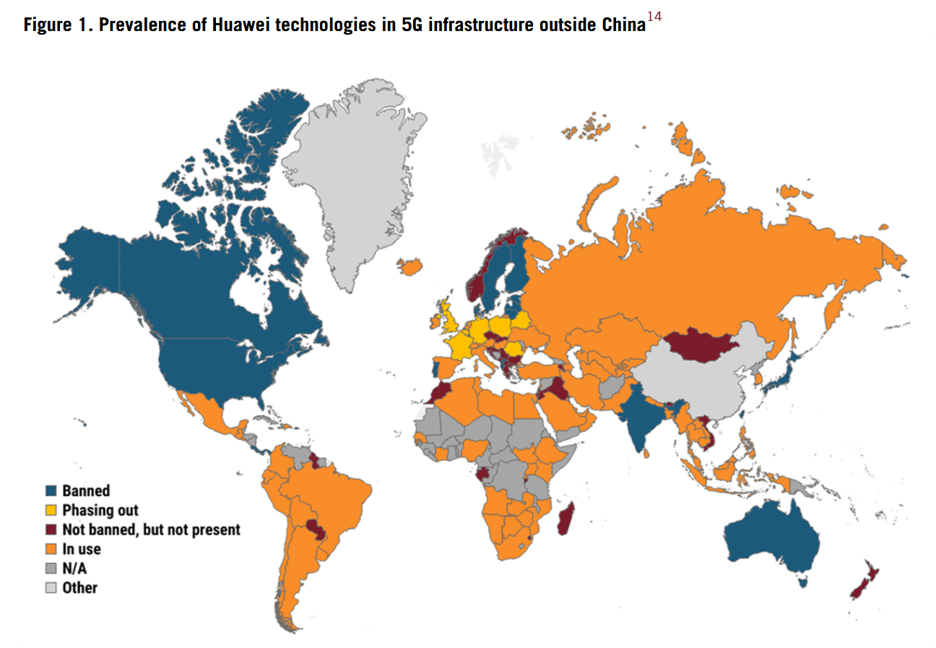
Autonomous mines first need the superfast communications infrastructure installed, Huawei and other Chinese companies build the gear for that, and Huawei equipment is banned in most Western countries. Orange on that map is where Huawei hardware is sold and in use. Any country on this map which is in blue or in yellow—including Australia, ironically—simply cannot compete with a mine anywhere else that can run smart trucks from China.
Be Good.
Resources and links:
U.S. On-Highway Diesel Fuel Prices*(dollars per gallon)
https://www.eia.gov/petroleum/gasdiesel/
AAA Fuel Prices
https://gasprices.aaa.com/
China unveils its largest pure electric mining truck with 1,400 kWh batteries
https://interestingengineering.com/transportation/china-unveils-largest-pure-electric-mining-truck
World’s first sodium-ion electric haul truck gets to work in China
https://electrek.co/2026/08/06/worlds-first-sodium-ion-electric-haul-truck-gets-to-work-in-china/
China debuts world’s first electric mining trucks with huge sodium-ion battery packs
https://thedriven.io/2026/08/10/china-debuts-worlds-first-electric-mining-trucks-with-huge-sodium-ion-battery-packs/
North China’s Yimin Mine deploys world’s first fleet of 100 5G-A connected, self-driving electric trucks
https://www.huawei.com/en/media-center/our-value/2025/driverless-trucks-yimin-mine
Cat® 793 Mining Truck
https://www.cat.com/en/_US/products/new/equipment/off-highway-trucks/mining-trucks/116620.html
How to Start a Diesel Truck in the Cold
https://dfcdiesel.com/2022/11/17/how-to-start-a-diesel-truck-in-the-cold/
Electric Mining Truck DTE145 /1,200 kWh Battery
Electric, autonomous, and there’s 800 of them: inside this week’s BIGGEST deal
https://electrek.co/2026/07/22/electric-autonomous-and-theres-800-of-them-inside-this-weeks-biggest-deal/
Backfire: Export Controls Helped Huawei and Hurt U.S. Firms
https://itif.org/publications/2025/10/27/backfire-export-controls-helped-huawei-and-hurt-us-firms/
Diesel fuel costs are blowing up American farmers. How China benefits from the coming shift
China’s “intelligent mines” are getting rid of truck drivers and diesel fuel
Inside China / Business is a reader-supported publication. To receive new posts and support my work, consider becoming a free or paid subscriber.
From Inside China / Business via This RSS Feed.