

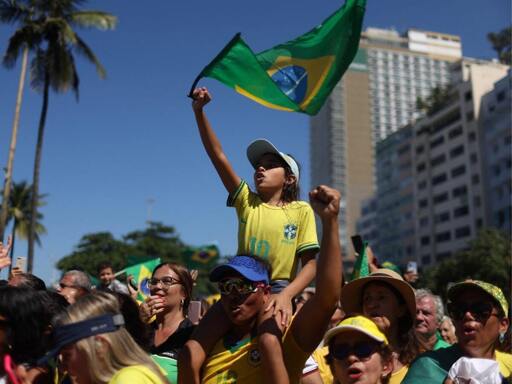

Brazil’s election in October could be a pivotal moment for US imperialism in Latin America, at a time when a pro-US far-right wave has taken power across the region. A win for the current centre-left president could buck the trend. But a win for the far-right candidate would significantly embolden Donald Trump’s aggressive offensive.
A return to power for the pro-Trump far right would have a huge impact because Brazil is the biggest country in Latin America and the biggest economy. It’s an agricultural, mining and manufacturing giant. And it was a founding member of BRICS alongside China (by far the economic superpower of the group), India, and Russia.
BRICS is about major non-Western economies pushing for global stability and growth, in respect for state sovereignty and the United Nations. It’s in many ways the anti-Trump, considering how the Trump regime has ramped up hostility on all of these fronts. So a far-right, pro-Trump shift in Brazil would likely weaken BRICS.
The significance of a Trumpian win in the election in Brazil
Far-right candidate Flávio Bolsonaro is the son of ex-president and jailed coup-plotter Jair Bolsonaro. And he’s pledging to continue his father’s mission of privatisation, spending cuts, attacks on the left, and militarising law enforcement (weaponising the term ‘terrorist’ against criminals).
Bolsonaro has gained the backing of Israeli war criminal Benjamin Netanyahu (whose genocide current president Luiz Inácio ‘Lula’ da Silva has firmly criticised) and Argentine uber-capitalist Javier Milei. And he has insisted:
Brazil is going to be the battleground where the future of the hemisphere will be fought, because Brazil is America’s solution to break dependence on China for critical minerals, especially rare earth elements
Embracing Trumpian rhetoric about ‘American values’ (i.e. extrajudicial executions, abducting presidents to steal oil, starving entire populations, and starting wars for genocidal apartheid states), Bolsonaro also claimed da Silva “hates America” and has “opposed America’s interests on every single issue of foreign policy”.
Apparently opposing policy independence, Bolsonaro asked for pressure to ensure “values of American origin” win – a nod to longstanding US efforts to dominate Latin America with money or force (especially against a supposedly ‘un-American‘ left during the Cold War). Trump, of course, has doubled down on this doctrine.
In short, Bolsonaro would be thoroughly servile to US interests if he won. And it would be easier to achieve key US aims in Latin America like strangling Cuba into submission.
A chance to boost racism and inequality, or to oppose it
Wealthy and white Brazilians tended to back Jair Bolsonaro, who rarely tried to hide his racist and misogynistic views.
Over half of Brazil’s population have African ancestry, and these people are more likely than white Brazilians to live in poverty or prison and to die violent deaths.
Though there are legitimate critiques of da Silva’s government, it has helped to lift millions of people out of poverty. And considering da Silva has actively sought to remedy ethnic inequality, creating in particular a ministry to foster racial equality, it’s little surprise that Black Brazilians tend to support him.
Brazil may be a middle-income country, but it has chronically high levels of economic inequality, poverty, and undereducation that put it alongside the figures of low-income countries. It’s among the least equal nations in Latin America (the most unequal region on the planet, where the richest 10% control over 50% of incomes).
We mustn’t ignore the sinister legacy of slavery
For many analysts, a big part of today’s inequality has roots in the legacy of slavery and the structural racism surrounding it.
Brazil was the destination of almost half the African people (around five million) whom European colonisers took by force to the Americas.
Wealthy colonisers first exploited the slave labour of Indigenous Brazilians, but then increasingly exploited African abductees to make money from coffee, sugar, tobacco, gold and diamonds. In the coffee boom of the early 19th century alone, Portuguese abductors forcibly brought 2.5 million Africans to Brazil.
Rio de Janeiro, meanwhile, was once the biggest ‘slave city’ in the world. It even has a mass grave of around 30,000 African abductees who died on the way over from Africa. And Brazil has never truly reckoned with this horrific legacy. Institutions which participated in the slave trade, for instance, haven’t faced justice.
Slavery didn’t end quickly either. Because Brazil’s elites resisted abolition as long as possible, becoming the Western Hemisphere’s last country to outlaw slavery in 1888.
Amid ongoing racist brutality and demands for reparations in today’s Brazil, many right-wingers (mostly white) think Brazil should just forget the past. But if violence is the top issue on voters’ minds, they would do well to acknowledge that the poverty and inequality that has persisted since slavery is a key driver of violent crime.
A clear election choice in Brazil
It’s perfectly acceptable to argue that da Silva’s government should have done even more to remedy Brazil’s extreme poverty, inequality, and structural racism. But it has asserted Brazil’s right as a Global South economy to choose its own path rather than bow down to the whims of an increasingly aggressive and unstable superpower.
Brazil’s far right, meanwhile, wants to hand the country to the US and financial elites. It’s very common, for example, to see US flags and requests for US intervention at pro-Bolsonaro events.
At a time when Brazil is one of just a few obstacles getting in Trump’s way in Latin America, the US is clearly interfering in the run-up to what is likely to be a close election in October.
The dirty forces favouring Flávio Bolsonaro
Just as the US funnelled millions into political and propaganda efforts to defeat the left and secure a dictatorship in power during the Cold War, it seems Brazil is also a key battleground today. Big US tariffs on Brazilian imports have coincided with an economic slowdown, for example. And the US has labelled Brazilian criminals as terrorists.
Political scientist Celso Rocha de Barros can’t believe people aren’t talking more about US interference. This is no ordinary election, he told the Guardian, because the world’s superpower is openly “strangling the Brazilian economy” to help Bolsonaro, who will “give them everything they want”. As he added:
Flávio will make a rare earths deal no other president would. Flávio will let American big techs do whatever they like in Brazil. Flávio will reduce economic relations with China as much as he can
US interference is going hand in hand with attempts to influence voters with artificial intelligence and fake news. Bolsonaro’s father entered power himself on the back of a strong fake news campaign in 2018, and almost benefited from a similar campaign in 2022.
One Bolsonaro tactic has been to try and make people doubt the integrity of Brazil’s voting system, despite it being generally trouble-free. Brazil’s government even denied entry visas to two officials from the Trump regime who were apparently planning to push such fake news. The US responded by revoking the Brazilian ambassador’s visa.
The propaganda isn’t going away. But voters can still turn out and stop Bolsonaro 2.0.
Grupo Globo, meanwhile, is Latin America’s biggest media conglomerate. Reaching 100 million people daily, it uses Palantir software and became an empire via support for Brazil’s Cold War dictatorship. It clearly opposes da Silva’s party and backs elite interests, but has had an up–and–down relationship with the Bolsonaros.
There are also some fears that big tech moguls supportive of Trump will use their social media platforms to help nudge voters in Bolsonaro’s direction too. In part, this is because big tech lobbyists have worked hard to oppose regulation around fake news, as has the far right.
Modest government attempts to regulate against digital propaganda seem unlikely to stop false information playing a role in boosting support for Bolsonaro.
Whatever voters decide, Brazil’s election will be a watershed moment. It will either bring the Trump regime one step closer to total dominance in Latin America, or it will put a spanner in the works and give hope that the region can successfully push back and assert its independence.
Featured image via the Canary
By Ed Sykes
From Canary via This RSS Feed.