

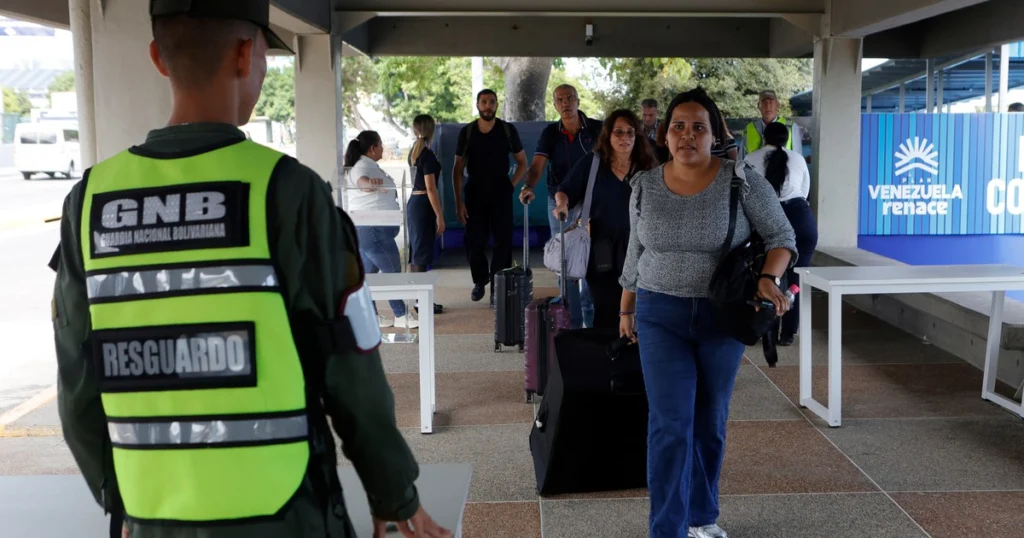
Venezuela’s Simón Bolívar International Airport, located in Maiquetía and main air gateway of Venezuela, reopened this Tuesday for domestic and international flights, two months after a double earthquake of June 24 destroyed its facilities.
On its first day back in service, the terminal was scheduled to dispatch eight flights, four international and four domestic. The initial departure covered the domestic route between Maiquetía and Valera.
Following the violent double earthquake of June 24, which left more than 6,500 dead and nearly 18,000 homeless, the air terminal operated only for humanitarian flights. The main airstrip was partially damaged by earthquakes.
RELATED: Venezuela Announces Historic Oil Agreement with U.S. to Rebuild Hydrocarbons Industry
Four temporary modular terminals, built as climate-controlled sheds equipped with essential services, now stand near the parking area. Authorities said every link in the airport chain is guaranteed, from check-in and baggage handling to security, migration, boarding, connectivity, restrooms and food service. Passengers will reach their aircraft by bus, a temporary workaround while the permanent infrastructure is rebuilt.
Roughly 600 security personnel will be deployed to maintain order at the terminal, Vice Minister of Citizen Security Endes Palencia reported.
The runway itself had to be reconditioned after cracking severely during the quake. Transport Minister Francisco Garcés said the temporary terminals are already running at 70% of capacity. “We have made a very special and necessary effort to maintain international standards for user comfort, and we have completed this solution for travelers very quickly,” he stated.
Ver esta publicación en Instagram
Una publicación compartida de teleSUR English (@telesurenglish)
This Monday around 10 A.M. local time, a first flight departed from Coviasa to Mexico City, according to an airport statement and a Global Crossing aircraft from Miami landed half an hour later, meanwhile cargo flights had been reactivated on August 5.
The structure, of about 10,000 square meters, has a capacity to serve 2,168 passengers per day, according to the airport and has checkrooms and air-conditioned waiting areas, free wireless networks, medical service and toilets, among other services.
“The airport runways are also fully operational” and the airport has “all safety measures,” assured Garcés. “The aeronautical services of radio aids, radars, etc., are fully made available and fully operational,” he added.
Airlines Resume Flights
The announcement brought relief to travelers, even though the arrangement is temporary. Airlines such as Iberia, Copa, Avianca, Latam, American Airlines, Gol, Air Europa and Plus Ultra, together with Venezuelan carriers Conviasa and Laser, have already resumed commercial operations or will do so this week.
The airport’s collapse generated widespread disruption, postponements and reschedulings in local air traffic at a moment of intense family emergency. It also complicated entry into Venezuela from abroad and internal movement by air.
Maiquetía is not only Venezuela’s international gateway par excellence; it also anchors nearly all domestic flights. Planes from other Venezuelan cities routinely stop at its facilities during their regular schedules, which made the closure especially damaging for the country.
For two months, passengers had to shift to other, considerably more modest international airports in Barcelona, Valencia and Maracaibo to travel within Venezuela or beyond its borders.
Full Rebuild by 2027
The Bolivarian government is working at top speed on the definitive reconstruction of the Simón Bolívar airport, though that goal remains some way off. Officials initially suggested it could be finished by the end of the year, but discussions now point to the first quarter of 2027.
The June 24 double earthquake severely damaged the complex, cracking the runway and wrecking its installations. The temporary terminals now in place are meant to bridge the gap while reconstruction moves forward.
The reopening restores a critical connection for a country where air travel had been badly strained. Before the earthquake’s disaster, Maiquetía handled the overwhelming majority of Venezuela’s air traffic. Whether the temporary capacity of 70% proves sufficient will depend on demand in the coming weeks.
From teleSUR English via This RSS Feed.