

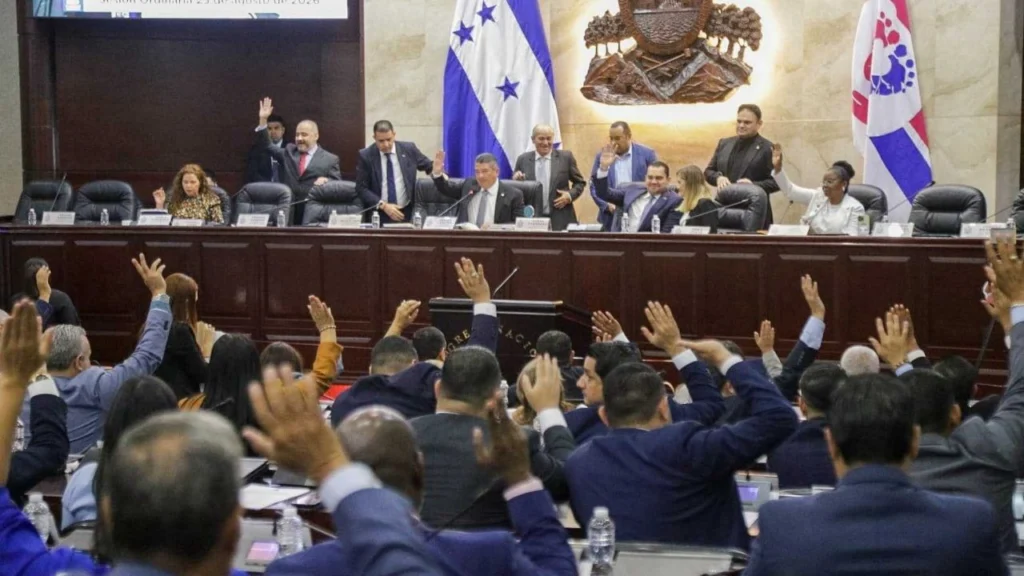
Honduras’ Congress approved the government’s energy reform this Tuesday to restructure the state-owned National Electric Energy Company (ENEE) and stem daily losses of $1.9 million.
The session closed with 78 lawmakers in favor and 35 opposed, a margin that reflected a coalition rather than a single-party majority. On the ruling side stood 49 deputies from the right-wing governing National Party, joined by a sector of the Liberal Party bench.
Meanwhile, the entire 35-member bloc of the Freedom and Refoundation Party (LIBRE, in Spanish) took the opposite stance.
RELATED: Honduras Demands Cerimedo Face Justice Over 2025 Electoral Fraud
The leftist legislators denounced what they described as privatization risks throughout the debate. The executive power, by contrast, presented the reform as an operational solution for National Electric Energy Company, a utility that has struggled to keep the lights on across the country.
*“Today, on behalf of the Freedom and Refoundation Party caucus, we appear with the firm conviction that we must defend what we consider to be essential for the Honduran people: electric power as a right of the Honduran people and not a business,*” expressed the Deputy Angélica Smith.
For its part, the leadership of the Liberal Party categorically rejected that the initiative conceals the alienation of state assets.
“The State of Honduras will be the sole owner of the share capital of the subsidiaries through the National Electricity Company in its capacity as a parent company, which will be the sole shareholder and holder of 100% of the shares,” affirmed Jorge Cálix, leader of the Liberal Party.
Congreso aprueba Ley de Justicia Energética y transforma la Enee sin privatizarlahttps://t.co/oNQuuG7fLu pic.twitter.com/yXJb0OWE6j
— Congreso Nacional de Honduras (@hn_congreso) September 1, 2026
Text reads: “Congress approves the Energy Justice Act and transforms National Electric Energy Company (ENEE) without privatizing it.””
According to this, the National Electric Energy Company keeps its public character and is excluded from any privatization process, with legal safeguards incorporated during the parliamentary debate, even though those protections were not part of the initial proposal.
Under the approved structure, the National Electric Energy Company will operate as a parent company. Its generation, transmission and distribution subsidiaries will remain exclusively owned by the State through the utility, according to the committee’s opinion.
Direct purchases of electricity are now prohibited. Acquiring power from private generators will require a competitive bidding scheme.
Tariff Adjustments Ahead
The new package also includes debt condonation, adjustments to the tariff structure and a reinforcement of the Electricity Regulatory Commission (CREE, in Spanish). The tariff changes will decide how much Honduran families pay for electricity in the coming months.
The transmission network is another front. Investment in its expansion and maintenance ranks as a priority, with the goal of easing rationing that in several regions reaches up to eight hours daily.
The accumulated crisis at the Electric Energy Company sits behind the legislative push. The state-owned company cannot sustain service without blackouts and carries a deficit the national governmentwants to curb, a gap reflected in the roughly $1.9 million lost every day.
Varios municipios del litoral atlántico estarán sin servicio de energía eléctrica durante ocho horas -el próximo miércoles 2 de septiembre-, debido a trabajos de mantenimiento general en las líneas de transmisión.
Si vive en #Atlántida, #Yoro o #Colón verifique si está su… pic.twitter.com/OoYh85yF6H
— Empresa Nacional de Energía Eléctrica (ENEE) (@EneeHnOficial) August 30, 2026
Text reads: “Several municipalities on the Atlantic coast will be without electric power for eight hours – next Wednesday, September 2 -, due to general maintenance work on transmission lines.”
The reform now awaits its application and European disbursements. Regions hardest hit by outages will watch whether the promised transmission investment shortens those eight daily hours without power.
The bill that Hondurans eventually pay will show whether the adjustment delivered on its promises. The government, meanwhile, insists the company will remain public, shielded by the newly passed law and separate from the bidding process, even though those guarantees only arrived through parliamentary debate.
The restructuring leaves the National Electric Energy Company in charge of a sector still defined by shortages. Whether the legal safeguards hold and the tariff overhaul reaches households will determine the reform’s real impact beyond the vote in Congress.
From teleSUR English via This RSS Feed.