

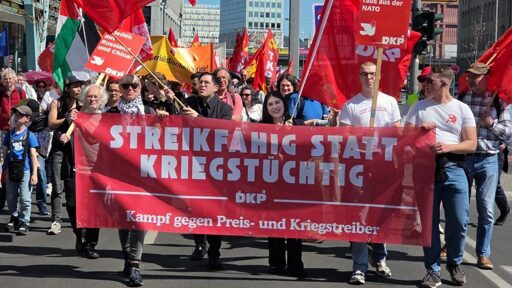

On August 28-30, over 5,000 people gathered in Berlin for the UZ-Friedenstage – Unsere Zeit’s Peace Days – the bi-annual festival organized by the German Communist Party (DKP). The program included political discussions, concerts, readings, and workshops, representing notable growth since the last edition in 2024.
The festival drew a cross-generational audience of trade unionists, activists, students, authors, ambassadors, renters’ associations, and communist and workers’ parties from around the world.
The Peace Days took place against the backdrop of Germany’s militarization and the government’s measures against workers’ rights, social provision, and democratic participation. This context shaped one of the festival’s core discussion points: the predicament of the labor movement’s integration in the militarization drive.
Trade unionists and representatives from DKP branches discussed how to move unions from passivity into active opposition. They laid out the challenges currently faced in their workplaces and turned to a key question facing the movement as militarization accelerates – countering the claim that shifting to a war economy can safeguard jobs and revive Germany’s stagnating economy.
Read more: Ulrike Eifler: ‘The workplace is a place where we have to fight against war’
International solidarity also marked the festival’s program, most notably with regard to Cuba and Palestine. Cuba’s Embassy Counselor in Germany, Professor Miguel Torres, spoke on the current state of the anti-imperialist struggle alongside Palestine activist Nasser El-Mokdad, linking the current situation in Gaza to the history of anti-imperialist struggle. In another panel, China’s Embassy Counselor Sun Shouliang joined Ana Prestes of the Communist Party of Brazil to examine the potential and the contradictions of the BRICS+ alliance as a counterweight to Western hegemony in the global economy.
The event itself did not escape the growing repression that has accompanied Germany’s militarization. Kenyan communist Booker Omole was unable to attend after authorities refused him a visa, citing an alleged “flight risk.” The organizers of the festival stated: “In truth, their aim is to hinder international solidarity in the struggle against imperialism and to support the Kenyan government in its repression of people who are resisting the neo-colonial exploitation of their country.”
Read more: Germany’s ‘summer of reforms’ to accelerate militarization
The venue itself complicated international exchange: it barred the Russian ambassador to Germany from attending and attempted to prevent some Palestinian groups from taking part. Journalist Hüseyin Doğru, who has faced heavy EU sanctions over his pro-Palestinian reporting, discussed these developments in conversation with Manfred Sohn, director of the Marx-Engels-Stiftung, situating the restrictions within a broader EU trend of clamping down on dissenting voices.
The Socialist German Workers’ Youth (SDAJ) organized its own slot during the festival, giving space to representatives from school strike committees resisting the reintroduction of conscription in Germany. SDAJ members also reported on their participation in the Global Sumud Flotilla and on a recent solidarity brigade to socialist Cuba, linking the youth organization’s domestic campaigning to its internationalist work.
Read more: German students expand their strike against conscription and militarization to 150 cities
Held just weeks before Berlin’s state elections, the festival also tackled the issue of housing, one of the campaign’s defining topics. Activists from the tenants’ association Berliner MieterGemeinschaft joined researchers from the International Research Centre DDR (IFDDR) to revisit the historical experience of socialist housing policy in the German Democratic Republic. The discussion drew out lessons for today’s struggles for affordable housing in a city where rents have become a central political battleground.
The festival brought together the more seasoned part of the peace movement with roots stretching back to the 1980s, with the youth movement now mobilizing against the militarization of schools. These forces are already mobilizing for a series of actions scheduled in the coming weeks: a nationwide school strike against conscription on September 25, trade union demonstrations against cuts to social programs on September 26, and a mass peace demonstration on October 3.
From BT News via This RSS Feed.